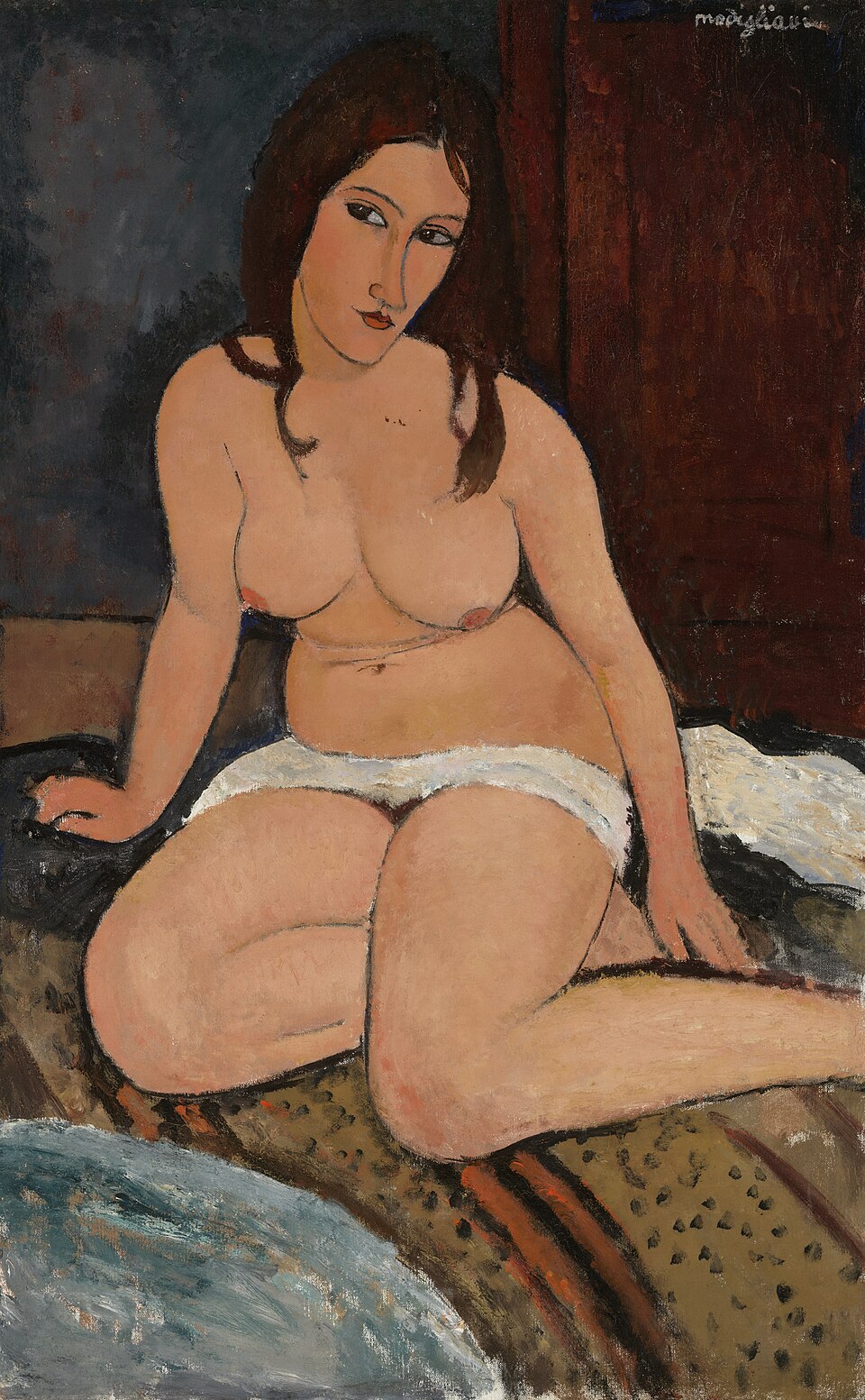
Amedeo Modigliani
Who
Born on 12 July 1884 in Livorno, he moved to Paris in 1906 and died there on 24 January 1920, aged 35, of tubercular meningitis. A painter and, from 1909 to about 1914, a sculptor of carved stone heads under the influence of Constantin Brancusi. His only solo exhibition in his lifetime, at Berthe Weill's gallery in 1917, was closed by the police on its opening day.
Why they matter
He made one kind of figure and made it unmistakable: the long neck, the tilted oval head, the almond eyes, often blank. The same simplified, elongated head runs through the carved stone and the paintings alike. The reclining nudes of 1917 now hold his auction records, but the portraits of his friends and of Jeanne Hebuterne, his partner at the end, are the reason most people know his name.
What to buy
Prints: his flat colour and strong outlines reproduce well at modest sizes. Buy a print that names the painting and the museum that holds it - the Met's Jeanne Hebuterne, MoMA's Reclining Nude - because with Modigliani a named public collection is the only guarantee that the picture is his at all. Books: Taschen's Basic Art Modigliani by Doris Krystof is the cheapest good introduction. There is no single standard catalogue: Lanthemann (1970), Ceroni (1972), Patani (1991-1994) and Parisot compete, and a work's standing often depends on which of them includes it. Originals: not realistic. The paintings are museum and record-auction pieces, and he is one of the most faked artists in the world. Treat any painting or drawing that arrives without a long, documented provenance and a place in the catalogues as a fake until proven otherwise; fakes have been good enough to fill a museum exhibition.
Notes
Jeanne Hebuterne threw herself from a fifth-floor window the day after he died, killing herself and their unborn child. Her remains were moved beside his in Pere Lachaise in 1930. In July 2017 police seized 21 works from a Modigliani exhibition at the Palazzo Ducale in Genoa after the collector Carlo Pepi raised the alarm; more than 100,000 people had already seen it.
Story
Livorno tells a story about its most famous son: that Modigliani, stung by bad reviews, threw some of his carved stone heads into the city's canal, the Royal Moat. In the summer of 1984, for the centenary of his birth, the organiser of the city's Modigliani exhibition, Vera Durbe, paid to have the canal dredged to find them. In July three stone heads came up out of the mud, and Durbe announced them as Modigliani originals.
Then three local art students confessed. They had carved one of the heads themselves, with a Black & Decker drill; the other two were the work of a Livorno artist. The sculptural discovery of the centenary was a prank.
The real heads belong to a short episode - he carved stone from 1909 and had given it up by 1914 - and Tate owns one, a limestone head of about 1911-12. The fakes did not go away. In 2014 Livorno planned an exhibition of the three hoax heads themselves, at the Fortezza Vecchia, with 27 panels of newspaper cuttings from around the world telling how the story spread. A Modigliani show that knows its exhibits are fake is still, in its way, the most honest one on record.
Key works
- Head (c. 1911-1912) - Tate, London
- Nu couche (Reclining Nude) (1917) - private collection
- Reclining Nude (c. 1919) - MoMA, New York
- Jeanne Hebuterne (1919) - The Met, New York
In museum collections
- caryatid
MoMA ↗ · Find a print ↗ - Female Nude (1916)
Art UK ↗ · Find a print ↗ - Jacques and Berthe Lipchitz (1916)
Art Institute of Chicago ↗ · Find a print ↗ - The Little Peasant (1918)
Art UK ↗ · Find a print ↗ - Chaim Soutine (1916)
National Gallery of Art ↗ · Find a print ↗ - Jeanne Hébuterne (1919)
The Met ↗ · Find a print ↗ - Jeanne Hébuterne in yellow sweater (1918)
Guggenheim ↗ · Find a print ↗ - Reclining Nude (1917)
The Met ↗ · MoMA ↗ · Find a print ↗ - Gypsy Woman with Baby (1919)
National Gallery of Art ↗ · Find a print ↗ - Madame Kisling (1917)
National Gallery of Art ↗ · Find a print ↗ - Portrait of the Artist Léopold Survage (1918)
Finnish National Gallery ↗ · Find a print ↗ - The Boy (1919)
Indianapolis Museum of Art ↗ · Find a print ↗
See the work
Prints
Books
See also
Browse all 2,101 artists · Open in the directory · Where the work hangs: 107 museums on a map