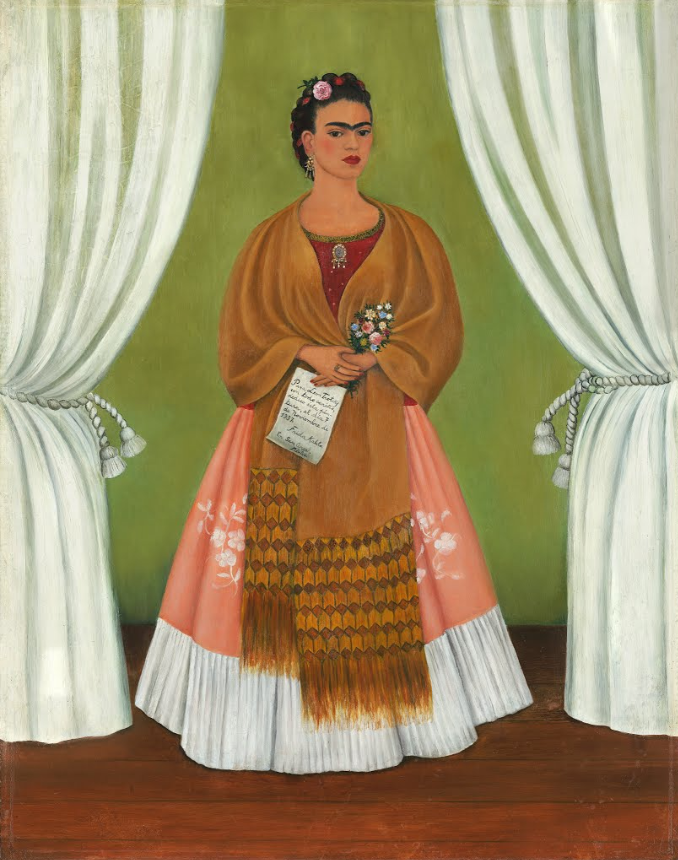
Frida Kahlo
Who
Born on 6 July 1907 in Coyoacan, Mexico City, and died there on 13 July 1954, aged 47. At 18 she was impaled by an iron handrail when a streetcar hit her bus, on 17 September 1925; the injuries shaped the rest of her life and much of her painting. She married Diego Rivera in 1929, divorced him in 1939 and married him again in 1940.
Why they matter
She painted small pictures of one subject, herself, and made that subject carry pain, politics, Mexican identity and a failing body without ever becoming a case history. Her first solo show, at Julien Levy's gallery in New York in November 1938, sold about half of its 25 paintings, and in 1939 the Louvre bought The Frame, making her the first Mexican artist in its collection. In November 2025 The Dream (The Bed) set the auction record for a work by a woman artist.
What to buy
Prints: buy one that names its painting and museum - MoMA's Design Store sells a poster of Self-Portrait with Cropped Hair from the museum's own painting - because her face is on so much merchandise that a print naming no painting may not reproduce one. Books: Taschen's Frida Kahlo. The Complete Paintings, edited by Luis-Martin Lozano, a former director of Mexico City's Museo de Arte Moderno, reproduces all 152 of her paintings; it is an XXL volume, so look for it second-hand or in a library if the size is too much. Originals: not realistic. Her output is small, the major paintings are in museums, and Mexico's 1984 decree forbids the permanent export of her work. A painting offered outside the major auction houses and missing from the complete catalogue should be treated as a fake.
Notes
The Two Fridas, her first large-scale painting, hangs in the Museo de Arte Moderno in Mexico City; Self-Portrait with Cropped Hair, painted after the divorce, has been at MoMA since 1943. Her house, the Casa Azul in Coyoacan, has been the Frida Kahlo Museum since Rivera gave it to the nation in 1958. In August 2026 Mexico's Supreme Court agreed to consider whether the 1984 export decree conflicts with the 1972 federal law on artistic monuments, which allows privately owned ones to be exported. Her work entered the public domain in most life-plus-70 countries in 2025.
Story
Kahlo died in the Casa Azul in 1954, and Rivera, fearing that her legacy would be turned into politics, locked a bathroom there with her things inside. He entrusted it to his friend Dolores Olmedo and asked her to keep it closed for fifteen years. Rivera died in 1957; Olmedo kept it closed until she died herself, in 2002.
When the museum finally opened it, fifty years after Kahlo's death, the room held more than 6,000 photographs, some 22,000 documents and over 300 of her garments: the Tehuana dresses she wore in the self-portraits, some flecked with paint, pre-Columbian necklaces she had strung herself, and the hand-painted medical corsets and back braces that held her spine together after the bus crash. There was also her prosthetic leg, fitted with a red platform boot decorated with Chinese dragons and small bells.
In 2018 the V&A in London built an exhibition around the hoard, Frida Kahlo: Making Her Self Up, which ran from June to November that year. The painter who made herself her only subject had left the evidence of how she built that self in a locked bathroom, and the man who locked it never saw it opened.
Key works
- The Two Fridas (1939) - Museo de Arte Moderno, Mexico City
- Self-Portrait with Cropped Hair (1940) - MoMA, New York
- The Dream (The Bed) (1940) - sold at Sotheby's, New York, 2025
In museum collections
- My Grandparents, My Parents, and I (Family Tree) (2026)
MoMA ↗ · Find a print ↗ - Fulang-Chang and I (1937)
MoMA ↗ · Find a print ↗ - Self-Portrait with Cropped Hair (1940)
MoMA ↗ · Find a print ↗ - Weeping Coconuts (1951)
LACMA ↗ · Find a print ↗
See the work
Prints
Books
See also
Browse all 2,101 artists · Open in the directory · Where the work hangs: 11 museums on a map