Jacques Callot
Who
Etcher and draughtsman from Nancy, in the Duchy of Lorraine, where he was born in about 1592 and died in 1635. He learned engraving in Rome, worked for the Medici court in Florence under Cosimo II, and later worked for the Infanta in Brussels and for Louis XIII in Paris.
Why they matter
He made etching a master's medium. His échoppe, a needle with a slanted oval section, gave the etched line the swell of an engraved one, and his hard ground and repeated stopping-out let him bite depth and distance into a plate. Abraham Bosse's manual spread the method across Europe. His subjects, commedia players, beggars, dwarfs, fairs and war, were the life of his own day; Rembrandt collected them and Goya learned from them.
What to buy
Originals: he etched about 1,400 plates, so genuine seventeenth-century impressions are within reach of an ordinary collector; single sheets from the big series are the affordable tier. What matters is when a sheet was printed. Lifetime and early impressions published by Israël Henriet carry "Israel excud." or Henriet's name; later states of some plates add Israël Silvestre's address, and in 1729-1730 the dealer Jacques Fagnani reissued the plates, so many series have posthumous states. Early impressions are silvery with a full tonal range; late ones show the wear of the plate. Every sheet should be described by its Lieure number and state: a dealer who cannot give them is not selling a Callot you can check. A flat sheet with no plate mark is a reproduction. Prints and books: Dover's Callot's Etchings (edited by Howard Daniel, 1974) reproduces 338 prints in a paperback and is the cheap way to see the range. Jules Lieure's Jacques Callot: catalogue raisonné de l'oeuvre gravé (Paris, 1924-1927; facsimile, Alan Wofsy, 1989) is the standard catalogue that every dealer cites.
Notes
The Met holds a deep collection, including the Temptation of St. Anthony of 1635 and the six plates of the Siege of Breda of 1628. The copper plates of the Grandes Misères survive in a museum in Nancy, and a large group of his tiny figure studies for it is in the Hermitage. The Temptation of St. Anthony at the Met is an open-access image.
Story
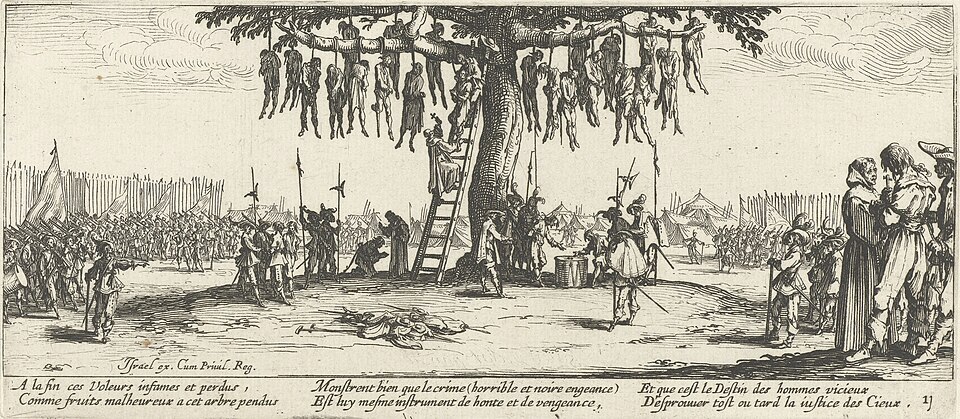
Callot's most crowded print was also his manifesto. The Fair at Impruneta shows the feast of Saint Luke, held every 18 October in a Tuscan town south of Florence, and packs 1,138 people, 45 horses, 67 donkeys and 137 dogs into one plate. In the lower right a charlatan works his crowd with a snake wound round his arm, a talisman of healing his audience would have recognised. To draw so much so small, Callot devised a slanted steel tool that swelled the etched line like an engraver's, and bit the plate in repeated acid baths so the crowd recedes into haze. Rembrandt collected his prints. The other famous story is about a print he refused to make. In 1633 Richelieu's army occupied Lorraine and Nancy fell. Louis XIII, it is said, commanded Callot to engrave a plate commemorating it, and Callot answered that he would sooner maim his own hand than use it on such a work. What he published that year instead was Les Grandes Misères de la guerre, eighteen small etchings of the brutality of the Thirty Years' War, with verses beneath each. It has been called the first anti-war statement in European art, and Goya's Disasters of War owe it a debt. Callot died in Nancy two years later. His copper plates for the series still exist there.
Key works
- The Fair at Impruneta (first version) (1620) - Philadelphia Museum of Art
- Balli di Sfessania (c. 1621-1622) - The Met
- The Siege of Breda (six plates) (1628) - The Met
- Les Grandes Misères de la guerre (18 plates) (1633)
- The Temptation of St. Anthony (1635) - The Met
In museum collections
- Entry of Monseigneur Henry de Lorraine, Marquis de Moy, under the Name of Pirandre (1627)
National Gallery of Art ↗ · Find a print ↗ - Mysteries of the Passion (1631)
National Gallery of Art ↗ · Find a print ↗ - The Annunciation (1631)
National Gallery of Art ↗ · Find a print ↗ - The Last Supper (1618)
National Gallery of Art ↗ · Find a print ↗ - Two Pantaloons Dancing (1617)
National Gallery of Art ↗ · Find a print ↗ - Lady in a Large Coat (1617)
National Gallery of Art ↗ · Find a print ↗ - The Adoration of the Magi (1623)
National Gallery of Art ↗ · Find a print ↗ - The Crowning with Thorns (1618)
National Gallery of Art ↗ · Find a print ↗ - The Entry into Jerusalem (1635)
National Gallery of Art ↗ · Find a print ↗ - The Massacre of the Innocents (1618)
National Gallery of Art ↗ · Find a print ↗ - Caesar's Coin (1635)
National Gallery of Art ↗ · Find a print ↗ - Christ Disputing with the Doctors (1635)
National Gallery of Art ↗ · Find a print ↗
See the work
Prints
Books
Originals
See also
Browse all 2,101 artists · Open in the directory · Where the work hangs: 38 museums on a map