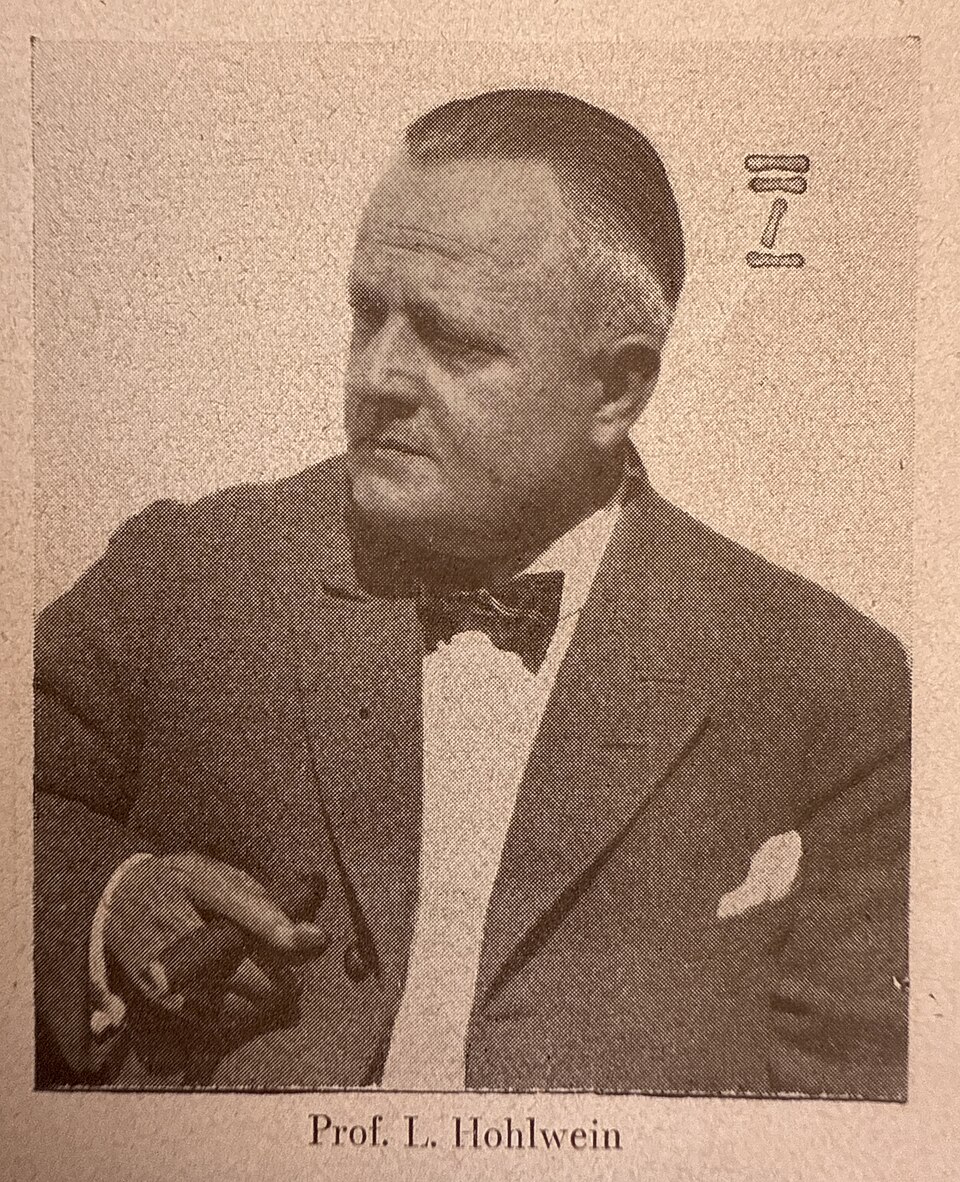
Ludwig Hohlwein
Who
German poster designer, born in Wiesbaden on 26 July 1874, who studied architecture in Munich and Dresden and practised as an architect in Munich, designing interiors, before he turned to graphic design around 1906. By the mid-1920s he had produced some three thousand advertisements, for tailors, cigarettes, the zoo, music festivals and firms such as Audi, BMW, Lufthansa and Pelikan. He died in Berchtesgaden in September 1949.
Why they matter
He was a pioneer of the German object poster, the Sachplakat, and its most painterly practitioner: next to Lucian Bernhard's version of the style, his has more texture and pattern, and his figures are more naturalistic and solid, often worked up from posed photographs. His 1908 posters for the Swiss clothier PKZ made his name, and the poster historian Alain Weill wrote that he found a style with disconcerting facility and varied it little for forty years. That style served the Nazi state too: he joined the party on 1 May 1933, made posters for the regime and the 1936 Olympics, and was on the regime's 1944 Gottbegnadeten list of favoured artists.
What to buy
Originals: the posters themselves are the originals, colour lithographs printed as commercial advertising, such as the 1908 Hermann Scherrer sheet from Schon & Maison in Munich. Swann's vintage-poster sales have handled them and are the place to learn the market. Know the date before you buy: the same hand drew advertising and, after 1933, propaganda, and the propaganda sheets circulate too. Reproductions are common; under a loupe a modern print shows a regular dot screen where a stone lithograph shows solid colour. Books: Dover's Hohlwein Posters in Full Color (1976), 48 pages with 45 full-page colour plates of his work from the first three decades of the century, is the standard picture book in English; look for it second-hand.
Notes
MoMA holds the 1908 Hermann Scherrer poster. His work was entered in the art competitions of the 1932 and 1936 Olympics. His 1935 Franziskaner monk for the brewery is still in use. Public domain since 2020, so scans are free on Wikimedia Commons.
Story
In 1912 Hohlwein drew a poster for Isidor Bach, a smart Munich shop for sport and travel clothing: a party of prosperous hikers in Bavarian costume, rucksacks on, a baleful dachshund at their feet, just off the train and heading for the mountains. Bach, who was Jewish, had founded the business in Augsburg in 1872, opened the Munich branch in 1878 and moved it in 1903 into a new four-storey building on the Sendlinger Strasse. Bach's was one of several Jewish-owned firms, Kunstanstalt Graphia among them, that hired Hohlwein.
Twenty-one years after the Bach poster, its designer joined the Nazi party, on 1 May 1933, and went on to make posters for the regime. In 1936 the Isidor Bach store was "aryanized": forcibly sold to one of its non-Jewish employees, Johann Konen. The Bach family emigrated to Switzerland in 1939. There were restitution efforts after the war, but the business went on trading under the name Konen, the employee who had taken it over, until the Breuninger chain bought it in 2021. For more than eighty years Munich shoppers bought their sport clothes under the name of the man who acquired the shop, not the man who founded it - and the cheerful hikers who advertised it were drawn by a party member.
Key works
- Hermann Scherrer, Sporting and Ladies-Tailor (poster) (1908) - MoMA
- PKZ (posters for the Swiss clothier) (1908)
- Richard Strauss festival (poster) (1910)
- Isidor Bach, Sport und Reisekleidung (poster) (1912)
- Munich zoo, Hellabrunn (poster) (1912)
- Franziskaner monk (brewery emblem) (1935)
In museum collections
- Und du? (1929)
MoMA ↗ · Find a print ↗
See the work
Prints
Books
Originals
See also
Browse all 2,101 artists · Open in the directory · Where the work hangs: 8 museums on a map