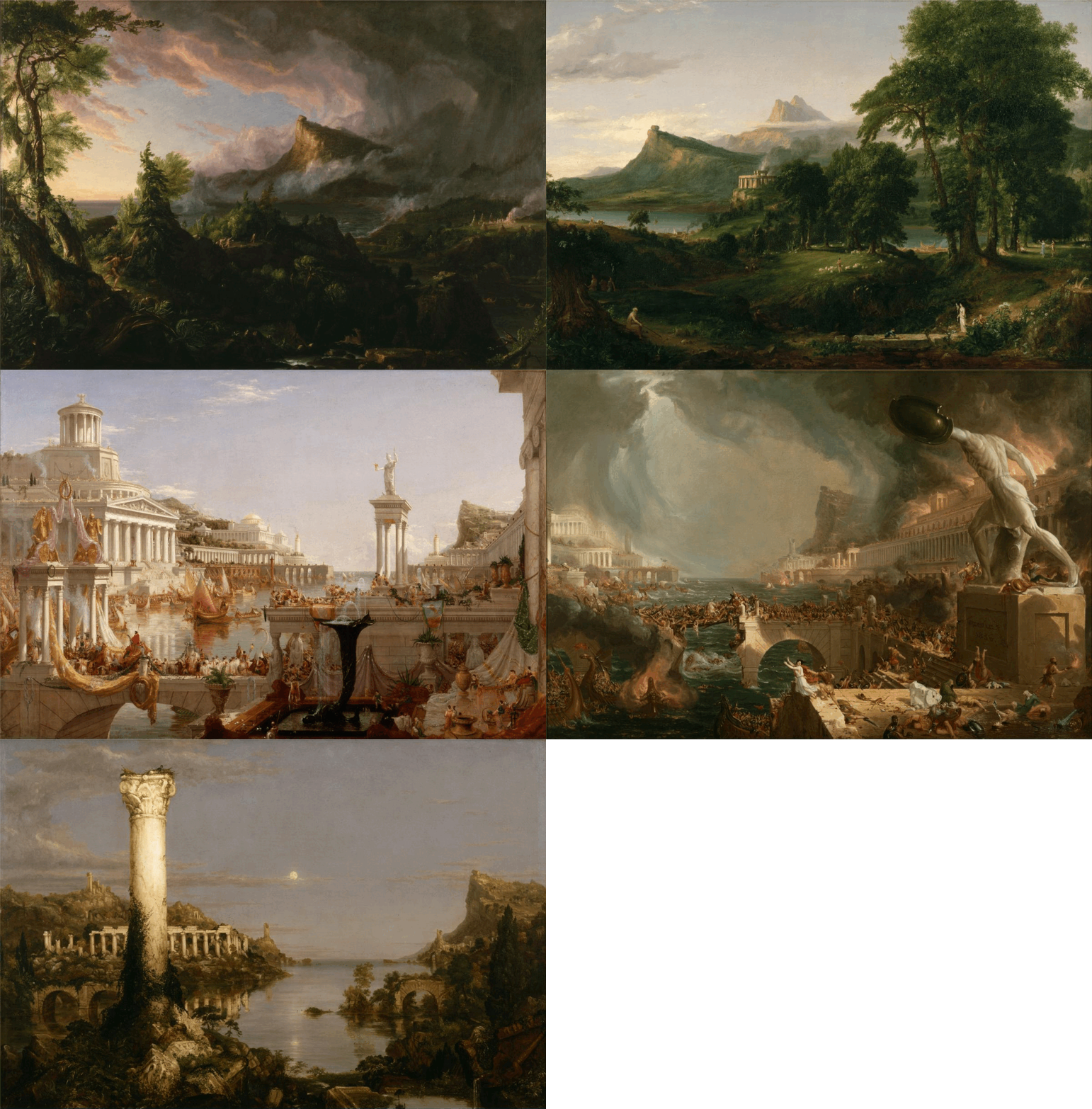
Thomas Cole
Who
Born at Bolton le Moors in Lancashire on 1 February 1801, he came to the United States with his family in 1818 and settled first in Steubenville, Ohio. From the late 1820s he worked at Cedar Grove in Catskill, New York, where he died of pleurisy on 11 February 1848. He painted American wilderness and large moral allegories in series.
Why they matter
He made American landscape carry ideas: The Course of Empire follows one imagined valley from wilderness through empire to ruin, and The Voyage of Life turns a human life into a river journey in four pictures. He also taught: Frederic Church studied with him at Catskill for two years from 1844, and Cole wrote that the young man had "the finest eye for drawing in the world."
What to buy
Prints: the National Gallery of Art in Washington owns Cole's second Voyage of Life and prints all four panels to order, on paper and framed as you choose, from its own photography; its shop also sells ready-made 11 x 14 inch prints of each. Hung as a set they are the cheapest honest way to see the series as he meant it. Books: Thomas Cole's Journey: Atlantic Crossings (2018), by Elizabeth Mankin Kornhauser and Tim Barringer for the Metropolitan Museum's exhibition (shown in London as Thomas Cole: Eden to Empire), is the current standard book: it reads him through his tours of England and Italy, hangs him beside Turner and Constable, and covers The Oxbow and The Course of Empire in depth. Originals: not realistic. The paintings are in museums. The period object within reach is an engraving after him: James Smillie engraved the Voyage of Life in the 1850s, and the Smithsonian American Art Museum holds his Youth of about 1853. Five other Cole pictures were engraved for the gift books The Token and Atlantic Souvenir between 1826 and 1842. These are reproductions made in his century, not his own work; buy from a dealer who states the medium, and remember that a modern photographic copy of a Smillie engraving is neither.
Notes
The first Voyage of Life (1840), commissioned by Samuel Ward, who died before it was finished, is at the Munson-Williams-Proctor Arts Institute in Utica. Legal trouble with Ward's estate kept Cole from showing it, so he made tracings and painted a second set in Rome in 1841-42, which toured Boston, New York and Philadelphia from 1843 to 1846 and is now in Washington. Cedar Grove, his house and studio in Catskill, has been a National Historic Site since 1999 and is open to the public.
Story
The Oxbow began as a break from a heavier job. Early in 1836 Cole was deep in The Course of Empire, the five-canvas cycle that follows one imagined landscape from wilderness to empire to ruin, and he set it aside to make something new for the National Academy of Design's exhibition that April. In March he wrote to his patron Luman Reed that he had already started a view from Mount Holyoke in Massachusetts: "it is about the finest scene I have in my sketchbook." He gave it a long, plain title, View from Mount Holyoke, Northampton, Massachusetts, after a Thunderstorm, and put himself in it: a tiny figure sitting at an easel on the rocks in the foreground. The picture held one more thing that nobody pointed out until long after Cole's death. The art historian Matthew Baigell noticed that the logging scars on the distant hillside can be read as Hebrew letters spelling Noah, the man who saw the world after the flood. Turned upside down, as if seen from above, the same marks read Shaddai, the Almighty. Technical study for the Met's 2018 exhibition found more under the surface: an earlier composition for Consummation of Empire, part of the very cycle he had put aside. The painting came to the Metropolitan Museum in 1908 from Margaret Olivia Slocum Sage.
Key works
- Expulsion from the Garden of Eden (1828) - Museum of Fine Arts, Boston
- The Titan's Goblet (1833) - The Met, New York
- The Course of Empire (five paintings) (1833-1836) - New-York Historical Society
- The Oxbow (View from Mount Holyoke, Northampton, Massachusetts, after a Thunderstorm) (1836) - The Met, New York
- The Voyage of Life (first set, four paintings) (1840) - Munson-Williams-Proctor Arts Institute, Utica
- The Voyage of Life (second set, four paintings) (1842) - National Gallery of Art, Washington
In museum collections
- The Oxbow (1836)
The Met ↗ · Find a print ↗ - The Titan's Goblet (1833)
The Met ↗ · Find a print ↗ - The Subsiding of the Waters of the Deluge (1829)
Smithsonian American Art Museum ↗ · Find a print ↗ - Expulsion from the Garden of Eden (1828)
MFA Boston ↗ · Find a print ↗ - View of Florence (1837)
The Met ↗ · Find a print ↗ - The Notch of the White Mountains (1839)
National Gallery of Art ↗ · Find a print ↗ - II Penseroso (1845)
LACMA ↗ · Find a print ↗ - A View of the Two Lakes and Mountain House, Catskill Mountains, Morning (1844)
Brooklyn Museum ↗ · Find a print ↗ - The Cross in the Wilderness (1845)
Louvre ↗ · Find a print ↗ - The Pic-Nic (1846)
Brooklyn Museum ↗ · Find a print ↗ - A View near Tivoli (Morning) (1832)
The Met ↗ · Find a print ↗ - An Italian Autumn (1844)
MFA Boston ↗ · Find a print ↗
See the work
Prints
Books
See also
Browse all 2,101 artists · Open in the directory · Where the work hangs: 53 museums on a map