Anthony van Dyck
Who
Born in Antwerp on 22 March 1599, he was the most famous pupil of Peter Paul Rubens. In 1632 Charles I knighted him and made him "principalle Paynter in ordinary" to the king and queen, with a pension. He died at Blackfriars, London, on 9 December 1641, and was buried in St Paul's Cathedral; the tomb was lost in the Great Fire of 1666.
Why they matter
He invented how the English court looked, and how it wanted to be remembered: the long-faced, elegant, melancholy Charles I on horseback or out hunting, and an aristocracy painted with the same unhurried grace; one historian wrote that Bernini's bust made from his triple portrait set the conventions of "the official portrait of secular absolutism". He was also, in a small number of etchings, a printmaker whom the Frick ranks among the best of all time.
What to buy
Prints: the National Gallery in London prints its Equestrian Portrait of Charles I to order from its own collection, on art paper or stretched canvas, framed or not; it is the picture that best shows what he did for the king. Books: the standard book is Van Dyck: A Complete Catalogue of the Paintings (Yale University Press for the Paul Mellon Centre, 2004) by Susan J. Barnes, Nora De Poorter, Oliver Millar and Horst Vey, a catalogue raisonné to look for secondhand. Originals: the paintings are not realistic, but the Iconography is. It is his series of engraved portraits of his contemporaries, artists, collectors and scholars among them; he etched the first state of some of the plates himself and left the rest to engravers working from his drawings. The earliest edition that survives was published by Gillis Hendricx in 1645, and the plates were reworked as they wore out and kept printing for centuries; in 1851 the Calcographie du Louvre bought them. So most Iconography sheets on the market are late impressions of plates finished by other hands, which are honest but are not the van Dyck etchings collectors mean. The prize is an early state of a plate he etched himself, before an engraver completed it; buy that only with the state identified by a dealer or auction house.
Notes
Charles I in Three Positions is in the Royal Collection, Charles I at the Hunt in the Louvre, and the Equestrian Portrait of Charles I came to the National Gallery in London in 1885. In the Frick's words, an etched early state "would not have been considered final by any standard of the time", yet surviving impressions show it was marketed and admired as a work of art in itself.
Story
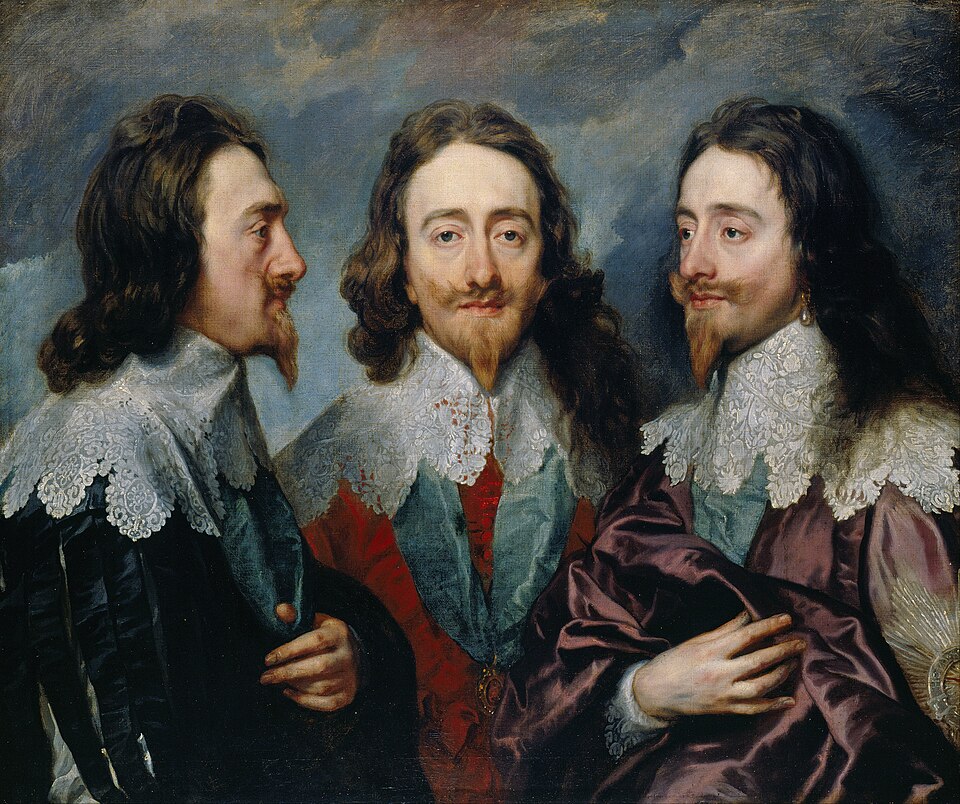
Charles I in Three Positions shows the king three times on one canvas: in profile, face on, and in three-quarter view. It was not painted to hang in England. Van Dyck began it, probably late in 1635, as a working document for a sculptor who would never see the king: in 1636 it was sent to Rome, to Gian Lorenzo Bernini. Pope Urban VIII was to send the finished marble bust to Queen Henrietta Maria, in the hope of encouraging a reconciliation between the Roman Catholic Church and the Church of England.
The bust was presented in 1637 and admired for its workmanship and its likeness to the king, and Charles rewarded Bernini with jewellery worth over 4,000 Roman scudi. Its luck then followed its subject's. It was sold at the end of the English Civil War, recovered for the Royal Collection at the Restoration, and destroyed in the fire at Whitehall Palace in January 1698.
The painting outlived the sculpture. It stayed with Bernini and his heirs in the Palazzo Bernini on the Via del Corso until about 1802, when the British dealer William Buchanan bought it and brought it back to England. It is in the Royal Collection today, and engravings and bronze copies are what remain of the marble it was painted to make.
Key works
- Charles I at the Hunt (c. 1635) - Louvre, Paris
- Charles I in Three Positions (1635-36) - Royal Collection
- Equestrian Portrait of Charles I (c. 1638-9) - National Gallery, London
In museum collections
- Charles I at the Hunt (1635)
Louvre ↗ · Find a print ↗ - The Crown of Thorns (1618)
Museo del Prado ↗ · Find a print ↗ - Samson and Delilah (1620)
Art UK ↗ · Kunsthistorisches Museum ↗ · Find a print ↗ - Lord John Stuart and His Brother, Lord Bernard Stuart (1638)
Art UK ↗ · Find a print ↗ - Equestrian Portrait of Charles I (1630)
Art UK ↗ · Find a print ↗ - The Vision of the Blessed Hermann Joseph (1629)
Kunsthistorisches Museum ↗ · Find a print ↗ - Coronation of Saint Rosalia (1629)
Kunsthistorisches Museum ↗ · Find a print ↗ - Entry of Christ into Jerusalem (1617)
Indianapolis Museum of Art ↗ · Find a print ↗ - Madonna with Two Donors (1630)
Louvre ↗ · Find a print ↗ - Portrait of Lady Theresa Shirley (1622)
Art UK ↗ · Find a print ↗ - Self-portrait with Sir Endymion Porter (1633)
Museo del Prado ↗ · Find a print ↗ - The Brazen Serpent (1618)
Museo del Prado ↗ · Find a print ↗
See the work
Prints
Books
Originals
See also
Browse all 2,101 artists · Open in the directory · Where the work hangs: 303 museums on a map