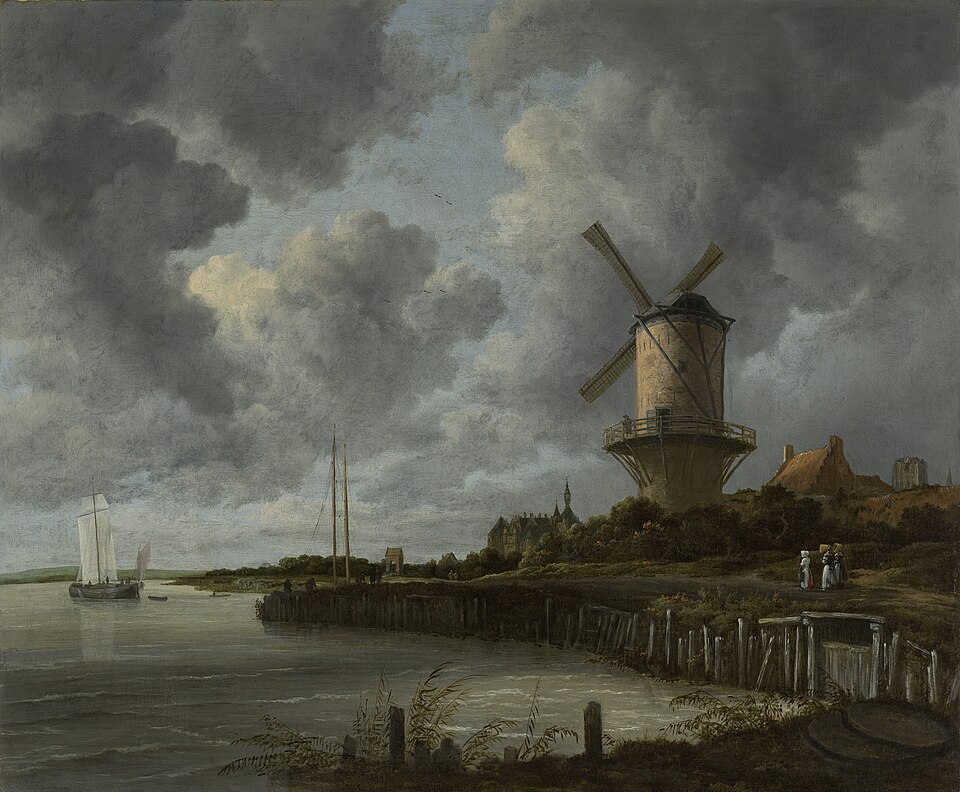
Jacob van Ruisdael
Who
Born in Haarlem in 1628 or 1629, the son of the painter Isaack van Ruisdael and nephew of the landscape painter Salomon van Ruysdael. His earliest dated work is from 1646; he joined the Haarlem Guild of St Luke in 1648 and moved to Amsterdam around 1657. He died in Amsterdam on 10 March 1682 and was buried in St Bavo's Church in Haarlem.
Why they matter
He made Dutch landscape serious. Where earlier painters recorded the flat country, he built it into drama: a windmill set against rain clouds, dead trees and broken tombs, a sky taking up two-thirds of the canvas. Goethe called him a thinking artist, even a poet; Constable copied him and wrote that a Ruisdael "haunts my mind and clings to my heart"; Kenneth Clark called him the greatest master of natural vision before Constable. His only registered pupil was Meindert Hobbema.
What to buy
Prints: the National Gallery in London prints The Shore at Egmond-aan-Zee to order, on art paper or stretched canvas, framed or not, from its own photography; his skies are fine gradations of grey that cheap reproductions turn to mud, so a museum giclee is the one to have. The Rijksmuseum publishes its own photograph of The Windmill at Wijk bij Duurstede as a free public-domain download, if you would rather have that printed yourself. Books: Seymour Slive's Jacob van Ruisdael: A Complete Catalogue of His Paintings, Drawings and Etchings (Yale University Press, 2001) is the standard book: almost seven hundred paintings, more than 130 drawings and his thirteen etchings, with a documented chronology and an appendix on the doctor question. It is a large reference book; look for it secondhand. Originals: not realistic. The paintings are in museums, and his thirteen etchings, all from his early years, are rare.
Notes
Slive's catalogue accepts 694 paintings and lists 163 more of doubtful attribution, so "Ruisdael" on a label covers a great deal of workshop and follower work. The Jewish Cemetery shows real tombs at Beth Haim, the Portuguese-Jewish burial ground at Ouderkerk aan de Amstel, set among ruins that were never there. The Windmill at Wijk bij Duurstede belongs to the City of Amsterdam through the Van der Hoop bequest of 1854 and has been lent to the Rijksmuseum since 1885.
Story
Three things everyone used to know about Jacob van Ruisdael are doubtful or wrong.
He painted more than 150 Scandinavian waterfalls, torrents crashing past fir trees and rocks. There is no record that he ever went to Scandinavia. A fellow Haarlem painter, Allart van Everdingen, had travelled there in 1644, and Everdingen is one of the painters Ruisdael learned from.
He was a doctor. Arnold Houbraken wrote in 1718 that he had studied medicine, and a 17th-century list of Amsterdam doctors does carry the name "Jacobus Ruijsdael", with a note that he took his degree at Caen in Normandy on 15 October 1676. But the name has been crossed out, the painter would have been in his late forties, and the spelling and his steady output of paintings have left scholars doubting it was him. Seymour Slive gave the question an appendix of its own in his catalogue.
He died poor, in the old men's almshouse in Haarlem. For a long time that was the romantic ending to the life of the melancholy painter of dead trees and graveyards. The historian Hendrik Frederik Wijnman showed that the man who died there was his cousin, Jacob Salomonsz van Ruysdael. The painter died in Amsterdam in 1682 and was buried in St Bavo's Church in Haarlem.
Key works
- The Jewish Cemetery (c. 1654-55) - Detroit Institute of Arts (a second version is in Dresden)
- A Landscape with a Ruined Castle and a Church (c. 1665-70) - National Gallery, London
- The Windmill at Wijk bij Duurstede (c. 1668-70) - Rijksmuseum, Amsterdam (lent by the City of Amsterdam)
- The Shore at Egmond-aan-Zee (c. 1675) - National Gallery, London
In museum collections
- The Windmill at Wijk bij Duurstede (1670)
Rijksmuseum ↗ · Find a print ↗ - Landscape with Waterfall (1660)
Art UK ↗ · Rijksmuseum ↗ · Find a print ↗ - A Waterfall in a Rocky Landscape (1660)
Art UK ↗ · Find a print ↗ - The Ray of Light (1665)
Louvre ↗ · Find a print ↗ - A Landscape with a Ruined Castle and a Church (1665)
Art UK ↗ · Find a print ↗ - The Thicket near Haarlem (1649)
Louvre ↗ · Find a print ↗ - Two Watermills and an Open Sluice near Singraven (1650)
Art UK ↗ · Find a print ↗ - View of Haarlem from the Northwest, with the Bleaching Fields in the Foreground (1666)
Rijksmuseum ↗ · Find a print ↗ - Bentheim Castle (1650)
Rijksmuseum ↗ · Find a print ↗ - Ships in stormy weather off the coast (1650)
Louvre ↗ · Find a print ↗ - Two Watermills and an Open Sluice (1653)
Getty ↗ · Find a print ↗ - View of Egmond aan Zee (1650)
Nationalmuseum Sweden ↗ · Find a print ↗
See the work
Prints
Books
See also
Browse all 2,101 artists · Open in the directory · Where the work hangs: 157 museums on a map