Élisabeth Louise Vigée Le Brun
Who
Born in Paris on 16 April 1755 and died there on 30 March 1842. A portrait painter, she made about 660 portraits and 200 landscapes. She left Paris on the night of 5 October 1789 and spent twelve years working in Italy, Vienna, Russia and Germany before returning to France in 1802; her Souvenirs appeared in three volumes in 1835-37.
Why they matter
She painted more than 30 portraits of Marie Antoinette and her family and became the queen's portraitist, and on 31 May 1783 she was admitted to the Academie royale by royal order, one of very few women it ever took. Her portraits are warm, flattering and alive in a way official portraiture rarely was: her 1783 portrait of the queen in a plain muslin dress caused a scandal and was hastily repainted in formal clothes. Her own self-portraits, smiling, working, looking straight out, made the painter as famous as her sitters.
What to buy
Prints: buy from the museums. The National Gallery in London sells a print of Self Portrait in a Straw Hat from its own painting, and the Met prints Madame Grand to order from its photography; her soft flesh tones and silks need that quality more than most. Books: the catalogue of the 2016 retrospective by Joseph Baillio, Katharine Baetjer and Paul Lang, published by the Met for its exhibition (it went on to the National Gallery of Canada), is the book to get in English. Her Souvenirs, in translation, are her own account of the court and the exile. Originals: not realistic for most buyers. Her paintings are museum and major-auction pieces, and she painted versions of her own successes: the National Gallery's Straw Hat is itself a signed copy she made of her 1782 self-portrait, which belongs to the baronne Edmond de Rothschild. "A version by the artist" is not the prime picture.
Notes
Madame Grand, shown at the Salon of 1783, is at the Met; Marie Antoinette and Her Children has been at Versailles since Louis Philippe's reign; the Self-Portrait with Julie is in the Louvre. The Straw Hat is modelled on Rubens's portrait long mistitled Le Chapeau de Paille; in her copy she changed her dress from lilac to rose pink.
Story
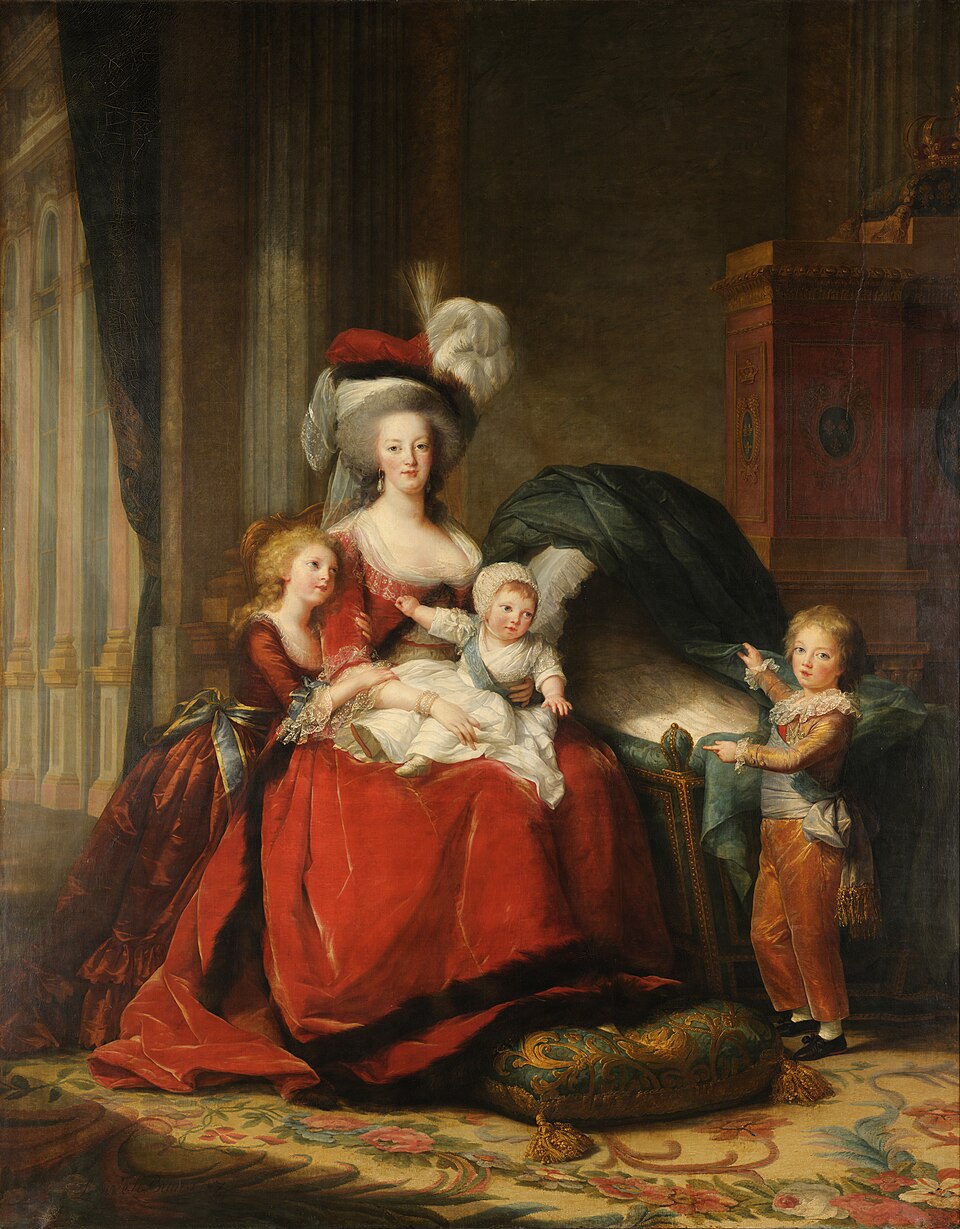
The Salon of 1787 held two paintings by Vigee Le Brun about motherhood, and both caused trouble. The first was a royal commission, Marie Antoinette and Her Children, meant to repair the queen's image after the Diamond Necklace scandal of 1785 by showing her as a mother. The painter did not want to exhibit it: the queen was so unpopular that she feared the picture would be damaged. The administration insisted. The queen's youngest child, Sophie, died shortly before it was finished, and Vigee Le Brun left the cradle beside the queen empty.
The second was her own Self-Portrait with Julie, mother and daughter embracing, and in it she smiles with her lips parted and her teeth showing. The newsletter Memoires secrets called it "an affectation which artists, art-lovers and persons of taste have been united in condemning": that in smiling she showed her teeth. The historian Colin Jones explains the outrage: in painting, an open mouth had meant the lower orders, lost self-control or bad teeth, and polite portraits kept their lips closed.
Two years later, at midnight on 5 October 1789, the queen's painter fled Paris, and did not come back for twelve years. The smiling mother now hangs in the Louvre, and the queen with the empty cradle at Versailles.
Key works
- Madame Grand (1783) - The Met, New York
- Self Portrait in a Straw Hat (c. 1782) - National Gallery, London
- Marie Antoinette and Her Children (1787) - Palace of Versailles
- Self-Portrait with Julie (Maternal Tenderness) (1787) - Louvre, Paris
In museum collections
- Marie Antoinette and Her Children (1787)
The Met ↗ · Find a print ↗ - Self-Portrait with Her Daughter, Julie (1786)
Louvre ↗ · Find a print ↗ - Self Portrait in a Straw Hat (1782)
Art UK ↗ · Find a print ↗ - Self-portrait of Élisabeth Louise Vigée Le Brun (1790)
Uffizi ↗ · Find a print ↗ - Comtesse de la Châtre (Marie Charlotte Louise Perrette Aglaé Bontemps, 1762–1848) (1789)
The Met ↗ · Find a print ↗ - Madame Grand (Noël Catherine Verlée, 1761–1835) (1783)
The Met ↗ · Find a print ↗ - Peace bringing back Prosperity (1780)
Louvre ↗ · Find a print ↗ - Portrait of countess Yekaterina Skavronskaya (1790)
The Met ↗ · Find a print ↗ - Countess Ekaterina Vassilievna Skavronskaia (1796)
Louvre ↗ · Find a print ↗ - Hubert Robert (1788)
Louvre ↗ · Find a print ↗ - Marie-Antoinette seated, in blue coat and white dress, holding a book in her hand (1788)
The Met ↗ · Find a print ↗ - Varvara Ivanovna Ladomirsky (1800)
The Met ↗ · Find a print ↗
See the work
Prints
Books
See also
Browse all 2,101 artists · Open in the directory · Where the work hangs: 112 museums on a map