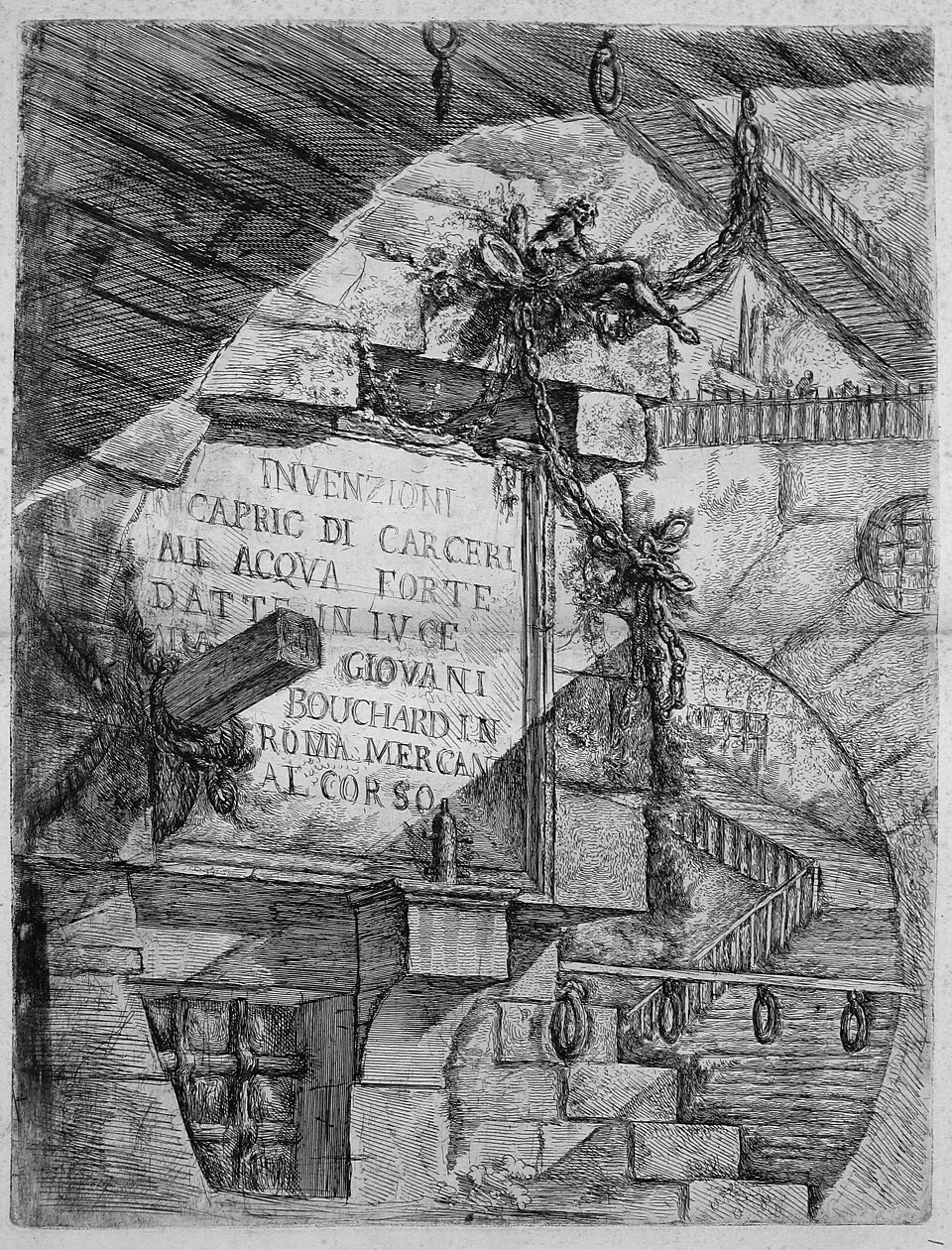
Giovanni Battista Piranesi
Who
Etcher, architect and antiquarian, born in Venice on 4 October 1720 and died in Rome on 9 November 1778. Trained as an architect under his uncle Matteo Lucchesi, he moved to Rome in 1740 and learned etching from Giuseppe Vasi. His one building, Santa Maria del Priorato on the Aventine, is where he is buried.
Why they matter
He made the image of Rome that Europe carried home. The Vedute di Roma were the Grand Tourist's souvenir, and they turned ruins into drama: low viewpoints, giant masonry, tiny figures. The Carceri, imaginary prisons of impossible geometry, took the same method into fantasy and have fed writers from Coleridge and Poe to Borges and Kafka.
What to buy
Originals: Piranesi is one of the few old masters whose genuine etchings an ordinary collector can own, because his plates never stopped printing. He published the 135 Vedute di Roma himself from 1760 until his death; his sons Francesco and Pietro reissued them in Rome until 1799, then took the plates to Paris, where the first Paris edition appeared in 1800-1807, intermediate Paris editions until about 1835, and the Firmin-Didot edition in about 1835-1839. The papal Calcografia bought the plates in 1839 and printed them in Rome from then on; impressions from 1870 on, under the Regia Calcografia, generally carry an embossed blind stamp, so a sheet without one is not necessarily early. The plates are now in the Istituto Centrale per la Grafica in Rome. So the order of value is lifetime Rome, then Francesco, then Paris, then Calcografia, with the plates wearing at every step; a late Paris or Calcografia sheet is the cheapest honest way in. Paper helps: every edition before the nineteenth-century restrikes is on thick laid paper, and Firmin-Didot used wove. A dealer should name the edition; "18th-century" on a sheet with a blind stamp is wrong. A flat sheet with no plate mark is a reproduction. Prints: Taschen's Piranesi. The Complete Etchings, edited by Luigi Ficacci, reproduces the whole output in 788 pages and is the best way to see it. Books: John Wilton-Ely's Giovanni Battista Piranesi: The Complete Etchings (1994) is the standard catalogue, with Andrew Robison's appendix of watermarks for dating impressions; Arthur M. Hind's 1922 study is still the reference for the states of the Vedute.
Notes
The Met, the British Museum and the V&A all show their impressions online; the V&A's include sheets from the Paris edition of 1800-1807. The Carceri were first issued in 1750 as 14 untitled, unnumbered plates; for the 1761 edition he reworked them, numbered them I-XVI and added two new ones.
Story
Le Antichità Romane, four volumes of etchings of the ruins of ancient Rome, came out in May 1756 dedicated to the Irish nobleman James Caulfield, Lord Charlemont, who had promised to subsidise it once the work had begun. The money never came. Charlemont had gone home to Ireland, and letter after letter failed to move him. So Piranesi went back to the copper. He erased Charlemont's name from the plates and dedicated the work instead to his contemporaries, to future generations and to the public good. In June 1757 the government in Rome ordered him never to publish anything that reflected on Charlemont, on pain of the galleys. At the beginning of February 1758 he published anyway: the Lettere di giustificazione, his letters to Charlemont and his agents, with satirical vignettes. In one, the agents lie buried with Horace's buffoons and wastrels under a headstone from which their names have been half erased, the same fate as their master's name on the dedication. Abbé Peter Grant, one of those agents, wrote to Charlemont that Piranesi "was so mad as to publish at the same time several most satirical prints." Six weeks later, on 15 March 1758, Piranesi wrote Charlemont a letter of retraction. The Queen's College, Oxford keeps a copy of it bound into its Lettere.
Key works
- Prima parte di architetture e prospettive (1743)
- Carceri d'invenzione (first edition, 14 plates) (1750)
- Le Antichità Romane (four volumes) (1756)
- Carceri d'invenzione (second edition, 16 plates) (1761)
- Vedute di Roma (135 plates) (begun c. 1748)
- Santa Maria del Priorato (1764) - Aventine Hill, Rome
In museum collections
- Piranesi Vase
British Museum ↗ · Find a print ↗ - Title Plate (1747)
National Gallery of Art ↗ · Find a print ↗ - Prisoners on a Projecting Platform (1758)
National Gallery of Art ↗ · Find a print ↗ - The Arch with a Shell Ornament (1758)
National Gallery of Art ↗ · Find a print ↗ - The Drawbridge (1758)
National Gallery of Art ↗ · Find a print ↗ - The Giant Wheel (1758)
National Gallery of Art ↗ · Find a print ↗ - The Gothic Arch (1758)
National Gallery of Art ↗ · Find a print ↗ - The Grand Piazza (1758)
National Gallery of Art ↗ · Find a print ↗ - The Pier with a Lamp (1758)
National Gallery of Art ↗ · Find a print ↗ - The Round Tower (1758)
National Gallery of Art ↗ · Find a print ↗ - The Sawhorse (1758)
National Gallery of Art ↗ · Find a print ↗ - The Smoking Fire (1758)
National Gallery of Art ↗ · Find a print ↗
See the work
Prints
Books
Originals
See also
Browse all 2,101 artists · Open in the directory · Where the work hangs: 34 museums on a map