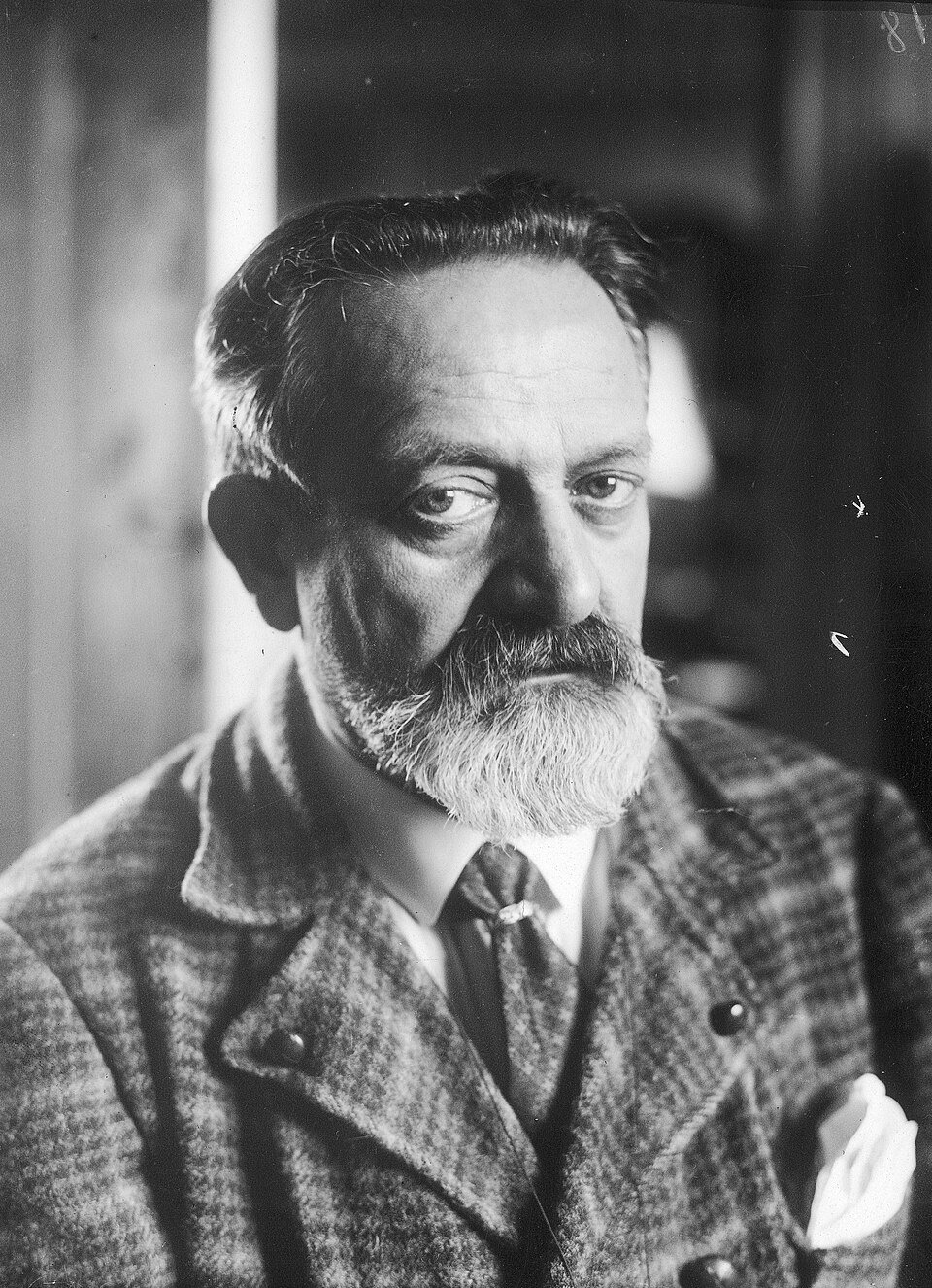
Emil Orlík
Who
Printmaker, painter and stage designer, born in Prague on 21 July 1870, trained in Munich, and a member of the Vienna Secession. He spent ten months in Japan in 1900-01 learning colour woodcut, taught from 1905 at the school of the Berlin Kunstgewerbemuseum, where George Grosz was among his students, designed for Max Reinhardt's theatre, and died in Berlin on 28 September 1932.
Why they matter
He was one of the very few Western artists to learn Japanese woodblock printing from the craftsmen themselves rather than from the prints, and he brought it back to Prague, Vienna and Berlin. He was also the portraitist of his generation's cultural celebrities - Mahler in 1902, Richard Strauss in 1917, Furtwangler in 1928 - in etching and lithograph.
What to buy
Originals: Orlik is a true printmaker, and his prints are the realistic way to own him. The affordable tier is the prints he published in art periodicals: his lithograph Painter, Carver and Printer in Japan was issued in Die Graphischen Kunste in 1902, so it exists as a real period impression from a magazine; the copy Scholten Japanese Art offered was still folded and mounted on its grey backing as issued. Ask whether any sheet is from a periodical or a separately printed impression, and expect the description to say which. The 1904 portfolio Aus Japan was published in only 50 sets of nine colour etchings and six colour lithographs, so a complete set is a rarity. Prints: reproductions are thin on the ground; a period impression from a periodical is better value than any poster. Books: there is no easy English standard monograph; search AbeBooks for exhibition catalogues of his Japan work.
Notes
His Japan woodcuts are in the V&A, the Philadelphia Museum of Art, the British Museum, MoMA, the Met and Harvard Art Museums. The Manggha Museum in Krakow showed his Japan work as Like a Dream! Emil Orlik in Japan, the first Polish exhibition devoted to him. Public domain: museum images and Wikimedia Commons are free to use.
Story
In March 1900 Orlik, a Prague-born painter of thirty, left for Japan. European artists of the time collected and copied Japanese prints; going there to learn the craft from the people who practised it was, as the Manggha Museum puts it, a rare achievement for a Western artist. He stayed until February 1901, took instruction from the painter Kano Tomonobu, ninth-generation master of the Kano school and an unofficial head of the foreign artists in Meiji Japan, and learned colour woodblock printing from local masters.
A Japanese colour print was made by three different men: one painted the design, one carved the blocks, one printed them. Orlik drew all three at work in a woodblock triptych made in Japan, and the painter in it is his own teacher, Tomonobu. Back in Europe he redrew the scene as a lithograph, Painter, Carver and Printer in Japan, published in the art periodical Die Graphischen Kunste in 1902 - a portrait of the trade he had just been let into.
His work was shown to great acclaim when he returned to Prague in spring 1901, and the woodcuts he made in Japan - pilgrims on the road to Mount Fuji, two figures walking into a gust of wind - look less like European japonisme than like the thing itself.
Key works
- Ein Windstoss (A Gust of Wind), colour woodcut (1901) - V&A
- A Japanese Woodcutter at Work (1901) - Philadelphia Museum of Art
- Painter, Carver and Printer in Japan, lithograph (1902) - published in Die Graphischen Kunste
- Aus Japan (From Japan), portfolio of 9 colour etchings and 6 colour lithographs (1904)
- Portrait of Gustav Mahler (1902)
In museum collections
- Max Slevogt (1917)
National Gallery of Art ↗ · Find a print ↗ - Dachstein (1904)
Belvedere ↗ · Find a print ↗ - Emigrants (1922)
National Gallery of Art ↗ · Find a print ↗ - Evening in Fukagawa (1900)
National Gallery of Art ↗ · Find a print ↗ - Ferdinand Hodler (1904)
National Gallery of Art ↗ · Find a print ↗ - Japanerin im Winterkleid (Japanese Woman in Winter Dress) (1901)
National Gallery of Art ↗ · Find a print ↗ - Japanischer Garten (1901)
Belvedere ↗ · Find a print ↗ - Max Klinger (1902)
National Gallery of Art ↗ · Find a print ↗ - Nächtliche Fahrt im Mittelmeer (1905)
Belvedere ↗ · Find a print ↗ - Oasis in the Desert (1913)
National Gallery of Art ↗ · Find a print ↗ - Thunderstorm (Small) (1896)
National Gallery of Art ↗ · Find a print ↗ - Volendam Girl in Costume (1898)
National Gallery of Art ↗ · Find a print ↗
See the work
Prints
Books
Originals
See also
Browse all 2,101 artists · Open in the directory · Where the work hangs: 16 museums on a map