Yoshitoshi
Who
Tsukioka Yoshitoshi, Japanese woodblock print designer, born in Edo on 30 April 1839 and dead in Tokyo on 9 June 1892. Apprenticed at eleven to Utagawa Kuniyoshi, he worked through the fall of the shogunate and the opening of Japan, designing warriors, ghosts, beauties and newspaper illustrations.
Why they matter
He is regarded as the last great master of the traditional Japanese woodblock print and the most important pupil of Kuniyoshi. His early prints are full of graphic violence; his late series, above all One Hundred Aspects of the Moon, are quiet and poetic, and in 1885 an art magazine ranked him the first ukiyo-e artist of the day.
What to buy
Originals: this is one of the most realistic places to own a genuine Japanese print. Single sheets from the Moon series are the obvious start, and many designs remain within reach of a first-time collector, while the rare ones sit much higher. The catch is the edition. After his death the publisher Akiyama Buemon went on printing the Moon series from the original blocks, so a genuine Meiji sheet can be a lifetime or a posthumous impression. Early impressions carry the artist's name and address and the printing and publication dates in the left margin; later ones show broken lines from worn blocks and often brighter colour, and a trimmed margin can hide the evidence. Beware too that a search for "Yoshitoshi" also brings up Mori Yoshitoshi, a different, twentieth-century artist. Books: John Stevenson's Yoshitoshi's One Hundred Aspects of the Moon is the standard work on the series. Stevenson estimates that two to three thousand impressions of the Moon prints, lifetime and posthumous together, were made.
Notes
The Art Institute of Chicago shows prints from his major late series online. His pupils included Mizuno Toshikata and Migita Toshihide, and he adopted Tsukioka Kogyo.
Story
By 1869 Yoshitoshi was counted among the best print designers in Japan. Then the commissions stopped. He fell into a deep depression and poverty, and in 1872 had a complete mental breakdown after his recent designs were poorly received. His mistress Okoto sold her clothes and belongings to keep him, and in 1876, with the two of them still poor, she sold herself to a brothel to support him. Yoshitoshi, meanwhile, had come back. In 1873 he changed the first part of his art name to Taiso, written with characters meaning "great resurrection". The Satsuma Rebellion of 1877 increased the demand for newspaper prints, he married in 1884, and his last years were among his most productive. One Hundred Aspects of the Moon, issued a few designs at a time from 1885, was so popular that people queued before dawn for each new sheet and still found it sold out. Then the illness returned. He was admitted to a mental hospital in 1891, and died of a cerebral haemorrhage in June 1892, aged 53.
Key works
- Mirror of Famous Generals of Great Japan (1877-1882) - series
- One Hundred Aspects of the Moon (1885-1892) - series
- Moon and Smoke, from One Hundred Aspects of the Moon (1886) - Art Institute of Chicago
- Thirty-two Aspects of Women (1888) - series
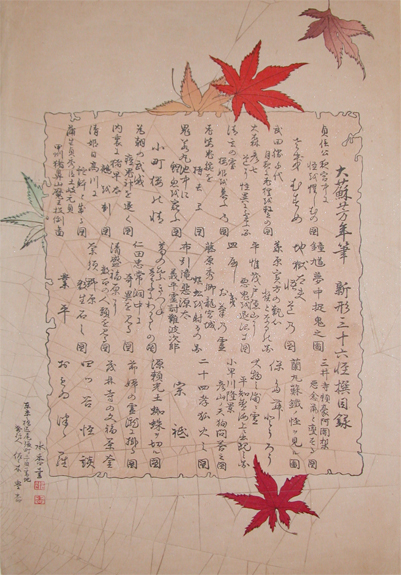
- New Forms of Thirty-six Ghosts (1889-1892) - series
- Heron Maiden, from New Forms of Thirty-six Ghosts (1889) - Art Institute of Chicago
In museum collections
- Great Generals of the East and West (1874)
Minneapolis Institute of Art ↗ · Find a print ↗ - A Civilized Daruma (1882)
LACMA ↗ · Find a print ↗ - A Memorial Portrait of Onoe Kikugorō IV (1860)
LACMA ↗ · Find a print ↗ - A Woman Saving the Nation (1886)
LACMA ↗ · Find a print ↗ - Asaoka Watching a Mouse on a Screen
LACMA ↗ · Find a print ↗ - Carp with Wisteria (1889)
LACMA ↗ · Find a print ↗ - Cascading Water
LACMA ↗ · Find a print ↗ - Clam Digging
Minneapolis Institute of Art ↗ · Find a print ↗ - Endō Kiemon Masatada with Assailant (1878)
LACMA ↗ · Find a print ↗ - Fire in the Lamp Stand
LACMA ↗ · Find a print ↗ - Fujiwara no Yasumasa Playing the Flute by Moonlight (1883)
LACMA ↗ · Find a print ↗ - Full Moon
LACMA ↗ · Find a print ↗
See the work
Prints
Books
Originals
See also
Browse all 2,101 artists · Open in the directory · Where the work hangs: 26 museums on a map