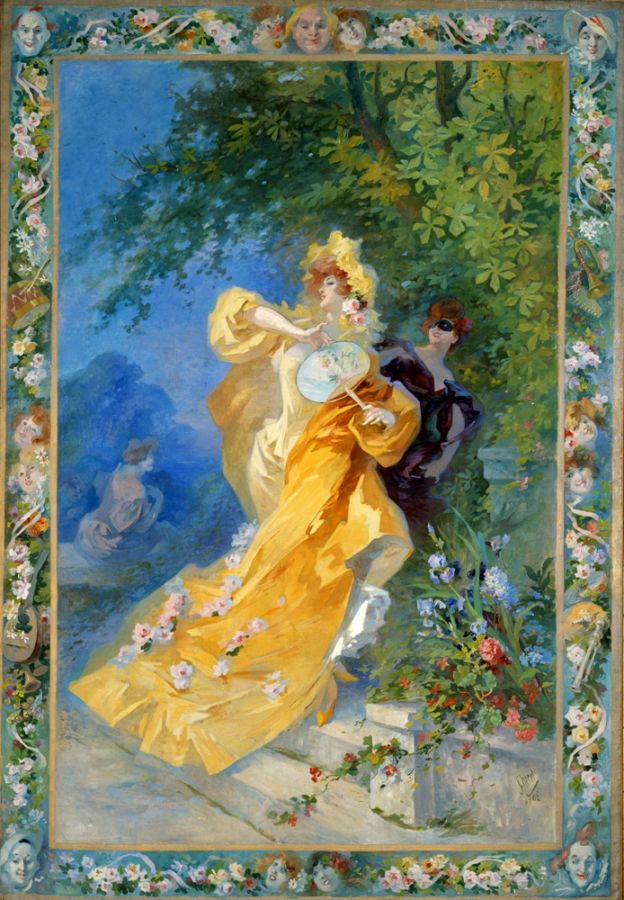
Jules Chéret
Who
French lithographer and poster designer, born in Paris in 1836 and died in Nice in 1932, at 96. Apprenticed to a lithographer at thirteen, he spent 1859 to 1866 in London, where he worked for the perfumer Eugene Rimmel, then came home to run his own press and make more than a thousand posters for theatres, music halls, skating rinks, cosmetics and aperitifs.
Why they matter
He is called the father of the modern poster. He simplified colour lithography to three stones inked red, yellow and blue, and filled Paris with big, bright sheets of liberated, dancing women, the "Cherettes", with his hand-drawn lettering built into the design rather than set in type. In 1890 he was made a Chevalier of the Legion d'honneur and described as the creator of an art industry.
What to buy
Originals: this is a genuinely collectable printmaker, because the posters themselves are the originals and they were printed in quantity. Full-size posters on thin paper, often backed on linen, go through the poster auctions; Swann's regular vintage-poster sales are the place to learn the market. The affordable tier is Les Maitres de l'Affiche: from December 1895 to November 1900 the Chaix press, where Cheret was artistic director, sent subscribers four reduced colour-lithograph posters a month, about 40 by 29 cm, 256 plates in all, and Cheret's own designs are a large share of them. Genuine plates are lithographs of the 1890s with the publication's blind stamp. Reproductions are common: under a loupe a modern print shows a regular dot screen where a stone lithograph shows solid colour, and an old poster's oily inks usually show through on the back. Books: Dover's The Complete "Masters of the Poster" reproduces all 256 plates a page each, the cheapest honest way to own the lot; Lucy Broido's The Posters of Jules Cheret (Dover, second edition 1992) is the catalogue raisonne dealers cite.
Notes
The Milwaukee Art Museum holds the largest collection of his posters in the United States, from the Wiechmann gift, shown in Always New: The Posters of Jules Cheret (2022). The Art Institute of Chicago has Le Rappel, Palais de Glace, Saxoleine and Vin Mariani. Nice's Musee des Beaux-Arts is named after him. Public domain, so scans are free on Wikimedia Commons.
Story
Chéret's posters were printed on flimsy paper to be pasted up and covered over, and they became collectors' items anyway. By the 1890s Paris had a word for it, affichomanie, poster mania, and the collectors did not wait for the art trade. According to the Driehaus Museum's history of the craze, some bribed the billposters to hand over the newest sheets before they were glued to billboards, kiosks and Morris columns, and many more crept out at night to peel them off the columns, risking a police fine. Dealers such as Edmond Sagot answered by stocking special impressions printed without the lettering and on expensive paper, for customers who wanted the picture without the advertisement.
Chéret profited twice. In 1895 he created Les Maitres de l'Affiche, the monthly subscription that sold reduced posters by ninety-seven artists to collectors who would rather not climb a Morris column. And he lived long enough to see himself enshrined: the city of Nice opened its art museum as the Palais des Arts Jules Cheret in January 1928, four years before he died there at 96. The man whose art was made to be thrown away ended up with a museum carrying his name.
Key works
- Orphee aux Enfers (poster for Offenbach) (1858)
- La Biche au Bois (1866)
- Le Rappel (1889) - Art Institute of Chicago
- Palais de Glace (1891) - Art Institute of Chicago
- Saxoleine (1893) - Art Institute of Chicago
- Vin Mariani (1894) - Art Institute of Chicago
In museum collections
- Au Quartier Latin (1894)
National Gallery of Art ↗ · Find a print ↗ - Elegant Lady Seated in a Chair (1900)
National Gallery of Art ↗ · Find a print ↗ - Folies-Bergere La Loïe Fuller - Jules Cheret
MoMA ↗ · Find a print ↗ - La Fille Élisa; Conte de Noël (1890)
National Gallery of Art ↗ · Find a print ↗ - Théâtrophone (Theater phone) (1890)
MoMA ↗ · Find a print ↗ - Papier à cigarettes Job (1895)
National Gallery of Art ↗ · Find a print ↗ - Tête de femme
Musee d'Orsay ↗ · Find a print ↗ - Waltz of the Blonde and Waltz of the Brunette (1880)
National Gallery of Art ↗ · Find a print ↗
See the work
Prints
Books
Originals
See also
Browse all 2,101 artists · Open in the directory · Where the work hangs: 23 museums on a map