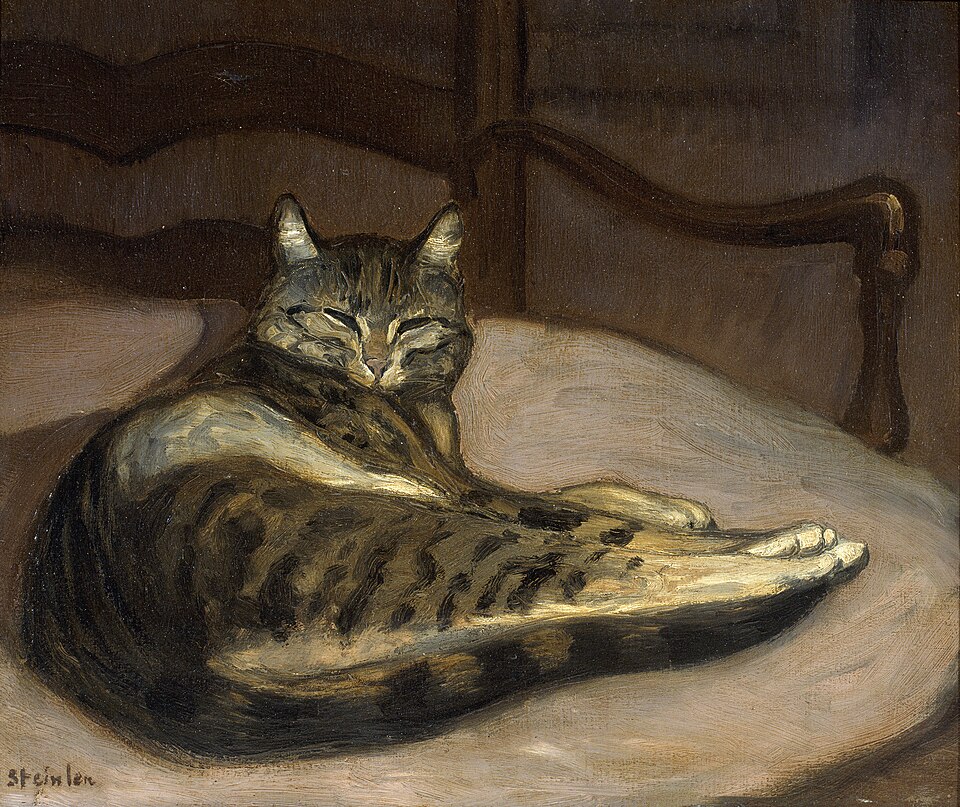
Théophile Steinlen
Who
Swiss-born painter, printmaker, illustrator and poster designer, born in Lausanne in 1859 and died in Paris in 1923. He settled in Montmartre in his early twenties, drew for Rodolphe Salis's weekly Le Chat Noir from 1884 to 1895 and for Gil Blas illustre, and is buried in the Saint-Vincent cemetery in Montmartre.
Why they matter
He was one of the handful of poster artists, with Cheret, Toulouse-Lautrec, Grasset and Mucha, hailed as masters of the medium in the 1890s, and his 1896 black cat for the Chat Noir is one of the most reproduced images of Paris. But the cats are only half of him: from the early 1890s he drew for the socialist and anarchist press, often under pseudonyms, and his lithographs and etchings of laundresses, workers and street life, and later of refugees and soldiers of the First World War, are the serious side of Montmartre. His work influenced Picasso's.
What to buy
Originals: Steinlen is a genuinely collectable printmaker. The full-size posters go through the poster auctions, and Swann's vintage-poster sales are where to learn the market. The affordable tier is twofold. Les Maitres de l'Affiche, the 1895-1900 subscription series of reduced colour lithographs, includes his milk poster (plate 95), about 29 by 39 cm on heavy paper. And his own smaller lithographs and etchings, of cats, workers and Montmartre streets, were made as prints from the start; the Art Institute of Chicago holds dozens. Ernest de Crauzat's 1913 catalogue of his etchings and lithographs is the reference, and a scan of it is free on the Internet Archive: ask which Crauzat number a sheet is. The Chat Noir image is on every souvenir stall in Paris; a copy that shows a regular dot screen under a loupe is a modern reproduction, while an old lithograph's oily inks usually show through on the back. Book: Dover's Steinlen Cats, a paperback of his cat drawings, is the cheap way in.
Notes
The Art Institute of Chicago has a large group of his prints, from the Bodiniere poster of 1894 to the war lithographs of 1915. The Musee de Montmartre held a centenary exhibition, Theophile-Alexandre Steinlen (1859-1923), which closed in February 2024. Public domain, so scans are free on Wikimedia Commons.
Story
The black cat of Montmartre was drawn by a man who took in cats by the dozen. Steinlen's house on the rue Caulaincourt was so full of them that his contemporaries renamed it "The Cat's Cottage", and when he made his 1896 poster for the Chat Noir cabaret, he was drawing a subject he knew at home. The cabaret itself, Rodolphe Salis's club at the foot of the butte, was said to be named after an old tomcat that had moved in while the builders were still at work.
The poster was an immediate hit, and it never stopped selling: today it is on postcards, key rings, magnets and posters in every tourist shop in Paris. Its author would not have been a comfortable mascot. Raised a Calvinist in Lausanne, Steinlen turned his back on accumulating wealth, drew for socialist and anarchist papers from the early 1890s, often under false names to stay out of trouble, and during the First World War joined an artists' mission to the armies to draw the distress of soldiers and civilians. The most commercialised image of Montmartre was made by a man whose sympathies lay with the street, not the shop.
Key works
- Tournee du Chat Noir de Rodolphe Salis (1896)
- Compagnie francaise des chocolats et des thes (1895)
- Lait pur sterilise de la Vingeanne
- A la Bodiniere (1894) - Art Institute of Chicago
- Winter: Cat on a Cushion (1909) - Art Institute of Chicago
- Refugees from the Meuse (1915) - Art Institute of Chicago
In museum collections
- Chat sur un fauteuil (1902)
Musee d'Orsay ↗ · Find a print ↗ - In the Rain: Mother and Children (Sous la pluie: La mere et les enfants) (1915)
National Gallery of Art ↗ · Find a print ↗ - Three Companions (Les trois compagnons) (1912)
National Gallery of Art ↗ · Find a print ↗ - A Man on a City Street, Surrounded by Children (Un Père)
National Gallery of Art ↗ · Find a print ↗ - A Wounded Soldier and His Comrade (1916)
National Gallery of Art ↗ · Find a print ↗ - Anarkisten eller den inspirerade
Nationalmuseum Sweden ↗ · Find a print ↗ - Aulestad
Nationalmuseum Sweden ↗ · Find a print ↗ - Bonde
Nationalmuseum Sweden ↗ · Find a print ↗ - C'est ici, chez nous! (1916)
National Gallery of Art ↗ · Find a print ↗ - Chez Maxime
National Gallery of Art ↗ · Find a print ↗ - De fattiga
Nationalmuseum Sweden ↗ · Find a print ↗ - Exodus (L'exode) (1916)
National Gallery of Art ↗ · Find a print ↗
See the work
Prints
Books
Originals
See also
Browse all 2,101 artists · Open in the directory · Where the work hangs: 33 museums on a map