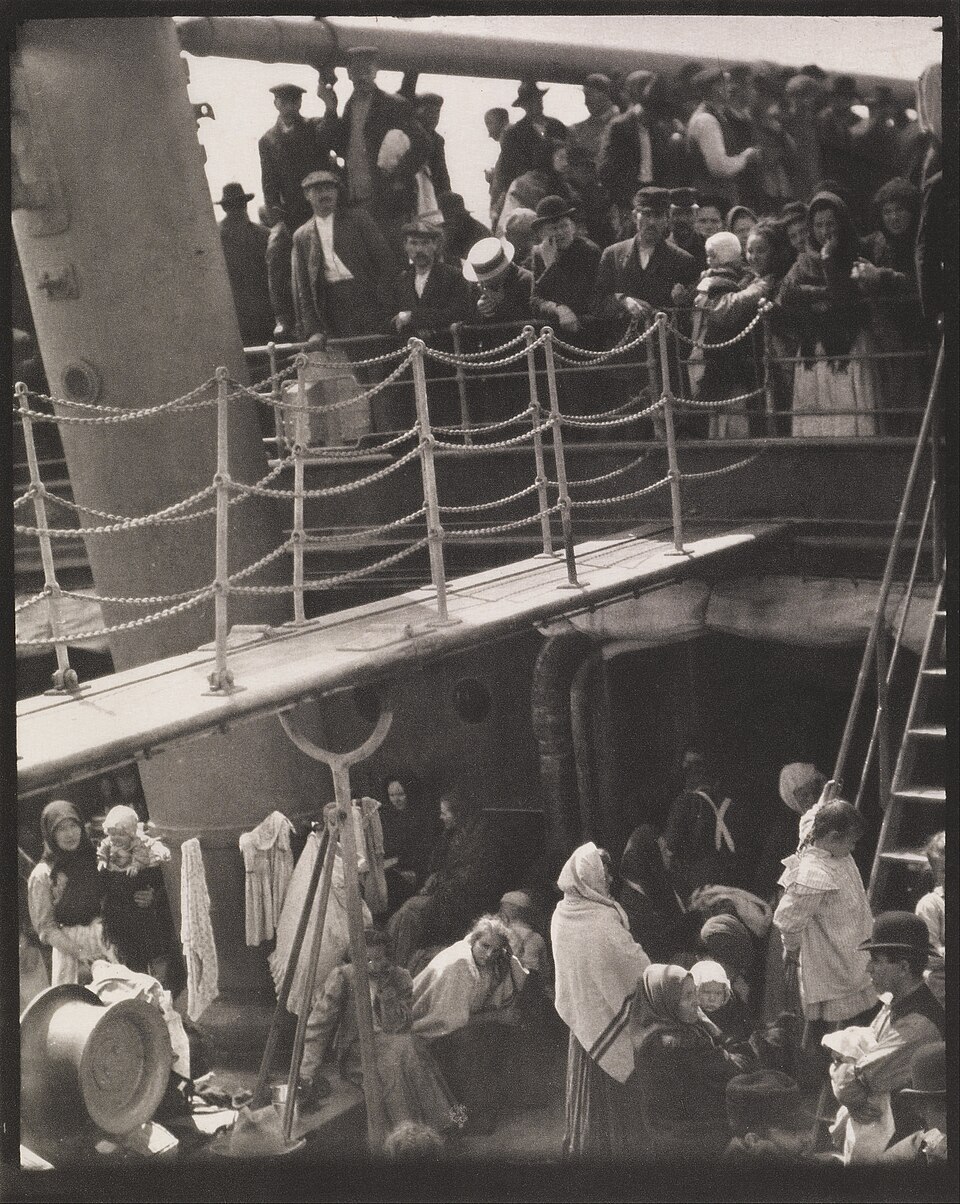
Alfred Stieglitz
Who
Alfred Stieglitz (1864-1946) was born in Hoboken, New Jersey, and died in New York City. He was a photographer, but also the editor of Camera Work, a founder of the Photo-Secession and the gallerist behind 291 (opened 1905 on Fifth Avenue) and later An American Place (1929).
Why they matter
Stieglitz argued, and eventually won the argument, that photography was an art and not a technical trade. His own pictures moved from the soft, painterly pictorialism of the 1890s to the hard-edged modernism of The Steerage and the cloud photographs he called Equivalents. From 1918 to 1925 alone he made more than 350 mounted prints of Georgia O'Keeffe, whom he married in 1924, a portrait of one person built up over years rather than in a sitting.
What to buy
Originals: Stieglitz's own prints are museum and top-auction objects, but his journal is not. Camera Work ran to 50 issues between 1903 and 1917, and its illustrations were hand-pulled photogravures on Japanese tissue, tipped into every copy by Stieglitz himself, who thought them fit to exhibit: when prints failed to arrive for a show in Brussels, the gravures were hung instead. Single gravures and whole issues are the realistic way to own his work and that of the Photo-Secession. Look for the thin tissue tipped onto the page; an image printed directly on ordinary book paper is a reproduction (a 1969 page-by-page scholarly reprint was made at a smaller size), and the 2018 facsimile is a facsimile, however good. The Steerage also appeared as a gravure in 291 magazine in 1915. Books: Taschen's Camera Work reproduces the photographs from all 50 issues in one volume and is the cheap, complete way to see what the originals look like.
Notes
The key set, 1,642 photographs given by O'Keeffe, is at the National Gallery of Art in Washington: 1,317 in 1949 and 325 more in 1980. The Met and the Art Institute of Chicago also credit many of their holdings to an Alfred Stieglitz Collection. Public domain.
Story
The Steerage, the picture that made Stieglitz a modernist, is not what most people think it is. In 1907 he was sailing to Europe first class on the Kaiser Wilhelm II when he found a spot overlooking the crowded lower decks. He did not have his camera with him, raced back to his cabin for his hand-held 4x5 Auto-Graflex, and had a single prepared glass plate. He made one exposure. The historian Beaumont Newhall, reading the shadows and the absence of wind, thought the ship was probably at anchor in Plymouth at the time. The picture is usually read as immigrants arriving in America. The ship was in fact sailing from America to Europe, and most of those passengers were artisans from the booming construction trade, in America on temporary visas. Stieglitz held the image back for four years before publishing it in Camera Work in October 1911, and in 1915 he gave a whole double issue of his magazine 291 to it alone. Picasso is reported to have said of it, "This photographer is working in the same spirit as I am."
Key works
- The Hand of Man (1902) - Art Institute of Chicago
- The Steerage (1907) - The Met (photogravure)
- Georgia O'Keeffe - Hands and Thimble (1919) - Art Institute of Chicago (palladium print)
In museum collections
- The Steerage (1907)
The Met ↗ · National Gallery of Art ↗ · Art Institute of Chicago ↗ · Musee d'Orsay ↗ · Find a print ↗ - Camera Work: Winter - Fifth Avenue (1892)
The Met ↗ · Musee d'Orsay ↗ · MoMA ↗ · MFA Boston ↗ · Find a print ↗ - Equivalents (1925)
National Gallery of Art ↗ · MoMA ↗ · Find a print ↗ - Georgia O'Keeffe - Torso (1918)
National Gallery of Art ↗ · Musee d'Orsay ↗ · Find a print ↗ - Spring Showers, the Coach (1899)
The Met ↗ · Find a print ↗ - Georgia O'Keeffe (1895)
The Met ↗ · National Gallery of Art ↗ · Find a print ↗ - Rebecca Salsbury Strand (1922)
National Gallery of Art ↗ · Find a print ↗ - From the Back-Window--291 (1915)
The Met ↗ · National Gallery of Art ↗ · Find a print ↗ - Georgia O'Keeffe — Neck (1921)
The Met ↗ · National Gallery of Art ↗ · Find a print ↗ - Camera Work: Spring Showers, New York (1900)
National Gallery of Art ↗ · Find a print ↗ - Equivalent (1923)
National Gallery of Art ↗ · Find a print ↗ - Songs of the Sky (1923)
National Gallery of Art ↗ · Find a print ↗
See the work
Prints
Books
Originals
See also
Browse all 2,101 artists · Open in the directory · Where the work hangs: 25 museums on a map