Eadweard Muybridge
Who
Born Edward James Muggeridge in Kingston upon Thames in 1830, he reinvented himself in California as Eadweard Muybridge, first as a landscape photographer working under the name "Helios" in Yosemite, then as the man who stopped motion. He died in Kingston in 1904.
Why they matter
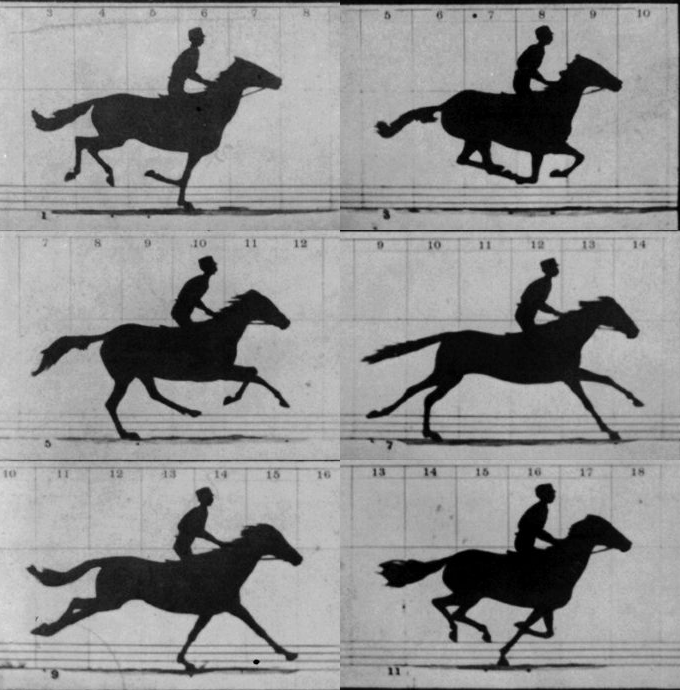
In June 1878, at Leland Stanford's stock farm in Palo Alto, a row of cameras with electrically triggered shutters caught the racehorse Sallie Gardner in mid-gallop and showed what no eye had seen. His zoopraxiscope then projected such sequences as moving pictures from glass discs, before cinema existed. The 781 plates of Animal Locomotion (1887) are still a reference for artists and animators: more than 20,000 pictures of people and animals in motion, up to 36 to a plate.
What to buy
Originals: this is one of the few nineteenth-century landmarks you can actually own. Animal Locomotion was sold by subscription in 1887: buyers chose 100 plates from the prospectus, and only a few dozen complete sets were made, so the plates have always circulated one by one. They are ink prints made by the Photo-Gravure Company of New York (most museums catalogue them as collotypes), on large sheets: the Art Institute of Chicago's plate 758 measures about 19 by 24 inches. Single plates come up regularly at Swann, Christie's, Sotheby's and on dealer sites. What they should not be: a photographic print, a page on modern book paper, or anything the size of a book page. Those are reproductions, honest or not. Yosemite albumen prints and stereoviews from the 1870s also appear at auction. Books: Dover's The Human Figure in Motion and Animals in Motion, first published in Muybridge's lifetime (1901 and 1899), are still in print, and Dover's 1979 Muybridge's Complete Human and Animal Locomotion reprints all 781 plates. These are the cheap, correct way to see the whole work.
Notes
Kingston Museum received his own collection, including the zoopraxiscope, over 2,000 lantern slides and 67 zoopraxiscope discs. The University of Pennsylvania, the Philadelphia Museum of Art and Stanford hold other major groups. Public domain.
Story
In October 1874, two years after Stanford first hired him, Muybridge learned that his wife Flora was having an affair with Harry Larkyns, and found a photograph of her baby son with "Harry" written on the back in her hand. He travelled to Calistoga, knocked on the door of the house where Larkyns was staying, said "I have a message for you from my wife" and shot him at point-blank range. At the trial in February 1875 the jury acquitted him of murder as justifiable homicide, explaining their verdict as being in accordance with "the law of human nature". Fourteen years earlier a stagecoach crash in Texas had left him with a severe head injury, double vision and lasting changes to his personality. He went on to finish the horse pictures that led to cinema. Even that brought him grief: when Stanford's friend J. D. B. Stillman published The Horse in Motion in 1882 using Muybridge's photographs without proper credit, the Royal Society of Arts refused to publish a paper by Muybridge, accusing him of plagiarism.
Key works
- The Horse in Motion (Sallie Gardner) (1878) - cabinet cards registered at the Library of Congress
- Animal Locomotion (1887) - 781 plates; Volume IX, Horses, at the Met
- Animal Locomotion, Plate 758 (cockatoo in flight) (1887) - Art Institute of Chicago
In museum collections
- Acajutla (1877)
National Gallery of Art ↗ · Find a print ↗ - Acapulco (1877)
National Gallery of Art ↗ · Find a print ↗ - Animal Locomotion, Plate 340 (1887)
National Gallery of Art ↗ · Find a print ↗ - Animal Locomotion, Plate 469 (1887)
National Gallery of Art ↗ · Find a print ↗ - Animal Locomotion, Plate 521 (1887)
National Gallery of Art ↗ · Find a print ↗ - Animal Locomotion, Plate 523 (1887)
National Gallery of Art ↗ · Find a print ↗ - Animal Locomotion, Plate 626 (1887)
National Gallery of Art ↗ · Find a print ↗ - Animal Locomotion, Plate 733 (1887)
National Gallery of Art ↗ · Find a print ↗ - Animal Locomotion, Plate 758 (1887)
National Gallery of Art ↗ · Find a print ↗ - Cathedral Spires, Valley of the Yosemite (1872)
National Gallery of Art ↗ · Find a print ↗ - Horses. Running. Phyrne L. No. 40 (1879)
National Gallery of Art ↗ · Find a print ↗ - Internegative for Horses. Trotting. Abe Edgington. No. 28 (1878)
National Gallery of Art ↗ · Find a print ↗
See the work
Prints
Books
Originals
See also
Browse all 2,101 artists · Open in the directory · Where the work hangs: 15 museums on a map