Eugène Atget
Who
Eugène Atget (1857-1927) was born in Libourne, in south-west France, and died in Paris. After the merchant navy, a failed career as an actor and an attempt at painting, he turned to photography, and from the 1890s until his death photographed the streets, shops, courtyards, street traders and parks of old Paris and its surroundings: about 10,000 pictures.
Why they matter
Atget called his pictures documents and sold them as such, by 1891 under a door sign reading "Documents pour artistes", to painters, architects, stage designers and, from 1898, the city's own museums and libraries. Photographers after him saw far more in them: the Surrealists published him, and Berenice Abbott spent four decades making his name. His systematic record of old Paris, made building by building and street by street with a large wooden view camera, became one of the foundations of modern documentary photography.
What to buy
Know how he printed before buying anything. Atget worked with a large wooden bellows camera and never used an enlarger: every print he made is a contact print the size of its glass negative, on albumen or printing-out paper, in warm browns. A large, glossy, neutral-grey print is therefore not his. Vintage prints by Atget are an auction-house market. The realistic tier is prints made later from his own negatives, which are genuine photographs but not by his hand, and should be labelled with who printed them: Berenice Abbott's 1956 portfolio of twenty silver prints from his original glass negatives, and the albumen prints made by the Chicago Albumen Works, including a 1978 sales edition of twelve negatives for the Museum of Modern Art, New York. A print that names neither Atget's own hand nor a later printer is almost certainly a reproduction. Books: the standard work is The Work of Atget by John Szarkowski and Maria Morris Hambourg, four volumes published by MoMA from 1981 to 1985, found used. The in-print way in is Taschen's Eugène Atget. Paris, some 500 photographs from the Paris city collections in one small, thick volume.
Notes
The Musée Carnavalet and the Bibliothèque historique de la ville de Paris, both of which bought from him in his lifetime, hold large Atget archives. The Museum of Modern Art holds the Abbott-Levy collection, bought from Abbott in 1968, and the Art Institute of Chicago holds prints from Julien Levy's share. Public domain.
Story
In June 1926 Man Ray published Atget's photograph Pendant l'éclipse in the Surrealist magazine La Révolution surréaliste. Asked how he wanted to be credited, Atget said: "Don't put my name on it. These are simply documents I make."
A young American photographer to whom Man Ray had shown the pictures, Berenice Abbott, thought otherwise. In the spring of 1927 she persuaded Atget to sit for her, and made the only formal portraits of him known to exist. When she climbed the stairs to his studio to bring him the proofs, the familiar sign on the door was gone. The concierge told her: "M. Atget is dead."
In June 1928 Abbott bought what was left in his studio: some 1,400 glass negatives and roughly 8,000 prints. To stay solvent she sold a half-interest to the New York dealer Julien Levy, shipped the archive to New York in 1929, published it, printed from it and promoted it for four decades. In 1968 she sold it to the Museum of Modern Art, which spent the early 1980s presenting it in four volumes. The man who would not sign his pictures became one of the best-known names in photography.
Key works
- Joueur d'orgue (Organ Player) (1898/99) - Art Institute of Chicago
- Versailles, Coin de Parc (1904) - Art Institute of Chicago
- Boulevard de Strasbourg (Corsets) (1912) - Art Institute of Chicago
- Marché du Temple (1925) - Art Institute of Chicago
- Pont Marie (1926) - Art Institute of Chicago
In museum collections
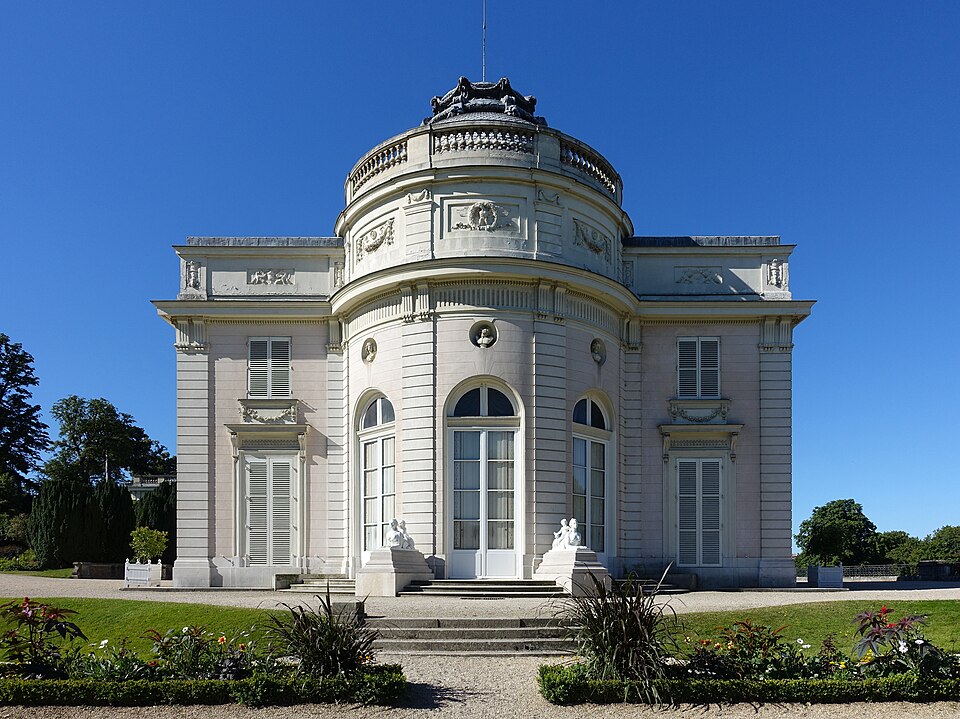
- Château de Bagatelle
MoMA ↗ · Find a print ↗ - rue de la Montagne-Sainte-Geneviève (1898)
MoMA ↗ · Find a print ↗ - Parc de Sceaux (1925)
National Gallery of Art ↗ · MoMA ↗ · Find a print ↗ - Saint-Cloud (1922)
National Gallery of Art ↗ · Find a print ↗ - Avenue des Gobelins (1925)
The Met ↗ · National Gallery of Art ↗ · Find a print ↗ - Hotel d'Argenson, rue de Grenelle 101 (1907)
National Gallery of Art ↗ · Find a print ↗ - Notre-Dame (1922)
National Gallery of Art ↗ · MoMA ↗ · Philadelphia Museum of Art ↗ · Find a print ↗ - Nymphéas (Bagatelle) (1925)
National Gallery of Art ↗ · Find a print ↗ - Poirier (1921)
National Gallery of Art ↗ · Find a print ↗ - Pont Marie (1912)
National Gallery of Art ↗ · Find a print ↗ - 15, rue Maître-Albert (1912)
The Met ↗ · Find a print ↗ - A la Grappe d'Or, 4 place d'Aligre (1911)
National Gallery of Art ↗ · Find a print ↗
See the work
Prints
Books
Originals
See also
Browse all 2,101 artists · Open in the directory · Where the work hangs: 20 museums on a map