Edmund Dulac
Who
Born Edmond Dulac in Toulouse on 22 October 1882, he studied law at the University of Toulouse before turning to art at the Ecole des Beaux-Arts and, briefly, the Academie Julian in Paris. He moved to London early in 1905, became a British subject in 1912, and died in London on 25 May 1953, having illustrated gift books, then designed stamps and banknotes.
Why they matter
With Rackham and Nielsen he is one of the three names of the de luxe illustrated gift book before the First World War: tipped-in colour plates in vellum-bound quartos. His Arabian Nights of 1907, done at 25, began an annual partnership with Hodder & Stoughton for a lavish Christmas edition of a classic. Late in life he turned the same eye on the smallest format there is, and designed British stamps for two coronations.
What to buy
The books as issued are the work. Hodder & Stoughton published his major titles as de luxe editions: the 1907 Stories from the Arabian Nights, for example, was issued in a quarto edition of 350 numbered copies signed by Dulac, bound in gilt-stamped vellum with ties, with 50 colour plates tipped onto heavy brown mounts under captioned tissue guards. That signed, numbered limitation leaf is what the top of the market pays for, so check it is there and that all 50 plates are present. One dealer notes that the vellum on this title is usually warped, so a flat copy is the exception, not a sign of a rebind. A plate removed from one of these books is a page reproducing his watercolour, not a print he made, whatever a framer's label says. The watercolours themselves are a separate and far more expensive market; the books as issued are the realistic original. Book: Colin White's Edmund Dulac (Studio Vista, 1976; Scribner's in New York).
Notes
Public domain in most countries, so the plates are freely scanned and poster reproductions are everywhere. His other gift books include The Sleeping Beauty (1910), Princess Badoura (1913) and Sindbad the Sailor (1914); in the war he contributed to King Albert's Book (1914) and made a picture book for the French Red Cross (1915). Art UK lists his works in British public collections. He shares a birthday with N. C. Wyeth: both were born on 22 October 1882.
Story
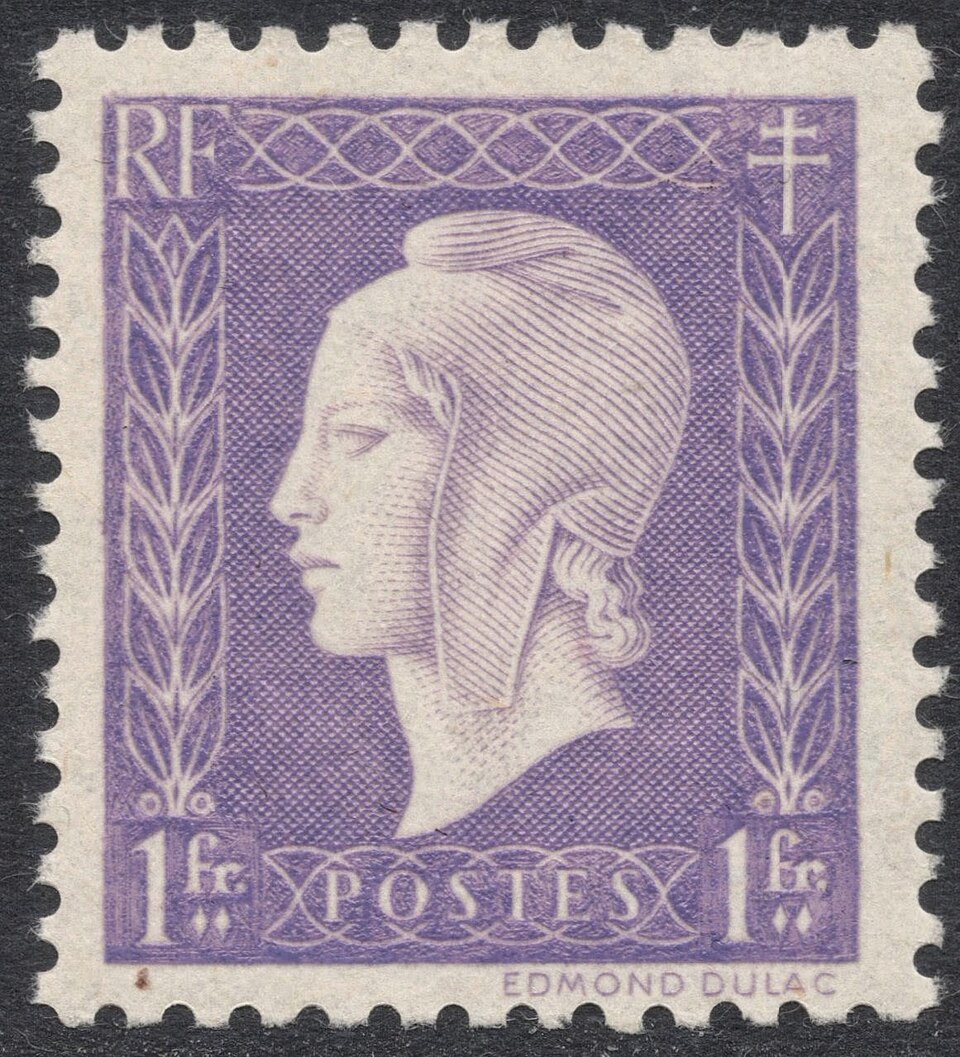
Dulac spent his last year arguing about a crown. When Elizabeth II came to the throne he was invited, with the country's leading stamp designers, to design stamps for her coronation. He was already the Post Office's man for royal heads: he had drawn the standard head of George VI and designed that king's 1937 coronation stamp.
First he was paid 100 guineas to draw the new Queen from a Dorothy Wilding photograph, swapping her tiara for a coronet. After rounds of retouching, the advisory panel chose the photograph over his drawing and asked him to retouch that instead. His own design showed her full face, holding orb and sceptre. He asked to keep the Imperial State Crown, since that is what she would actually be wearing at that moment of the ceremony. The panel ruled for St Edward's Crown instead, because it was the more beautiful.
The design became the 1s 3d value. The Queen approved it in December 1952, still not over-happy with his portrait of her; according to the Postal Museum's history, she cheered herself with the thought that at 1s 3d it would sell fewer copies than the lower values. Lord Crawford called it a failure. The stamps went on sale on 3 June 1953. Dulac had died in London nine days earlier.
Key works
- Stories from the Arabian Nights (1907) - Hodder & Stoughton, 50 colour plates
- The Tempest (1908) - Hodder & Stoughton
- The Rubaiyat of Omar Khayyam (1909) - Hodder & Stoughton
- Stories from Hans Christian Andersen (1911)
- King George VI Coronation stamp (1937) - Royal Mail
- Elizabeth II Coronation stamp, 1s 3d (1953) - Royal Mail
In museum collections
- Charles Ricketts and Charles Shannon as Medieval Saints (1920) (1920)
Art UK ↗ · Find a print ↗ - Elizabeth Allhusen (1922)
Art UK ↗ · Find a print ↗
See the work
Prints
Books
Originals
See also
Browse all 2,101 artists · Open in the directory · Where the work hangs: 4 museums on a map