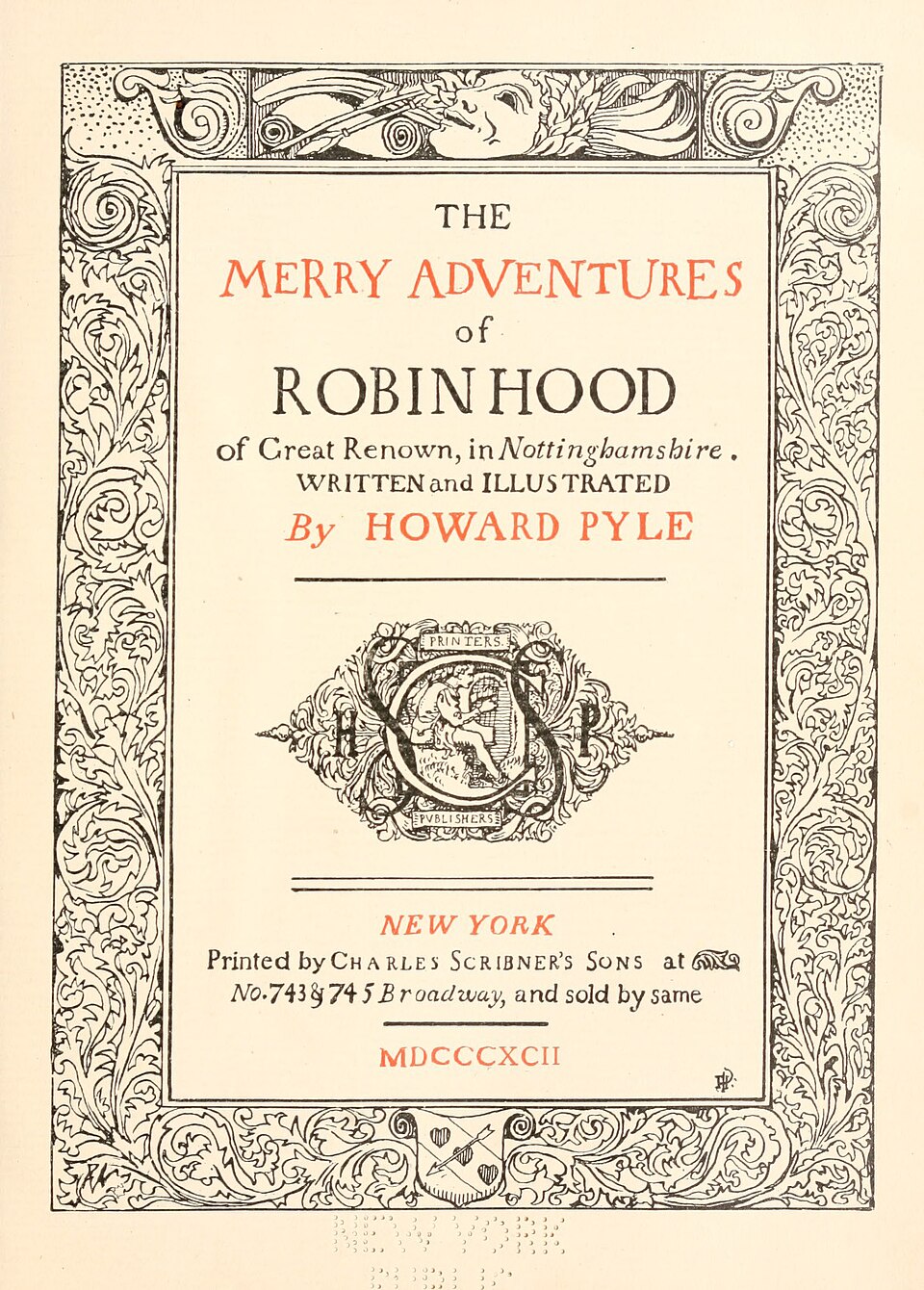
Howard Pyle
Who
American illustrator, author and teacher, born in Wilmington, Delaware, in 1853. He wrote and illustrated his own books of Robin Hood, King Arthur and pirates, drew for Harper's Magazine and St. Nicholas, and taught a generation of illustrators. He went to Italy in 1910 to study mural painting and died in Florence in November 1911.
Why they matter
He is the reason American illustration had a school at all. He taught at the Drexel Institute from 1894 to 1900 and then in his own classes in Wilmington, with summers at Chadds Ford, Pennsylvania, and his pupils included N. C. Wyeth, Jessie Willcox Smith, Maxfield Parrish, Violet Oakley, Harvey Dunn and Frank Schoonover; the group was later called the Brandywine School. And he invented the pirate as films still dress him.
What to buy
Paintings and drawings are not a realistic purchase: the core of his work was bought from his widow after his death and is in the Delaware Art Museum. What a collector can own is the work as it was published. His own books in first editions are the collectable tier, The Merry Adventures of Robin Hood of 1883 above all, then the four King Arthur volumes of 1903-1910. Much cheaper, and closer to how most people first saw his pictures, are period issues of Harper's Magazine carrying his illustrations: whole issues, not pages cut out of them. Later reprints of the books and modern posters of the pirate pictures are everywhere and fine to hang. The standard book is Howard Pyle: American Master Rediscovered, edited by Heather Campbell Coyle, the Delaware Art Museum's curator, and published with the 2011 exhibition. For reading, Dover keeps Robin Hood in print.
Notes
The Delaware Art Museum in Wilmington grew out of a society his students and friends formed to preserve his work, and works bought from his widow still form the core of its collection, including Marooned and The Mermaid. His Wilmington studio is on the National Register of Historic Places. Public domain.
Story
Almost nobody knew what a pirate of the 1700s had actually worn: few authentic outfits survived and hardly any drawings had been preserved. So Howard Pyle made it up. For the buccaneers in his stories and pictures he designed a flamboyant costume, borrowing freely from Romani dress, with no historical precedent behind it. The look stuck. It passed through his pictures into Hollywood and dressed screen pirates from Errol Flynn to Johnny Depp, though critics have pointed out that no working sailor could have done his job in it.
Pyle was not careless about realism; he was a stickler for it where he could get it. For The Flying Dutchman, painted in 1900, he had buckets of water thrown over the model to see how a man on the deck of a storm-tossed ship would really look. "I have always had a strong liking for pirates and highwaymen, for gunpowder smoke and for good hard blows," he admitted. He also never charged his students: the classes that produced N. C. Wyeth and a generation of American illustrators were tuition-free. His collected pirate pictures and stories, Howard Pyle's Book of Pirates, only appeared in 1921, ten years after his death.
Key works
- The Merry Adventures of Robin Hood (1883)
- The Story of King Arthur and His Knights (1903) - first of four Arthurian volumes, to 1910
- Marooned (1909) - Delaware Art Museum
- The Mermaid (1910) - Delaware Art Museum
- Howard Pyle's Book of Pirates (1921) - published after his death
In museum collections
- Avary Sells His Jewels: from “Buccaneers and Marooners of the Spanish Main” (1887)
Yale University Art Gallery ↗ · Find a print ↗
See the work
Prints
Books
Originals
See also
Browse all 2,101 artists · Open in the directory · Where the work hangs: 10 museums on a map