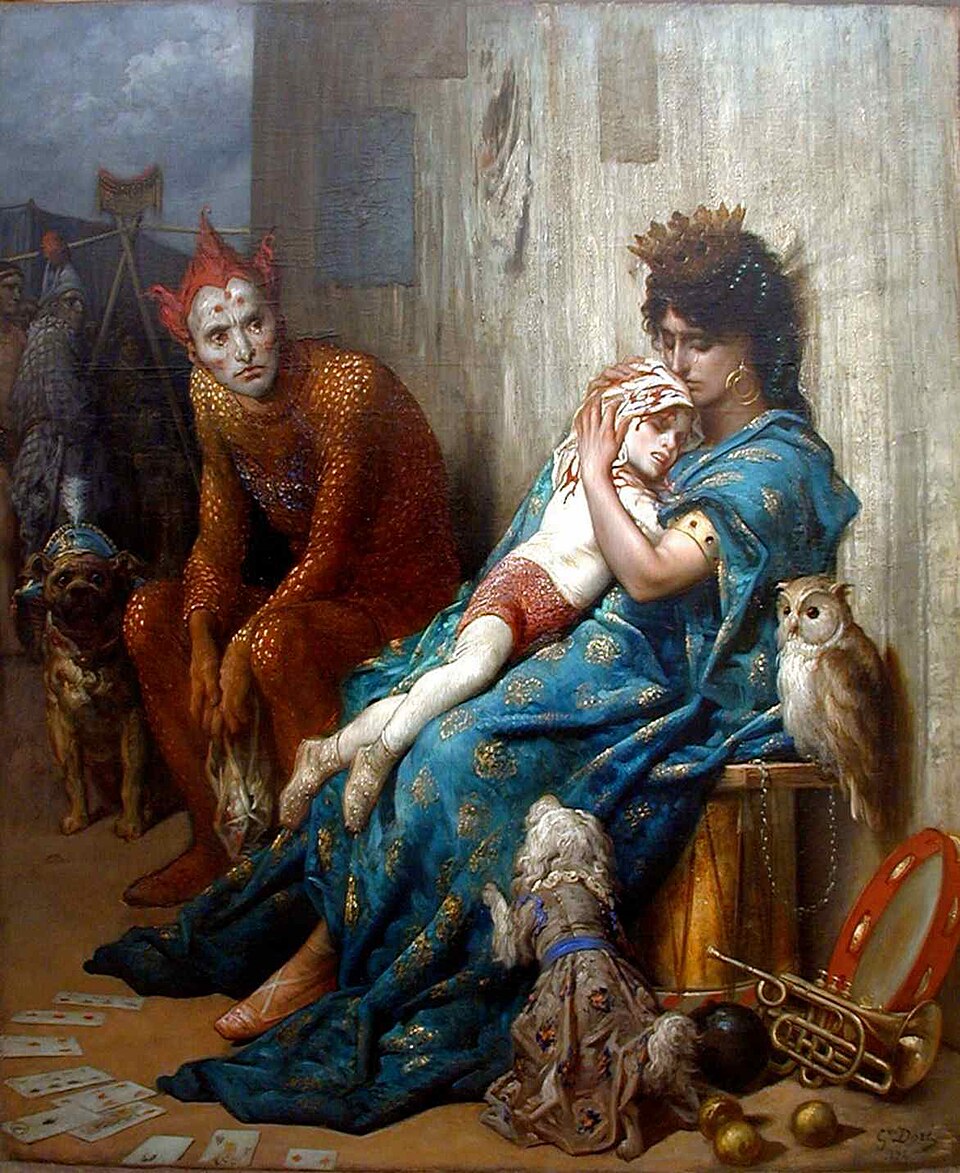
Gustave Doré
Who
Illustrator and painter, born in Strasbourg on 6 January 1832 and died in Paris on 23 January 1883. He began at fifteen as a caricaturist for Le Journal pour rire, and became the most famous book illustrator of his century with Dante's Inferno, Don Quixote (1863), the Bible (1866) and London: A Pilgrimage (1872).
Why they matter
He fixed how whole books look in the mind's eye. His Don Quixote shaped the way later readers, stage directors and film makers pictured the knight, and his Bible images were reproduced so widely, first by Cassell in Britain and then by pirate publishers, that they reached readers all over the world. At his peak some forty block-cutters were employed cutting his drawings into wood.
What to buy
Originals: Doré drew on the wood and craftsmen cut the blocks, which is why his engravings often carry two signatures, his and the engraver's (Héliodore Pisan, for one). So the genuine article is the engraving as printed in the period book, and that is well within reach: nineteenth-century editions of the Bible, the Dante, Don Quixote and London: A Pilgrimage, and single leaves taken from them, are common. The 1866 Bible was printed from metal stereotype plates mounted on wood, not from the cut blocks, and that is normal for the period, not a defect. What to avoid are the photomechanical reproductions in later cheap editions and posters: under a magnifier a real wood engraving shows solid, continuous lines, while a halftone breaks up into a regular pattern of dots. A leaf sold as "original" should come from a named edition with a date. Books: the Dover volumes (the Bible, the Dante, Don Quixote, Paradise Lost) reproduce the engravings full page and are the cheap way to have the whole sequence.
Notes
The Enigma (1871), painted after the Franco-Prussian War and the Commune, is in the Musée d'Orsay. Christ Leaving the Praetorium, over six metres by nine, is in a room devoted to Doré at the Museum of Modern and Contemporary Art in Strasbourg, his birthplace; a smaller version is in the Musée d'Arts de Nantes.
Story
Doré's engravings travelled further than he did, and in stranger forms. In February 1890, shut in the asylum at Saint-Rémy-de-Provence, Vincent van Gogh painted Prisoners' Round, a ring of convicts trudging round a walled yard. The picture came from Doré's engraving of the exercise yard at Newgate prison in London: A Pilgrimage, but Van Gogh never worked from the book. His source was a reproduction by the engraver Héliodore Pisan printed in a Dutch magazine, De Katholieke Illustratie. The painting is now in the Pushkin Museum in Moscow. Doré's own paintings had the opposite fate. A London gallery at 35 New Bond Street was given over entirely to them, and there his largest canvas, Christ Leaving the Praetorium, six metres high and more than nine wide, went on show in May 1872. After his death it toured the United States, opening at Carnegie Hall in New York in 1892 and ending in Chicago in 1896. Then it was put into storage and forgotten. The city of his birth, Strasbourg, bought it in 1988, restored it in public view from 1998 to 2003, and hung it in a room of its own, more than a century after the prints had made him famous everywhere.
Key works
- Illustrations for Dante's Inferno
- Don Quixote (1863)
- La Grande Bible de Tours (241 wood engravings) (1866) - Mame, Tours, and Cassell, London
- The Enigma (1871) - Musee d'Orsay, Paris
- London: A Pilgrimage (with Blanchard Jerrold) (1872)
- Christ Leaving the Praetorium (1867-1872) - Musee d'art moderne et contemporain, Strasbourg
In museum collections
- Enigma (1871)
Musee d'Orsay ↗ · Find a print ↗ - La Parque et l'Amour (1877)
Musee d'Orsay ↗ · Find a print ↗ - The Angel of Tobias (1865)
Musee d'Orsay ↗ · Find a print ↗ - After the Shipwreck - Design for an Illustration of Coleridge's The Rime of the Ancient Mariner
Getty ↗ · Find a print ↗ - "'Alas!' answered Sancho, 'I found him in his shirt, lean, pale, and almost starved, sighing for his Lady Dulcinea'" from Don Quixote
Indianapolis Museum of Art ↗ · Find a print ↗ - "He spied upon the top of a stony crag just before him a man that skipped from rock to rock with wonderful agility." from Don Quixote
Indianapolis Museum of Art ↗ · Find a print ↗ - A Poor-House (1869)
Art UK ↗ · Find a print ↗ - Alpine Scene (1865)
Art Institute of Chicago ↗ · Find a print ↗ - Aurore. Souvenir des Alpes (1877)
Art UK ↗ · Find a print ↗ - Christ Leaving the Praetorium
Art UK ↗ · Find a print ↗ - Coin de cellier
Art UK ↗ · Find a print ↗ - Don Quixote and Sancho Panza Entertained by Basil and Quiteria (1863)
The Met ↗ · Find a print ↗
See the work
Prints
Books
Originals
See also
Browse all 2,101 artists · Open in the directory · Where the work hangs: 83 museums on a map