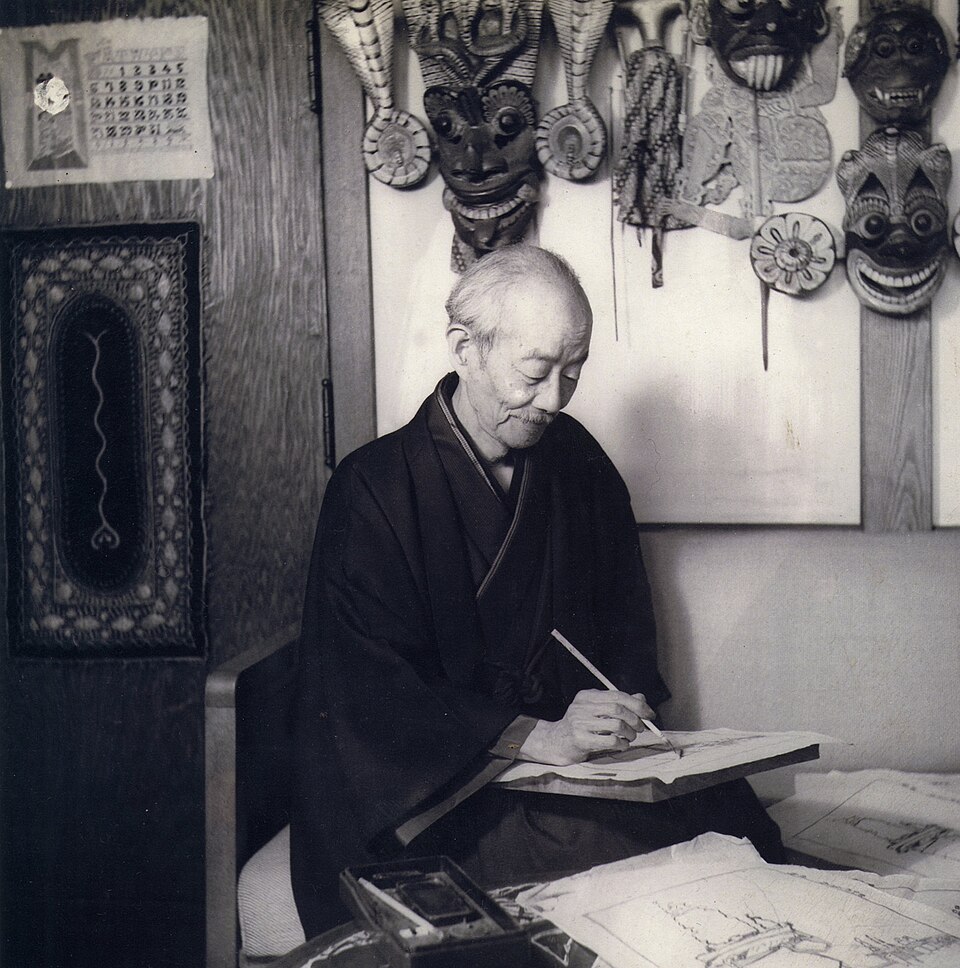
Hiroshi Yoshida
Who
Japanese painter and printmaker, the leading landscape artist of shin-hanga, the twentieth-century revival of the woodblock print. A trained Western-style oil painter who toured the United States selling watercolours before turning to prints in his forties.
Why they matter
He mastered the entire process - drawing, carving and printing - so he could supervise impressions requiring up to a hundred separate printings, and he brought Western light and atmosphere to a Japanese medium. His views of the Alps, the Grand Canyon and the Taj Mahal are the first great Japanese prints of foreign places.
What to buy
Originals: Yoshida is the best value in serious Japanese prints. Lifetime impressions carry a "jizuri" (self-printed) seal in the margin and his pencil signature; prints made by the family studio after his death from the same blocks are still hand-printed, still genuine, and cheaper. The two are often confused on eBay in both directions. Fuji Arts and Scholten are reliable; expect a few hundred dollars for a posthumous print and low thousands for a good jizuri impression of a famous design.
Notes
His sons Toshi and Hodaka and grandson Ayomi are printmakers too, and the family studio in Tokyo is still active.
Key works
- Kumoi Cherry Trees (1926)
- Sailing Boats series (1926) - the same block printed in six colourways for different times of day
- Fujiyama from Okitsu (1928)
- The Taj Mahal series (1931-1932)
In museum collections
- Harbor View
Minneapolis Institute of Art ↗ · Find a print ↗ - Road with Ox Cart and Coolies
Harvard Art Museums ↗ · Find a print ↗ - Sailboats on the Inland Sea
Minneapolis Institute of Art ↗ · Find a print ↗