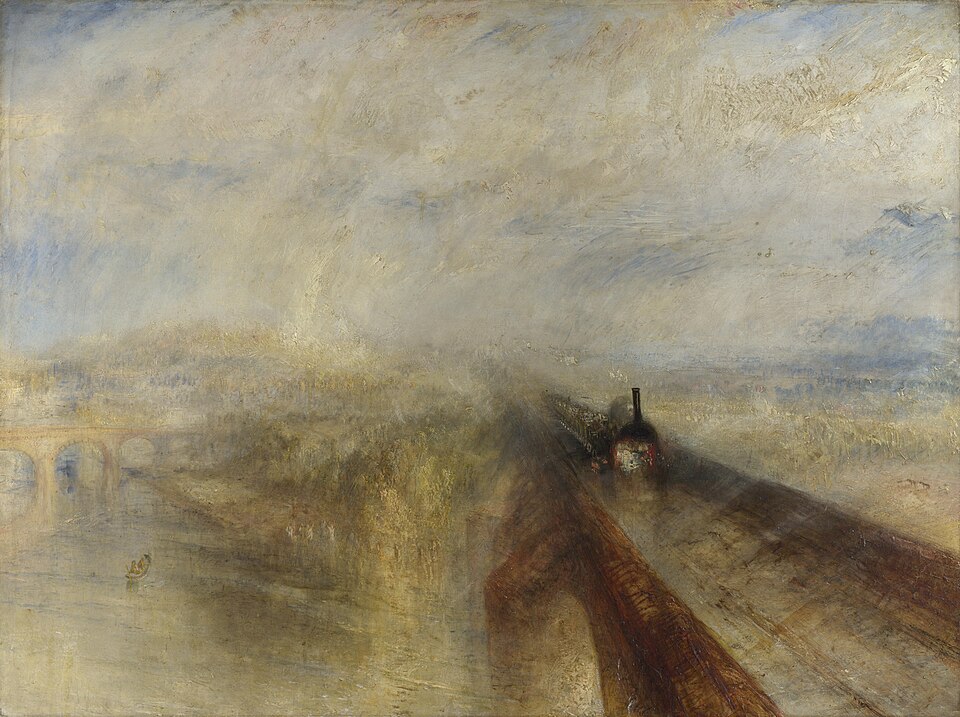
J. M. W. Turner
Who
Joseph Mallord William Turner, born in Maiden Lane, Covent Garden, on 23 April 1775 and dead in London on 19 December 1851. A landscape painter in oil and watercolour who also ran his own print publication, the Liber Studiorum, and designed subjects for the engravers of illustrated books.
Why they matter
He turned landscape into weather, light and speed: a steam train coming at you through rain, a snowstorm swallowing an army, a warship towed to the breakers under a burning sky. The late pictures dissolve almost into colour, and he did it while insisting, through the Liber Studiorum, that landscape deserved the prestige of history painting. Constable, a year younger, was the other half of English Romantic landscape.
What to buy
Prints: the National Gallery in London sells The Fighting Temeraire made to order, on art paper or stretched canvas, in the size and frame you choose, and Tate, which holds the Turner Bequest, sells a long list of Turner prints through its shop. Buy from the museum that owns the picture; a late Turner is mostly colour and haze, and a poor reproduction loses exactly that.
Books: the standard catalogue of the oils is Martin Butlin and Evelyn Joll's The Paintings of J.M.W. Turner (Yale, 1977, revised 1984), now a secondhand book. For the prints, W.G. Rawlinson's The Engraved Work of J.M.W. Turner (1908-13) and A.J. Finberg's Liber Studiorum catalogue (1924) are the references dealers cite. For a readable life, the Turner Society lists James Hamilton's Turner: A Life (new edition 2025).
Originals: the paintings and watercolours are auction-house and museum territory. Turner is still collectable, though, because so much of his work was issued as prints. The Liber Studiorum, published 1807-1819 as 71 plates in 14 parts, is etching with mezzotint printed in warm brown ink; Turner etched plates himself and professional engravers such as Charles Turner did the mezzotint. Its prints are sold by Rawlinson number and state, and early states are what collectors pay for, so check both against the catalogue. Beware Frank Short: in the late nineteenth century he made his own mezzotints after the Liber and printed unpublished plates, fine prints in their own right but not Turner's issue. The cheapest honest way in is a line engraving on steel after a Turner design, from Samuel Rogers's Italy (1830) or Picturesque Views in England and Wales (1827-38). These are the engraver's work after Turner, and a proper listing names the engraver, such as Robert Wallis.
Notes
Turner left the nation about 100 finished oil paintings, 200 unfinished canvases, over 19,000 sketches, drawings and watercolours and some 200 sketchbooks. Most is at Tate Britain, whose Clore Gallery opened for the bequest in 1987; the works on paper can be seen by appointment in Tate's Prints and Drawings Rooms. The National Gallery keeps The Fighting Temeraire and Rain, Steam and Speed. In his seventies he lived part of the time under the name Mr Booth, or Admiral Booth.
Story
The painting Britain voted its favourite shows a warship on her way to be scrapped, and hardly a detail of it is true. HMS Temeraire, a 98-gun ship of the line, had defended Nelson's flagship at Trafalgar in 1805. In 1838 she was towed up the Thames to Rotherhithe, where the ship-breaker John Beatson took her apart. Turner painted the scene that year and showed it at the Royal Academy in 1839. He put back her masts and rigging, which had been removed before the tow; he gave her one tug where there were two, and changed the tug's design; and his sun, as the National Gallery puts it, is setting in the wrong direction, which started a lively debate in The Times. Thackeray, reviewing for Fraser's Magazine, dropped his usual tone to call it as grand a picture as ever figured on the walls of any academy. Turner called it his darling. He refused offers for it, one of them a blank cheque around 1848, and kept it to leave to the nation; it entered the National Gallery with the Turner Bequest in 1856. In 2005 listeners to BBC Radio 4's Today programme voted it Britain's favourite painting, and since February 2020 it has been on the Bank of England's banknote, next to his self-portrait.
Key works
- Fishermen at Sea (1796) - Tate Britain, London
- Snow Storm: Hannibal and his Army Crossing the Alps (1812) - Tate Britain, London
- The Fighting Temeraire (1839) - National Gallery, London
- The Slave Ship (1840) - Museum of Fine Arts, Boston
- Rain, Steam and Speed - The Great Western Railway (1844) - National Gallery, London
- Liber Studiorum (1807-1819) - 71 etchings with mezzotint, issued in 14 parts
In museum collections
- Rain, Steam and Speed – The Great Western Railway (1843)
Art UK ↗ · Find a print ↗ - The Fighting Temeraire (1839)
Art UK ↗ · Find a print ↗ - Dido building Carthage (1815)
Art UK ↗ · Find a print ↗ - The Slave Ship (1840)
MFA Boston ↗ · Find a print ↗ - The Battle of Trafalgar (1823)
Art UK ↗ · Find a print ↗ - Dolbadarn Castle (1800)
Art UK ↗ · Find a print ↗ - Fishermen at Sea (1796)
Art UK ↗ · Find a print ↗ - Snow Storm: Hannibal and his Army Crossing the Alps (1812)
Art UK ↗ · Find a print ↗ - Snow Storm: Steam-Boat off a Harbour's Mouth (1842)
Art UK ↗ · Find a print ↗ - Sunrise with Sea Monsters (1845)
Art UK ↗ · Find a print ↗ - Ulysses deriding Polyphemus (1829)
Art UK ↗ · Find a print ↗ - The Golden Bough (1834)
Art UK ↗ · Find a print ↗
See the work
Prints
Books
Originals
See also
Browse all 2,101 artists · Open in the directory · Where the work hangs: 100 museums on a map