John Constable
Who
Born at East Bergholt in Suffolk on 11 June 1776 and dead in London on 31 March 1837. A landscape painter of the Stour valley where he grew up, of Hampstead, Salisbury and the sky. He married Maria Bicknell in 1816 and was elected to the Royal Academy only in February 1829, at 52.
Why they matter
He painted the English countryside as it looks and works - a mill, a lock, a hay cart in a river - at the scale of history painting, in the six great canvases of the Stour he painted between 1819 and 1825. His open-air oil sketches of light and weather, with notes on the backs recording the conditions and time of day, were as radical as the finished pictures. The French understood it first: The Hay Wain won a gold medal in Paris in 1824 and inspired a generation of French painters, Delacroix among them.
What to buy
Prints: the National Gallery in London sells The Hay Wain made to order, on art paper or stretched canvas, in the size and frame you choose. A reproduction from the museum that owns the painting is the one to trust over an anonymous poster.
Books: the standard work is Graham Reynolds's catalogue raisonne for the Paul Mellon Centre and Yale University Press, in two parts divided at 1816, the year of his marriage: The Early Paintings and Drawings of John Constable (1996) and The Later Paintings and Drawings of John Constable (1984). Reynolds's much shorter Constable: The Natural Painter (1965) is the lighter way in.
Originals: the paintings and oil sketches are for museums and major auctions. The genuine period tier is English Landscape, the mezzotints David Lucas made after his pictures: twenty-two plates published in parts from June 1830 to July 1832, with Constable returning proofs to Lucas with instructions and sometimes drawing on them. It sold badly - Constable called it a total failure - and it was reissued: a revised second edition in 1833, and in 1855 the publisher Henry Bohn brought the plates out again, adding plates engraved after Constable's death. That is the thing to check. The 1830-32 sheets are large and in landscape format; the Bohn edition is smaller and in portrait format. A Lucas mezzotint is Lucas's work after Constable, and a good listing says which edition it comes from.
Notes
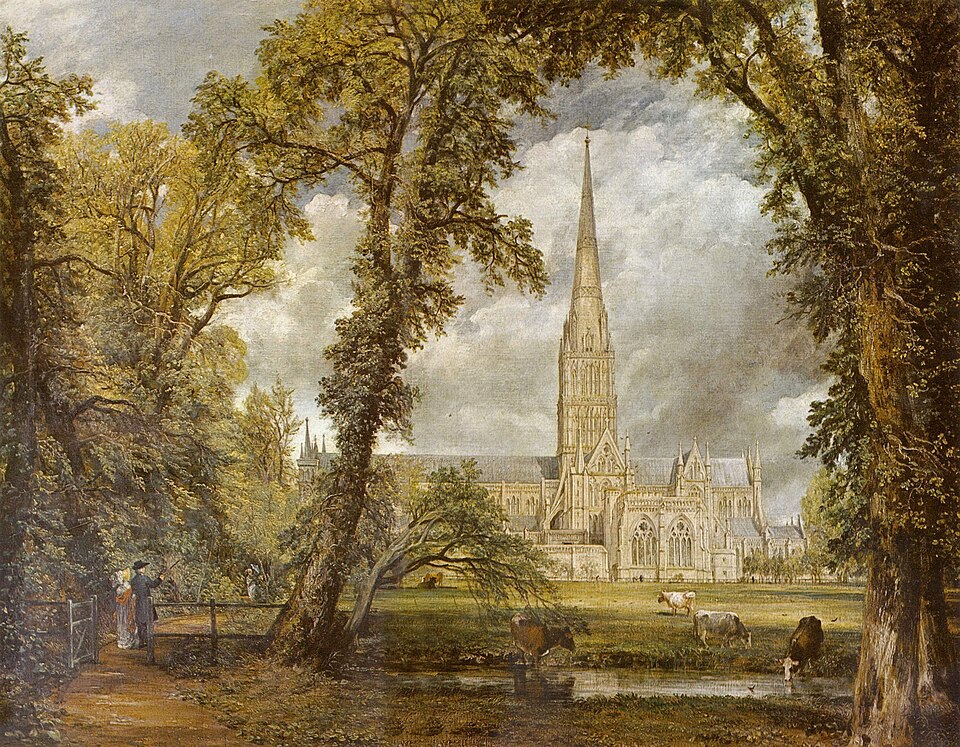
The V&A holds what was left in his studio: in 1888 his daughter Isabel gave the family's remaining studio contents, three easel paintings, 92 oil sketches, 297 drawings and watercolours and three sketchbooks. He painted some sketches on both sides, and V&A conservators have found an unrecorded oil sketch on the back of Branch Hill Pond: Hampstead after taking off a loose lining canvas. There are two Salisbury Cathedral from the Bishop's Grounds: 1823 at the V&A and 1825 at the Frick Collection in New York.
Story
Britain's second-favourite painting could not find a buyer in Britain. Constable showed it at the Royal Academy in 1821 as Landscape: Noon, one of his six-foot canvases of the River Stour, and it failed to sell. The French painter Theodore Gericault saw it there and went home, in the National Gallery's words, quite stunned. The picture reached the Paris Salon of 1824 through the dealer John Arrowsmith, and there it caused a sensation: Charles X awarded Constable a gold medal, and Stendhal wrote that we have never seen anything like these pictures before. In his lifetime Constable sold only twenty paintings in England; in France he sold more than twenty in a few years. The house on the left belonged to Willy Lott, a tenant farmer said to have been born in it and never to have left it for more than four days in his life. The wagon stands in the river for a practical reason: to let the horses drink and cool down, and to soak the wooden wheels so they swell and their iron tyres stay tight. The collector Henry Vaughan gave the painting to the National Gallery in 1886, and in a 2005 poll it came second in Britain only to Turner's The Fighting Temeraire.
Key works
- Flatford Mill (1816) - Tate Britain, London
- Wivenhoe Park, Essex (1816) - National Gallery of Art, Washington
- Dedham Lock and Mill (1820) - V&A, London
- The Hay Wain (1821) - National Gallery, London
- Salisbury Cathedral from the Bishop's Grounds (1823) - V&A, London
- Salisbury Cathedral from the Meadows (1831) - Tate Britain, London
In museum collections
- The Hay Wain (1821)
Art UK ↗ · Find a print ↗ - Salisbury Cathedral from the Bishop's Grounds (1823)
Art UK ↗ · V&A ↗ · Find a print ↗ - The Cornfield (1826)
Art UK ↗ · Indianapolis Museum of Art ↗ · Find a print ↗ - Salisbury Cathedral from the Meadows (1829)
Art UK ↗ · Find a print ↗ - Wivenhoe Park (1816)
National Gallery of Art ↗ · Find a print ↗ - Flatford Mill (1810)
Art UK ↗ · Find a print ↗ - The Vale of Dedham (1828)
Art UK ↗ · Find a print ↗ - Boat-building near Flatford Mill (1815)
Art UK ↗ · V&A ↗ · Find a print ↗ - Weymouth Bay: Bowleaze Cove and Jordon Hill (1816)
Art UK ↗ · Find a print ↗ - Dedham Lock and Mill (1816)
Art UK ↗ · V&A ↗ · Find a print ↗ - Hadleigh Castle, The Mouth of the Thames--Morning after a Stormy Night (1829)
Art UK ↗ · Find a print ↗ - Dedham Vale (1802)
Art UK ↗ · Find a print ↗
See the work
Prints
Books
Originals
See also
Browse all 2,101 artists · Open in the directory · Where the work hangs: 109 museums on a map