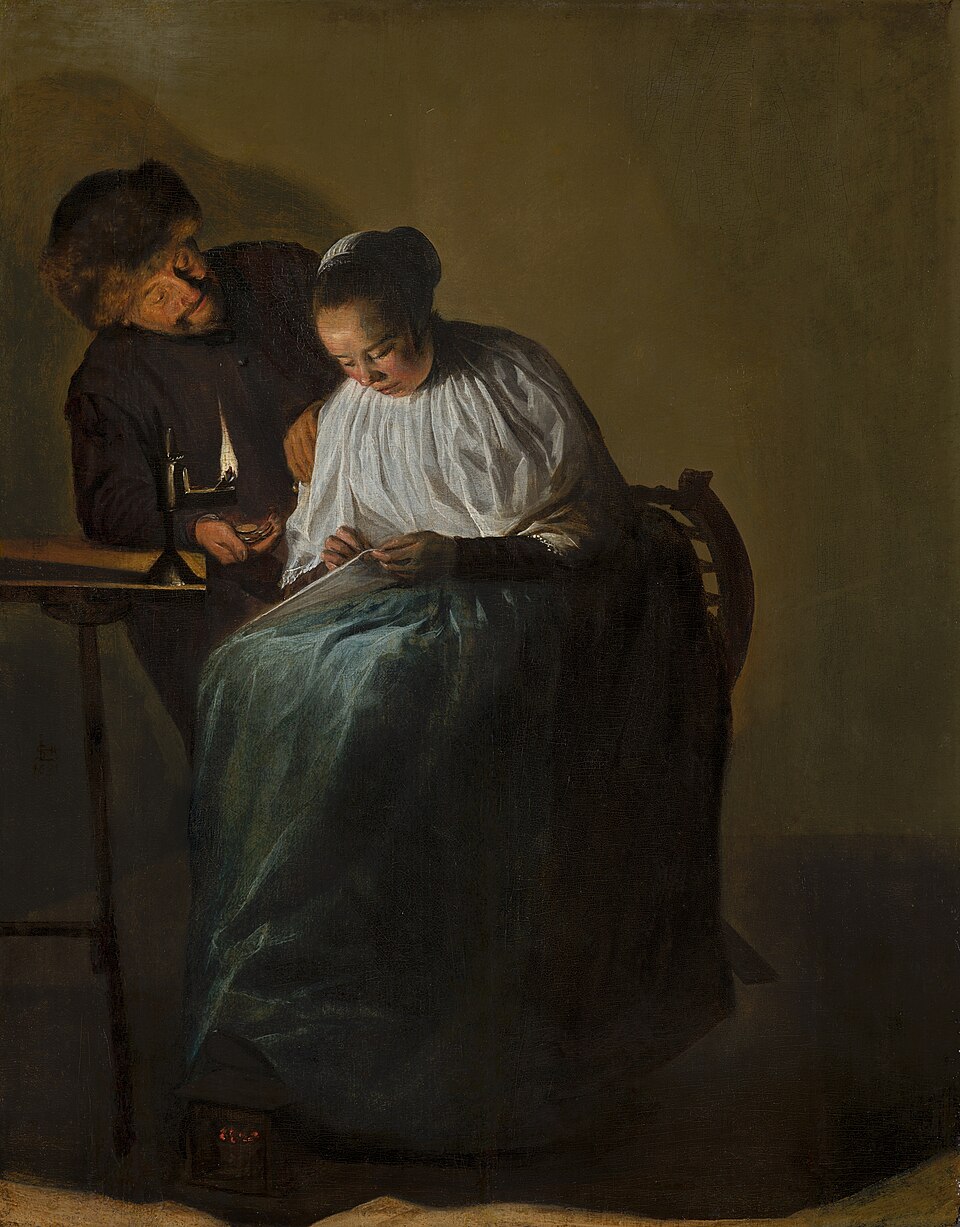
Judith Leyster
Who
Baptised in Haarlem on 28 July 1609, she was a member of the city's Guild of St Luke by 1633 and within two years had taken on three male apprentices. She painted genre scenes of drinkers, musicians and children, most of them between about 1629 and 1635. In 1636 she married the painter Jan Miense Molenaer; she painted little afterwards, and died in Heemstede on 10 February 1660.
Why they matter
She was, in the Rijksmuseum's words, Haarlem's only female master painter, working in Hals's own town and years, and her best pictures were good enough to pass as his for two centuries. The Serenade, a lutenist seen from below and lit from a hidden source, shows she was not copying him but solving her own problems. In 2021 the Rijksmuseum hung her, Gesina ter Borch and Rachel Ruysch in its Gallery of Honour, the first women there in its 200-year history.
What to buy
Prints: no museum shop prints her to order yet, so the best print is one you make yourself. The Rijksmuseum, which owns The Serenade and The Jolly Drinker, publishes its own photography of both as free public-domain downloads, at a size any good print shop can work from; that beats a poster-factory copy of an unknown scan. Books: Judith Leyster: A Dutch Master and Her World (1993), edited by James A. Welu and Pieter Biesboer for the exhibition at the Frans Hals Museum in Haarlem and the Worcester Art Museum, published by Waanders with a Yale University Press edition, is the standard book; look for it secondhand. Originals: not realistic. Her known work is small and almost all in museums, and paintings once sold as Hals and later found to be hers are the reason any "Leyster" needs a specialist's opinion.
Notes
She signed with a monogram of her initials entwined with a star, a play on her name, "lode star". In 1635 she went to the guild because a pupil, Willem Woutersz, had left her after a few days for Frans Hals's workshop; the boy's mother paid her four guilders in damages, Hals paid a three-guilder fine rather than give him back, and Leyster was fined for never registering the pupil. The Proposition is in the Mauritshuis; the self-portrait in Washington may have been her presentation piece to the guild. The Rijksmuseum bought The Jolly Drinker in 1897 and The Serenade in 1908.
Story
In 1893 the Louvre acquired a merry company scene signed by Frans Hals. When its restorers worked on the signature, they found it was a forgery. Under it were two letters, J and L, and a star: the monogram of a painter almost nobody had heard of.
Judith Leyster had been a working master in Haarlem in the 1630s, the same town and the same years as Hals, but after her death she was forgotten, and her pictures were sold under his far more valuable name. Her Jolly Companions passed through dealers to a buyer named Thomas Lawrie as a Hals; when her signature was found he sued the English firm that sold it to him, and the case was settled on 31 May 1893. Sometimes a dealer did more than misattribute: another version of the picture, sold in Brussels in 1890, had her monogram crudely altered into an interlocking FH.
That same year the Dutch scholar Cornelis Hofstede de Groot published the first article on her, attributing seven paintings, six of them carrying the star. The Rijksmuseum's Jolly Drinker, long given to Hals, turned out to bear the monogram too, above the jug. Wilhelm von Bode had seen the J on The Serenade back in 1883 and given it to Jan Hals. Once people knew what to look for, the star kept turning up.
Key works
- The Jolly Drinker (1629) - Rijksmuseum, Amsterdam
- The Serenade (1629) - Rijksmuseum, Amsterdam
- The Proposition (1631) - Mauritshuis, The Hague
- Self-Portrait (c. 1633) - National Gallery of Art, Washington
- A Boy and a Girl with a Cat and an Eel (c. 1635) - National Gallery, London
In museum collections
- Self-portrait by Judith Leyster (1630)
National Gallery of Art ↗ · Find a print ↗ - The Jolly Toper (1629)
Rijksmuseum ↗ · Find a print ↗ - The Serenade (1629)
Rijksmuseum ↗ · Find a print ↗ - A boy and a girl with a cat and an eel (1635)
Art UK ↗ · Find a print ↗ - The Last Drop (1639)
Philadelphia Museum of Art ↗ · Find a print ↗ - Carousing Couple (1630)
Louvre ↗ · Find a print ↗ - Boy with a Lute (1626)
The Met ↗ · Find a print ↗ - Boy playing the Flute (1635)
Nationalmuseum Sweden ↗ · Find a print ↗ - Young Boy in Profile (1630)
National Gallery of Art ↗ · Find a print ↗ - Rommelpot player (1630)
Art Institute of Chicago ↗ · Find a print ↗ - Round portrait of a boy with beret (1632)
Nationalmuseum Sweden ↗ · Find a print ↗ - The lute player (1620)
Rijksmuseum ↗ · Find a print ↗
See the work
Prints
Books
See also
Browse all 2,101 artists · Open in the directory · Where the work hangs: 24 museums on a map