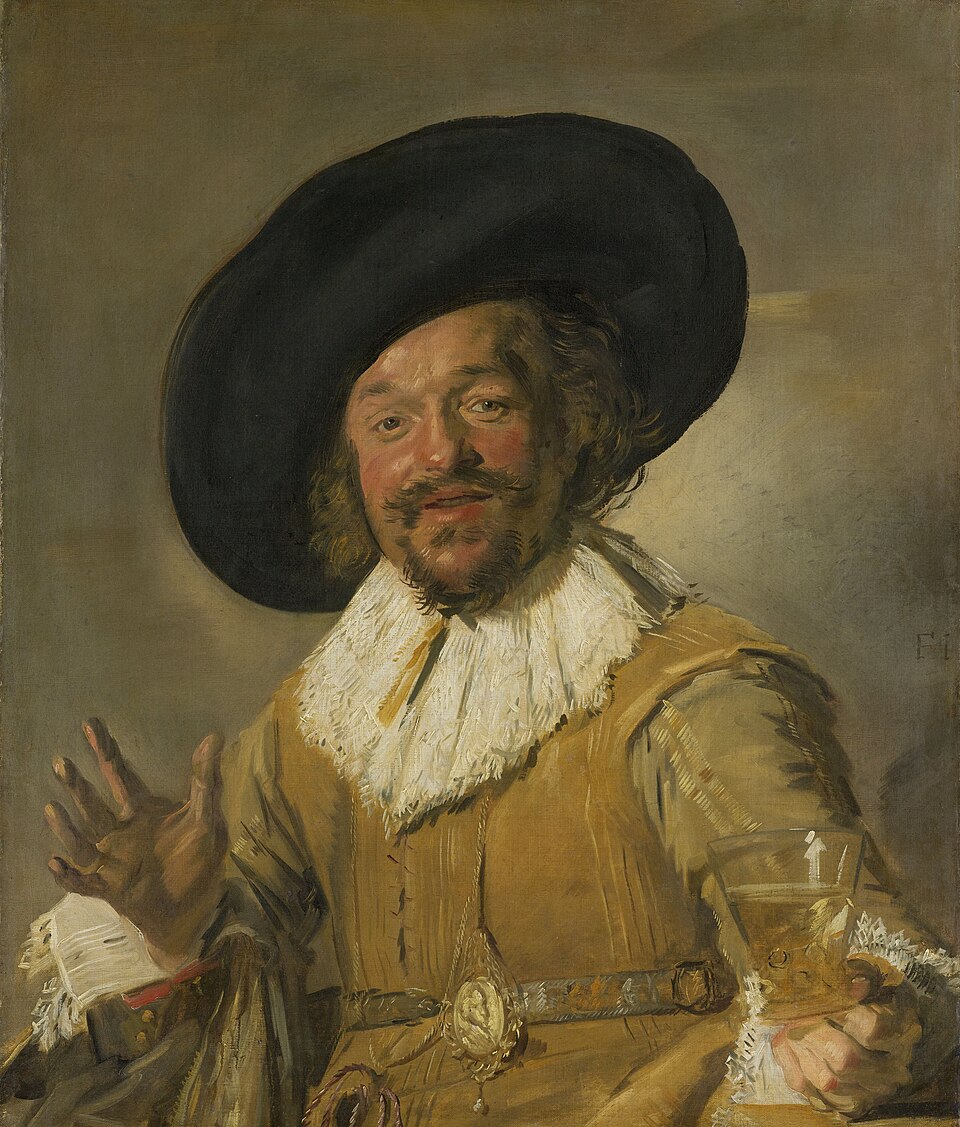
Frans Hals
Who
Born in Antwerp around 1582 or 1583; his parents fled the city during the Fall of Antwerp in 1584-85, and the family settled in Haarlem, where he worked for the rest of his life. He painted portraits of individuals, couples and civic guard companies. He died in Haarlem on 26 August 1666 and is buried in the Grote Kerk there.
Why they matter
He made paint look fast. His brushstrokes criss-cross the canvas and leave the sitter caught mid-gesture, about to raise a glass to a toast, and he changed what a portrait could feel like: alive rather than posed. That loose, visible handling is what made his name again from the 1860s, when the critic Théophile Thoré-Bürger championed him, and what the Impressionists, Manet among them, took from him.
What to buy
Prints: the National Gallery in London prints its Young Man holding a Skull to order, on art paper or stretched canvas, framed or not, from its own collection; his broken brushwork needs a good, large print, so this beats a poster of the Laughing Cavalier. The Rijksmuseum in Amsterdam, which shows The Merry Drinker and The Meagre Company, is the other house to watch. Books: the catalogue of the 2023-24 exhibition shared by the National Gallery and the Rijksmuseum, Frans Hals by Bart Cornelis, Friso Lammertse, Justine Rinnooy Kan and Jaap van der Veen (224 pages, in English and Dutch), is the current standard introduction; both museums sell it. Originals: not realistic. The important paintings are in museums, and attributions to him and his circle are a field for specialists.
Notes
The Frans Hals Museum in Haarlem holds several of his most important works, which used to hang in the city hall. The Laughing Cavalier is in the Wallace Collection in London, Malle Babbe in Berlin, and Willem van Heythuysen in the Alte Pinakothek in Munich. Late in life he was poor: creditors took him to court, in 1652 he sold his belongings to settle a debt with a baker, and in 1664 the town of Haarlem gave him an annuity of 200 florins. He was one of only two artists from outside Amsterdam commissioned to paint one of its civic guard companies in the 17th century, but he refused to keep travelling there to finish it, and the Amsterdam painter Pieter Codde completed The Meagre Company in 1637.
Story
The most famous portrait in the Wallace Collection is neither laughing nor a cavalier. Frans Hals painted the man in 1624 and inscribed on the canvas that he was 26; who he was is still unknown, though one scholar has proposed the cloth merchant Tieleman Roosterman. The nickname is Victorian, and the painting has never been renamed.
Before 1865, the Wallace Collection says, Hals had been lost to obscurity. That year, at the famous Pourtalès-Gorgier sale in Paris, the 4th Marquess of Hertford outbid Baron James de Rothschild and paid 51,000 francs for the picture, more than six times the estimate. The publicity, in the Wallace Collection's own words, led to the immediate fame of the painting and of Hals, causing prices of his works to soar.
The picture then stayed put. The Wallace Collection has only been allowed to lend since 2019, after a reinterpretation of Lady Wallace's bequest and an Order from the Charity Commission. In autumn 2023 it lent The Laughing Cavalier for the first time since 1888, to the Frans Hals exhibition at the National Gallery in London and then to the Rijksmuseum in Amsterdam. Its director said he looked forward to seeing the sitter "in his homeland of Holland".
Key works
- The Laughing Cavalier (1624) - Wallace Collection, London
- Young Man holding a Skull (Vanitas) (1626-8) - National Gallery, London
- The Merry Drinker (c. 1628-30) - Rijksmuseum, Amsterdam
- Militia Company of District XI under Captain Reynier Reael (The Meagre Company), with Pieter Codde (1637) - Rijksmuseum, Amsterdam (lent by the City of Amsterdam)
In museum collections
- A Militiaman Holding a Berkemeyer, Known as the ‘Merry Drinker’ (1629)
Rijksmuseum ↗ · Find a print ↗ - Laughing Cavalier (1624)
Art UK ↗ · Find a print ↗ - Gipsy Girl (1626)
Louvre ↗ · Find a print ↗ - Portrait of a young man with a skull (1626)
Art UK ↗ · Find a print ↗ - Portrait of a Couple probably Isaac Massa and Beatrix van der Laen (1622)
Rijksmuseum ↗ · Find a print ↗ - Militia Company of District XI under the Command of Captain Reynier Reael (1633)
Rijksmuseum ↗ · Find a print ↗ - Jester with lute (1623)
Louvre ↗ · Find a print ↗ - Merrymakers at Shrovetide (1610)
The Met ↗ · Find a print ↗ - Portrait of Claes Duyst van Voorhout (1638)
The Met ↗ · Find a print ↗ - Young Man and Woman in an Inn (1623)
The Met ↗ · Find a print ↗ - Boy with a Lute (1626)
The Met ↗ · Find a print ↗ - Portrait of Feyntje van Steenkiste (1635)
Rijksmuseum ↗ · Find a print ↗
See the work
Prints
Books
See also
Browse all 2,101 artists · Open in the directory · Where the work hangs: 122 museums on a map