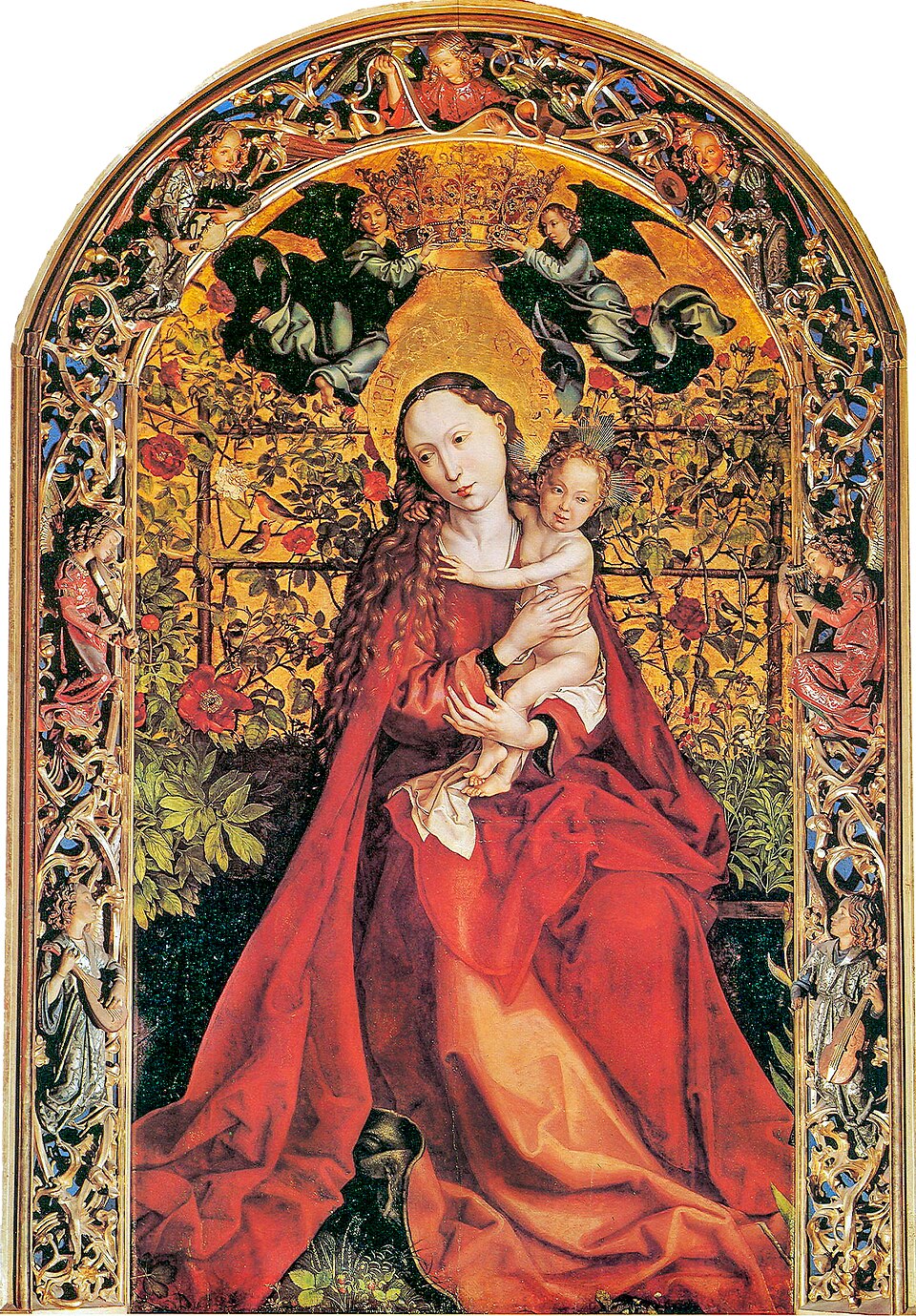
Martin Schongauer
Who
Painter and engraver of Colmar in Alsace, born there in the 1440s or early 1450s (sources disagree) and dead at Breisach on 2 February 1491. His father Caspar was a goldsmith from Augsburg. From 1488 until his death he was painting a huge Last Judgment in the church at Breisach, left unfinished.
Why they matter
He was the most important German artist before Dürer. His 116 engravings, all signed with the monogram M+S and none dated, joined the naturalism of the early Netherlandish painters to the clarity of copperplate engraving. They were copied across Europe: Israhel van Meckenem made close copies of 58 of them, exactly half. The boy Michelangelo copied one, and Dürer set out to meet him.
What to buy
Originals: realistically, only for serious collectors. Genuine fifteenth-century impressions are rare, most are in museums, and the few that come to market go through the major old-master print auctions and specialist dealers, at the top tier of the market. Two kinds of "Schongauer" catch buyers. The first are period copies: Israhel van Meckenem copied half of Schongauer's engravings in his own lifetime, and a copy is a genuine old print but not a Schongauer. The second are the photomechanical facsimiles made from about 1870 by the French engraver Amand Durand. They are accurate and are often sold as originals. A red Amand Durand stamp on the back gives one away, but stamps can be hidden or removed, so ask for the Lehrs number and a provenance before buying anything offered as period. An Amand Durand is a fine and affordable thing to hang, as long as it is sold as what it is. Prints: the Met, Cleveland and other museums publish his engravings online, and the Temptation of Saint Anthony and Christ Carrying the Cross make the strongest wall prints. Books: the standard catalogue of his engravings is by Max Lehrs, whose numbers museums still cite; look second-hand for exhibition catalogues of his prints.
Notes
The Madonna of the Rose Bower (1473), his best-known painting, hung first in St Martin's Church in Colmar and is now in the Dominican church there. The Musée Unterlinden in Colmar holds his work. The Temptation of Saint Anthony exists in two states, the second adding only minor details; impressions are also at the Met, the Art Institute of Chicago and the British Museum.
Story
Two of the great artists of the next generation sought Schongauer out, and neither met him. In Florence around 1487-88, a boy of twelve or thirteen named Michelangelo painted a copy of Schongauer's engraving The Temptation of Saint Anthony, in which demons swarm around a calm hermit. Giorgio Vasari tells the story, and the early accounts add that the boy went to a market to draw fish scales for the demons, a detail the engraving does not have. A panel matching the story, long given to the workshop of Domenico Ghirlandaio, was sold at Sotheby's in London in 2008. After cleaning and study at the Metropolitan Museum it was bought in 2009 by the Kimbell Art Museum in Fort Worth as Michelangelo's earliest surviving painting, though its authorship is still disputed. Meanwhile Albrecht Dürer set out on his journeyman years in 1490, possibly meaning to work under Schongauer. He reached Colmar in 1492 to find that the master had died in February 1491. Schongauer's brothers, the goldsmiths Caspar and Paul and the painter Ludwig, took him in, and he went on to Basel to stay with another brother, the goldsmith Georg.
Key works
- The Temptation of Saint Anthony (engraving) (c. 1470-1475) - Musée Unterlinden, Colmar
- Madonna of the Rose Bower (1473) - Dominican Church, Colmar
- Christ Carrying the Cross (engraving) (1475-1490) - Cleveland Museum of Art
- Last Judgment (mural, unfinished) (begun 1488) - Breisach
In museum collections
- Saint Anthony Tormented by Demons (1470)
The Met ↗ · Art Institute of Chicago ↗ · Find a print ↗ - The Holy Family (1485)
Kunsthistorisches Museum ↗ · Find a print ↗ - Madonna and Child in a Window (1487)
Getty ↗ · Find a print ↗ - Saint Martin Dividing His Cloak (1475)
National Gallery of Art ↗ · Find a print ↗ - Death of the Virgin (1470)
National Gallery of Art ↗ · Find a print ↗ - Christ Appearing to Mary Magdalene (1480)
National Gallery of Art ↗ · Find a print ↗ - Christ Blessing the Virgin (1480)
National Gallery of Art ↗ · Find a print ↗ - Christ Carrying the Cross (1477)
The Met ↗ · National Gallery of Art ↗ · Find a print ↗ - Christ Crowned with Thorns (1480)
National Gallery of Art ↗ · Find a print ↗ - Christ before Pilate (1480)
National Gallery of Art ↗ · Find a print ↗ - Christ in Limbo (1480)
National Gallery of Art ↗ · Find a print ↗ - Saint Catherine of Alexandria (1480)
National Gallery of Art ↗ · Find a print ↗
See the work
Prints
Books
See also
Browse all 2,101 artists · Open in the directory · Where the work hangs: 27 museums on a map