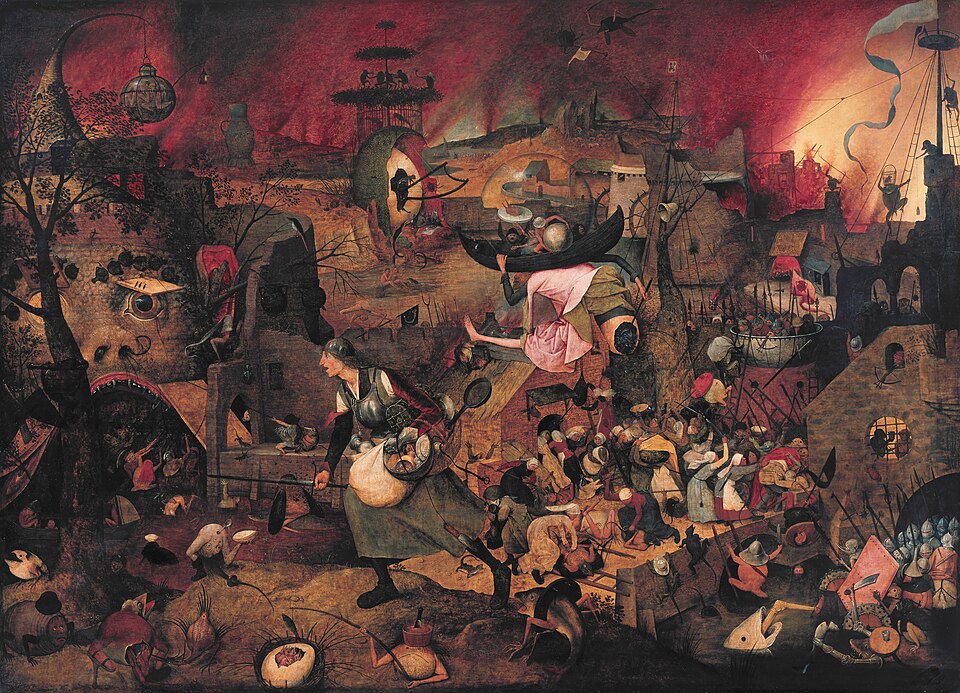
Pieter Brueghel the Elder
Who
Pieter Bruegel, born around 1525-1530 and entered in the Antwerp painters' guild of Saint Luke in 1551. He travelled to Italy, was back in Antwerp by 1555 designing prints, married in Brussels in 1563 and lived there until his death on 9 September 1569.
Why they matter
He painted peasants, villages and the land they worked as subjects in their own right, without a religious story to justify them. The Hunters in the Snow is called by its own museum the first and most prominent winter landscape of European painting, and the Met calls The Harvesters the first modern landscape. Only about forty paintings survive; twelve of them are in Vienna, the largest group anywhere.
What to buy
Prints: the paintings are in Vienna, New York and a few other museums, and posters of the Hunters in the Snow are everywhere; pick one that names the museum and shows the whole panel. For Bruegel, though, the better thing for a wall is not a reproduction at all but an old engraving (see Originals). Books: Jurgen Muller and Thomas Schauerte's Bruegel. The Complete Works for Taschen covers all forty paintings, 65 drawings and 89 engravings; the XL edition is a 492-page hardback and the one to own if you want the prints as well as the paintings. Originals: the paintings are not realistic, but the engravings are. Bruegel designed dozens of prints for Hieronymus Cock's Antwerp publishing house, At the Four Winds, though he etched only one plate, The Rabbit Hunt, himself; the rest were cut by specialist engravers such as Johannes and Lucas van Doetecum. Sixteenth-century impressions of these come up regularly at print auctions, catalogued "after Pieter Bruegel", and are the one genuine Bruegel object a collector can own. Buy by state: a serious catalogue gives the reference number (New Hollstein) and the state, and says whose address is on the plate. Cock's plates outlived him; his widow ran the business until 1601, and publishers who bought plates at her estate sale reprinted them with their own address, so an old engraving is not necessarily one Cock published. Modern reproductions of the same images are common too; if a listing gives no state and no reference, assume it is one of those.
Notes
He dropped the "h" in 1559 and signed Bruegel from then on; his family went on writing Brueghel or Breughel. The Hunters in the Snow and The Harvesters belong to a cycle of six seasons, of which five survive; the Hunters was owned by the Antwerp collector Nicolaas Jongelinck and given by the city to Archduke Ernst in 1594. The Harvesters has been at the Met since 1919. Rubens later owned eleven or twelve of his paintings.
Story
The founder of a family of painters never taught his sons a thing. Pieter Bruegel married Mayken Coecke, daughter of Pieter Coecke van Aelst, in Brussels in 1563. Their son Pieter was born in 1564 and Jan in 1568. On 9 September 1569 their father was dead, too early to train either of them. The early art historian van Mander records that before he died he told his wife to burn some drawings, perhaps designs for prints, because their inscriptions were "too sharp or sarcastic". The boys were trained instead by their grandmother, Mayken Verhulst, and both became well-known painters. Pieter the Younger spent decades making replicas and adaptations of his father's pictures. Even the family name split. From 1559 the father dropped the "h" and signed his paintings Bruegel, while his relatives went on writing Brueghel or Breughel, so the man most people think of as Brueghel is, on his own panels, the one Bruegel who did not use it. A generation after his death, Rubens owned eleven or twelve of his paintings; today twelve hang in a single room in Vienna.
Key works
- Rustic Market, from the Large Landscapes (1555-1557) - engraving by Johannes and Lucas van Doetecum, published by Hieronymus Cock
- Children's Games (1560) - Kunsthistorisches Museum, Vienna
- Hunters in the Snow (Winter) (1565) - Kunsthistorisches Museum, Vienna
- The Harvesters (1565) - The Met, New York
- Peasant Wedding (1568) - Kunsthistorisches Museum, Vienna
In museum collections
- The Hunters in the Snow (1565)
Kunsthistorisches Museum ↗ · Find a print ↗ - The Triumph of Death (1560)
Museo del Prado ↗ · Find a print ↗ - The Peasant Wedding (1568)
Kunsthistorisches Museum ↗ · Find a print ↗ - The Harvesters (1565)
The Met ↗ · Find a print ↗ - Children's Games (1560)
Kunsthistorisches Museum ↗ · Find a print ↗ - The Fight Between Carnival and Lent (1559)
Kunsthistorisches Museum ↗ · Find a print ↗ - The Return of the Herd (1565)
Kunsthistorisches Museum ↗ · Find a print ↗ - The Gloomy Day (1565)
Kunsthistorisches Museum ↗ · Find a print ↗ - The Procession to Calvary (1564)
Kunsthistorisches Museum ↗ · Find a print ↗ - Christ and the Woman Taken in Adultery (1565)
Art UK ↗ · Find a print ↗ - The Adoration of the Kings (1563)
Art UK ↗ · Find a print ↗ - The Beggars (1568)
Louvre ↗ · Find a print ↗
See the work
Prints
Books
Originals
See also
Browse all 2,101 artists · Open in the directory · Where the work hangs: 59 museums on a map