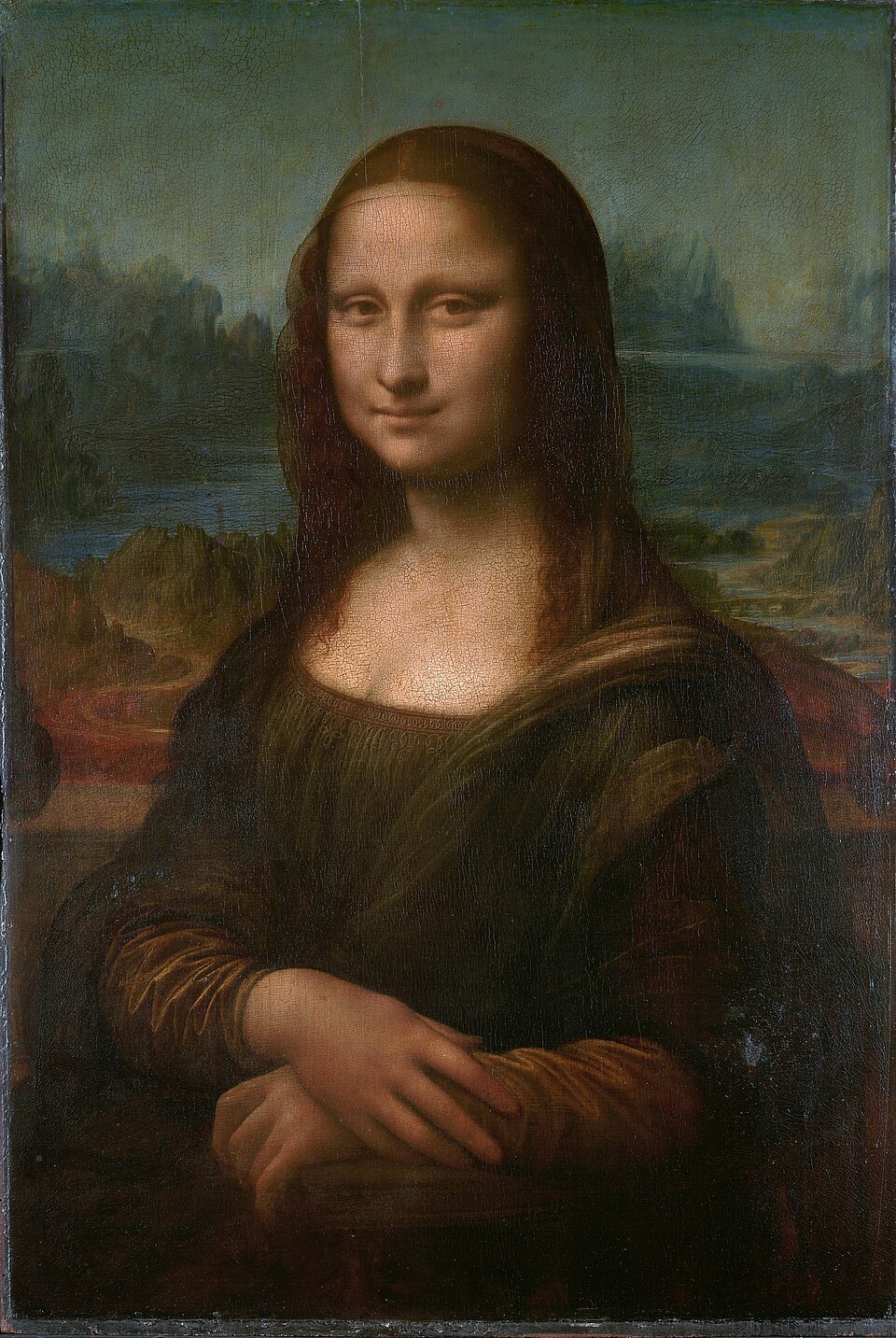
Leonardo da Vinci
Who
Painter, draughtsman, engineer and anatomist, born near Vinci in Tuscany in 1452 and dead at Clos Luce, Amboise, in France, in 1519. Fewer than 25 major paintings are attributed to him, several of them unfinished, alongside the notebooks and drawings.
Why they matter
He made the portrait breathe: soft shadow instead of outline, a sitter turned and caught mid-thought, a landscape dissolving into haze behind her. The Last Supper set the pattern for a dramatic narrative scene for centuries. And the notebooks and drawings, on everything from water to anatomy to machines, are the reason "Renaissance man" means what it does.
What to buy
Prints: the National Gallery in London sells made-to-order reproductions of its own Leonardos - The Virgin of the Rocks and the Burlington House Cartoon - where you choose the size, material and frame. That is the honest source: the gallery's own photograph of the thing it owns. The Mona Lisa in poster form is everywhere and mostly muddy; the Louvre's own collection page is a better way to look at it. Books: Taschen's Leonardo. The Complete Paintings and Drawings by Frank Zollner and Johannes Nathan is the standard survey, with a catalogue raisonne of the paintings and almost 700 drawings; it is an XXL book of more than 700 pages, so check you have the shelf. Originals: not realistic. The paintings are in museums and a Milan monastery, and the one recent attribution to reach the market, the Salvator Mundi - attributed "in whole or part" to Leonardo - set the auction record for any painting in 2017. Anything offered as a Leonardo drawing on a marketplace is a facsimile.
Notes
The Louvre holds the Mona Lisa and the first version of The Virgin of the Rocks; the second version is in London. Ginevra de' Benci, bought from the Prince of Liechtenstein in 1967, is the only Leonardo painting on public view in the Americas. The Last Supper is painted on a wall of the monastery of Santa Maria delle Grazie in Milan, so it can only be seen there.
Story
The Mona Lisa was not the most famous painting in the world until somebody stole it. On 21 August 1911, a day the Louvre was closed, Vincenzo Peruggia, an Italian who had worked at the museum and had helped build the painting's glass case, took it off the wall, removed the case and frame on a service stairway, and walked out after a plumber, taking him for an employee, unlocked a door for him. The police investigation that followed was enormous. The poet Guillaume Apollinaire was arrested and jailed, and he implicated his friend Pablo Picasso, who was brought in for questioning; both were cleared. Meanwhile the painting sat in a trunk in Peruggia's Paris flat for two years. In December 1913 he took it to Florence by train and offered it to the dealer Alfredo Geri, signing himself "Leonardo V." Geri brought in Giovanni Poggi, director of the Uffizi, who confirmed it was the real thing, and the police arrested Peruggia at his hotel. He said he was returning the picture to Italy. The painting was shown at the Uffizi before going back to the Louvre on 4 January 1914. Peruggia was sentenced to a year and fifteen days and served seven months; the headlines had made the portrait a household image.
Key works
- Ginevra de' Benci (c. 1474-1478) - National Gallery of Art, Washington
- Lady with an Ermine (1489-1491) - Czartoryski Museum, Krakow
- The Virgin of the Rocks (about 1491/2-1499 and 1506-1508) - National Gallery, London
- The Last Supper (c. 1495-1498) - Santa Maria delle Grazie, Milan
- Mona Lisa (c. 1503-1519) - Louvre, Paris
In museum collections
- Mona Lisa (1503)
Louvre ↗ · Find a print ↗ - Ginevra de' Benci (1476)
National Gallery of Art ↗ · Find a print ↗ - The Virgin and Child with Saint Anne (1511)
Louvre ↗ · Find a print ↗ - Saint John the Baptist (1514)
Louvre ↗ · Art UK ↗ · Find a print ↗ - La Belle Ferronnière (1495)
Louvre ↗ · Find a print ↗ - Adoration of the Magi (1482)
Uffizi ↗ · Find a print ↗ - Annunciation (1472)
Louvre ↗ · Uffizi ↗ · Find a print ↗ - The Baptism of Christ (1470)
Uffizi ↗ · Find a print ↗ - The Virgin and Child with Saint Anne and Saint John the Baptist (1500)
Art UK ↗ · Find a print ↗ - Portrait of Isabella d'Este (1500)
Louvre ↗ · Find a print ↗ - Virgin of the Rocks (1482)
Louvre ↗ · Art UK ↗ · Find a print ↗ - Rearing Horse and Mounted Warrior
The Met ↗ · Find a print ↗
See the work
Prints
Books
See also
Browse all 2,101 artists · Open in the directory · Where the work hangs: 63 museums on a map