Peter Paul Rubens
Who
Born in Siegen, in Nassau-Dillenburg, on 28 June 1577; he died in Antwerp, in the Spanish Netherlands, on 30 May 1640. In Antwerp he built up a studio of students and assistants and worked with specialists such as Frans Snyders and Jan Brueghel the Elder; his most famous pupil was the young Anthony van Dyck. He was also a diplomat, ennobled by Philip IV of Spain in 1624 and knighted by Charles I of England in 1630.
Why they matter
He is Flemish Baroque painting: altarpieces, mythologies, hunts and portraits of huge energy, flesh and movement, made at a scale only a workshop could produce. He also ran his reputation as a publishing business, commissioning engravings and woodcuts of his designs and protecting them with privileges, an early form of copyright, so that his compositions travelled as prints far beyond the churches and palaces that held them.
What to buy
Prints: the National Gallery in London prints its own paintings to order, on art paper or stretched canvas, framed or not; Le Chapeau de Paille is the one to start with, a portrait whose light and colour hold up in reproduction better than the crowded altarpieces do. Books: the standard reference is the Corpus Rubenianum Ludwig Burchard, the catalogue raisonné, more than forty books since the first volume of 1968; the Rubenshuis in Antwerp makes every volume older than fifteen years free online as searchable PDFs, so read it there before buying any volume secondhand. Originals: the paintings are not realistic. The realistic tier is the prints made under his eye. In 1618 he began soliciting a triple privilege to protect his designs in France, the Spanish Netherlands and the Dutch Republic; Lucas Vorsterman was his sole engraver from 1619 to 1621, Paulus Pontius and others followed, and in the early 1630s Christoffel Jegher cut large woodcuts after his designs. These are by other hands, after Rubens, and what you are paying for is how early and how good the impression is. Buy from a dealer who names the engraver, the state and the catalogue reference; a sheet labelled only "after Rubens" may be a much later copy.
Notes
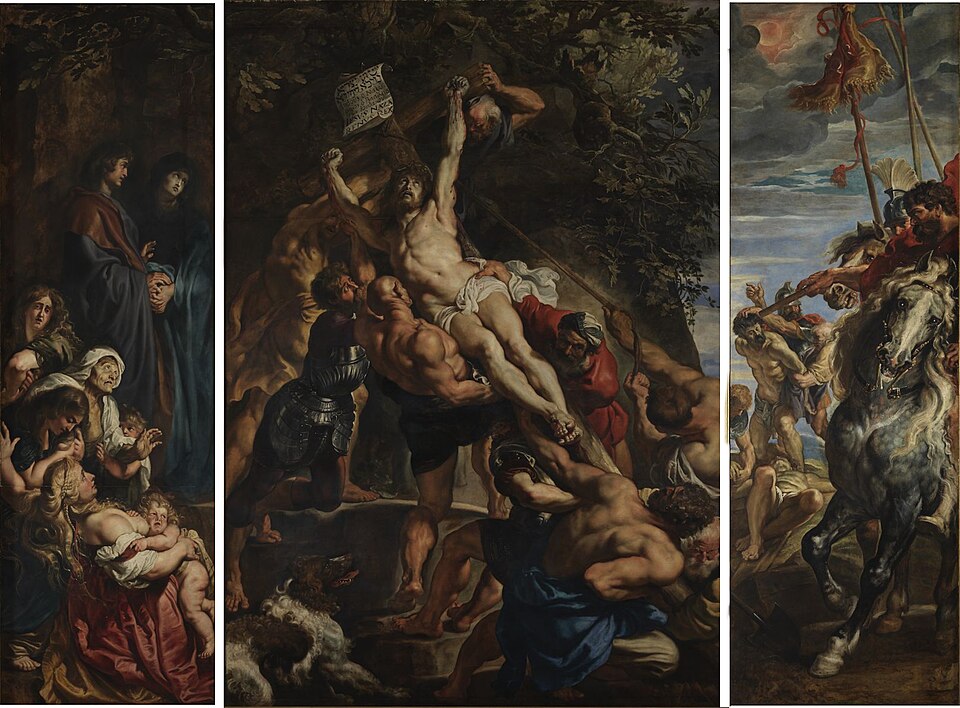
The great altarpieces are still in Antwerp, The Elevation of the Cross in the cathedral; the Alte Pinakothek in Munich, the Prado in Madrid and the National Gallery in London all hold key easel paintings. His ceiling for the Banqueting House at Whitehall, The Apotheosis of James I, is still in place. Vorsterman and Rubens fell out violently in 1621, probably over who owned the rights to the prints, and the partnership ended.
Story
Rubens came to London in 1629 not to paint but to negotiate. He was an envoy of Philip IV of Spain, and England and Spain had been at war for five years. As a present for Charles I he painted Minerva protects Pax from Mars, an allegory carrying a political message in favour of peace. While the talks went on, Cambridge gave him an honorary Master of Arts degree in 1629, and in 1630 the king knighted him. He stayed until April 1630, and that November a peace treaty between England and Spain was signed.
The visit brought another commission. Charles wanted the ceiling of Inigo Jones's Banqueting House at Whitehall painted with the glorification of his father, James I. Rubens sketched it in London but completed it in his Antwerp studio, because of the scale of the job, and the canvases were installed in 1636.
Thirteen years later the building was put to another use. On the afternoon of 30 January 1649 Charles I stepped out of a first-floor window of the Banqueting House onto a scaffold built outside it for his own execution: the building whose ceiling Rubens had painted to glorify his father. The peace painting had a quieter fate: after passing through collections across Europe it was presented to the National Gallery by the Duke of Sutherland in 1828.
Key works
- Rubens and Isabella Brant in the Honeysuckle Bower (c. 1609) - Alte Pinakothek, Munich
- The Elevation of the Cross (1610-11) - Antwerp Cathedral
- The Rape of the Daughters of Leucippus (c. 1618) - Alte Pinakothek, Munich
- Portrait of Susanna Lunden (Le Chapeau de Paille) (probably 1622-5) - National Gallery, London
- Minerva protects Pax from Mars (Peace and War) (1629-30) - National Gallery, London
- The Three Graces (c. 1630-35) - Museo del Prado, Madrid
In museum collections
- The Three Graces (1630)
Museo del Prado ↗ · Art UK ↗ · Find a print ↗ - Samson and Delilah (1609)
Art UK ↗ · Find a print ↗ - Head of Medusa (1618)
Kunsthistorisches Museum ↗ · Find a print ↗ - Helena Fourment in a Fur Robe (1638)
Kunsthistorisches Museum ↗ · Find a print ↗ - The Fall of Man (1628)
Museo del Prado ↗ · Find a print ↗ - The Garden of Love (1630)
Museo del Prado ↗ · Art UK ↗ · Find a print ↗ - The Origin of the Milky Way (1637)
Museo del Prado ↗ · Find a print ↗ - The Rape of Ganymede (1637)
Museo del Prado ↗ · Find a print ↗ - Portrait of Susanna Lunden (1622)
Art UK ↗ · Find a print ↗ - Saturn (1637)
Museo del Prado ↗ · Find a print ↗ - The Hippopotamus and Crocodile Hunt (1616)
V&A ↗ · Find a print ↗ - A View of Het Steen in the Early Morning (1636)
Art UK ↗ · Find a print ↗
See the work
Prints
Books
Originals
See also
Browse all 2,101 artists · Open in the directory · Where the work hangs: 296 museums on a map