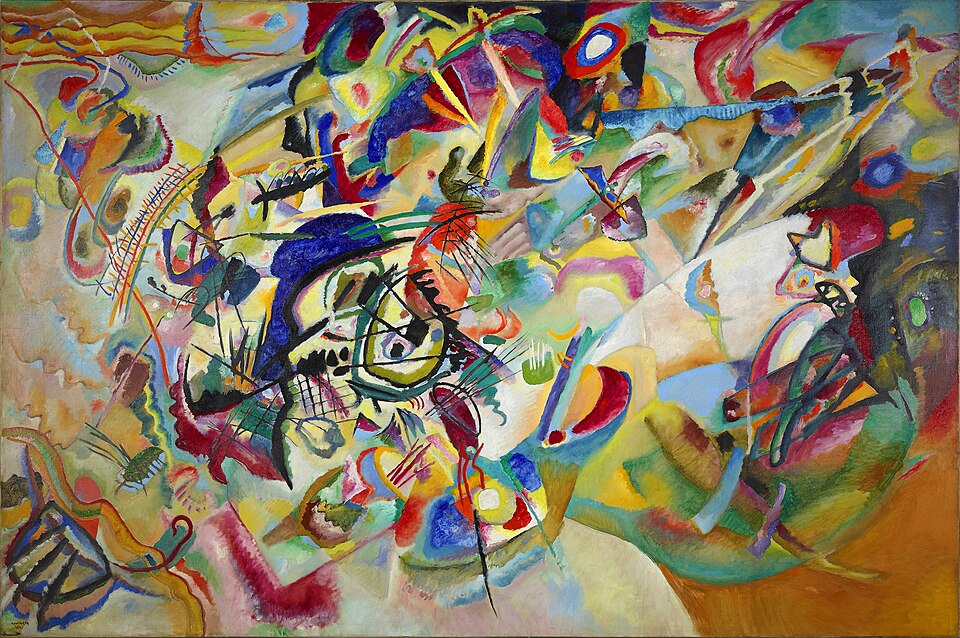
Wassily Kandinsky
Who
Born in Moscow on 16 December 1866 and died at Neuilly-sur-Seine, outside Paris, on 13 December 1944. He gave up an academic career in law at thirty and went to Munich in 1896 to paint; he co-founded the Blue Rider in 1911, taught at the Bauhaus from 1922 until the Nazis closed it in 1933, and spent his last years in France.
Why they matter
He is one of the founders of abstract painting and its most articulate theorist. Concerning the Spiritual in Art (1911) and Point and Line to Plane (1926) argued that colour and form could act on the viewer directly, as music does, without depicting anything. He traced it to seeing one of Monet's Haystacks: "That it was a haystack the catalogue informed me. I could not recognise it."
What to buy
Prints: the paintings are big and saturated, and most reproduce well; buy one at a generous size from a reputable printer. Read before you buy: Dover's inexpensive paperback of Concerning the Spiritual in Art, in M. T. H. Sadler's translation, is the book that explains the pictures, in his own words. Originals: Kandinsky was a real printmaker, and his prints are catalogued by Hans Konrad Roethel, the Lenbachhaus director who first saw Munter's hidden collection; dealers cite the Roethel numbers. The landmark is Kleine Welten (Small Worlds), published by Propylaen in Berlin in 1922: twelve sheets, four lithographs, four woodcuts and four drypoints, in an edition of 200 on Butten paper plus 30 on japan, every sheet signed. Sheets from it come up singly as well as in complete portfolios. The trap is the lithographs "after Kandinsky" printed by Mourlot for Maeght's magazine Derriere le Miroir from the 1950s on - Promenade (1957), for instance, is a lithographic reproduction of a 1920 painting, with the initials printed in the stone. They are attractive and honest when sold as what they are, but they were made after his death and are not Kandinsky prints.
Notes
The Lenbachhaus in Munich holds the great early collection, from Munter's gift of 1957: ninety oil paintings by him, about 330 watercolours and drawings, his sketchbooks, reverse glass paintings and his printed work. The Guggenheim in New York has a large group, including Several Circles (1926); Composition VII (1913) is in the Tretyakov Gallery in Moscow. MoMA holds sheets from Kleine Welten.
Story
Kandinsky met Gabriele Munter in 1901, when she enrolled in the beginners' class at the Phalanx, the art school he had founded in Munich. They travelled and worked together for over a decade and furnished a home together at Murnau, south of Munich. When war broke out in 1914 he returned to Russia without her; in 1917 he married Nina Andreevskaya. Munter sent some of his paintings and drawings back to him, but much of what he had left behind stayed with her. Under the Nazis, abstract art was condemned as "degenerate". Munter had the works by herself, Kandinsky and their circle brought to the Murnau house and stored them in the basement. The house was searched several times; the pictures were never found. In 1956 Hans Konrad Roethel, soon to direct Munich's Lenbachhaus, was finally allowed to see the whole collection. The next year, for her eightieth birthday, Munter gave it to the city: more than a thousand works by the Blue Rider artists, among them ninety oil paintings by Kandinsky - the man who had left her four decades before.
Key works
- Impression III (Concert) (1911) - Lenbachhaus, Munich
- Improvisation 19 (1911) - Lenbachhaus, Munich
- Composition VII (1913) - Tretyakov Gallery, Moscow
- Small Worlds (Kleine Welten), portfolio of twelve prints (1922) - MoMA, New York
- Several Circles (1926) - Guggenheim, New York
In museum collections
- The Blue Rider (1903)
MoMA ↗ · Find a print ↗ - Composition VIII (1923)
Guggenheim ↗ · Find a print ↗ - Several Circles (1926)
Guggenheim ↗ · Find a print ↗ - Upward (1929)
Guggenheim ↗ · Find a print ↗ - Circles in a Circle (1923)
Philadelphia Museum of Art ↗ · Find a print ↗ - Graceful Ascent (1934)
Guggenheim ↗ · Find a print ↗ - Improvisation 27 (Garden of Love II) (1912)
The Met ↗ · Find a print ↗ - Improvisation 28 (second version) (1912)
Guggenheim ↗ · Find a print ↗ - Landscape with Red Spots, No. 2 (1913)
Guggenheim ↗ · Find a print ↗ - Painting with White Border (1913)
Guggenheim ↗ · Find a print ↗ - Red Oval (1920)
Guggenheim ↗ · Find a print ↗ - Swinging (1925)
Art UK ↗ · Find a print ↗
See the work
Prints
Books
Originals
See also
Browse all 2,101 artists · Open in the directory · Where the work hangs: 101 museums on a map