Paul Gauguin
Who
Born in Paris on 7 June 1848, he spent his early childhood in Lima, Peru, worked as a stockbroker from 1871, and turned to painting full time after the crash of 1882. He painted at Pont-Aven in Brittany from 1886, spent October to December 1888 with Van Gogh in Arles, and sailed for Tahiti in 1891 and again, for good, in 1895. He died at Atuona in the Marquesas Islands on 8 May 1903. A painter, printmaker and writer.
Why they matter
He broke with Impressionism's record of what the eye sees for flat, strong colour, heavy outlines and invented meaning - the Synthetism of Pont-Aven - and carried it to Tahiti. His woodcuts, cut and then scraped into the block, are as radical as the paintings. The legacy is shadowed: in Tahiti in 1891 he took Teha'amana, who was thirteen, as his wife, and the paintings of her are part of what he is now judged by.
What to buy
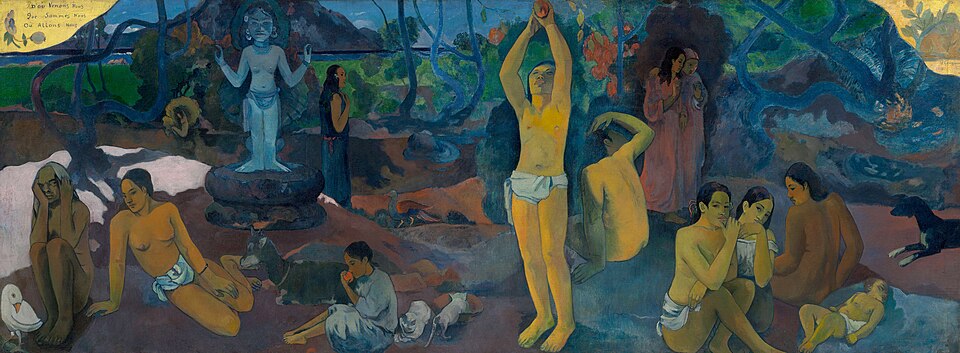
Prints: the Museum of Fine Arts, Boston makes Where Do We Come From? to order from its own image; it is a long frieze, so buy it wide or not at all. Books: the standard catalogue of the prints is Paul Gauguin: Catalogue Raisonne of His Prints by Elizabeth Mongan, Eberhard Kornfeld and Harold Joachim (Galerie Kornfeld, Bern, 1988); dealers cite it as "M./K./J.", and a seller who cannot give that number has not checked. Originals: the woodcuts are where a real Gauguin comes within reach, and the one thing to understand is who printed the sheet. Of the ten Noa Noa blocks of 1893-94, no more than a dozen impressions survive by Gauguin himself from any block. What one usually meets is later: an edition by Louis Roy, with added colour blocks, or the posthumous edition of 100 printed in Copenhagen in 1921 by his son Pola, who bought the blocks in 1919. Pola's impressions, on China paper, are genuine prints from Gauguin's own blocks and the honest entry tier; a lifetime impression is a museum object. Anything described only as "Gauguin woodcut" with no printer and no M./K./J. number is a reproduction until proven otherwise.
Notes
The Met, the Museum of Fine Arts in Boston, the Art Institute of Chicago and the National Gallery in London hold his paintings. The Noa Noa title is also that of his account of Tahiti, first published in 1901. The block for the title print, Noa Noa, is itself in the Met. In his last years he likely suffered from cardiovascular syphilis.
Story
In the summer of 1889 Paris held a World's Fair on the Champ de Mars, and not far from the official art pavilion a man named Volpini ran the Grand Cafe des Arts. He had a problem: the mirrors he had ordered from Italy to decorate the cafe would not arrive in time for the opening. Gauguin's friend Emile Schuffenecker had a solution. His circle had plenty of paintings and nowhere to show them.
So in June and early July 1889 about 94 works by nine artists, calling themselves the "Impressionist and Synthetist Group", hung on the walls of a cafe at the fair. Gauguin also brought something new: a suite of zincographs, lithographs drawn on zinc plates, printed on bright yellow paper, of scenes from Brittany, Martinique and Arles. The catalogue noted that an album of lithographs by Bernard and Gauguin could be seen on demand.
The press ignored the show, and it was counted a failure. It is now called the first Symbolist exhibition. The cafe owner's name stuck to the prints: they are the Volpini Suite, and the Cleveland Museum of Art owns a complete set. A show hung because the mirrors were late became the first public statement of the painter who would go to Tahiti.
Key works
- Volpini Suite (zincographs on yellow paper) (1889) - complete set, Cleveland Museum of Art
- Ia Orana Maria (Hail Mary) (1891) - The Met, New York
- Noa Noa suite (ten woodcuts) (1893-94)
- Where Do We Come From? What Are We? Where Are We Going? (1897-98) - Museum of Fine Arts, Boston
- The Yellow Christ (1889) - Albright-Knox Art Gallery, Buffalo
In museum collections
- Where Do We Come From? What Are We? Where Are We Going? (1897)
MFA Boston ↗ · Find a print ↗ - Tahitian Women on the Beach (1890)
Musee d'Orsay ↗ · Find a print ↗ - Vision After the Sermon (1888)
Art UK ↗ · Find a print ↗ - Ia Orana Maria (1891)
The Met ↗ · Find a print ↗ - Oviri (1894)
Musee d'Orsay ↗ · Find a print ↗ - Two Tahitian Women (1899)
The Met ↗ · Find a print ↗ - Nevermore (1897)
Art UK ↗ · Find a print ↗ - Arearea (1892)
Musee d'Orsay ↗ · Find a print ↗ - Fatata te Miti (1892)
National Gallery of Art ↗ · Find a print ↗ - La belle Angèle (1889)
Musee d'Orsay ↗ · Find a print ↗ - Portrait of the Artist with the Yellow Christ (1890)
Musee d'Orsay ↗ · Find a print ↗ - Still Life with Profile of Laval (1886)
Indianapolis Museum of Art ↗ · Find a print ↗
See the work
Prints
Books
Originals
See also
Browse all 2,101 artists · Open in the directory · Where the work hangs: 164 museums on a map