Paul Klee
Who
Born on 18 December 1879 at Munchenbuchsee near Bern and died on 29 June 1940 at Muralto in Ticino. A painter, draughtsman and teacher who joined the Blue Rider circle in 1911, taught at the Bauhaus from 1921 to 1931 and at the Dusseldorf Academy until the Nazis dismissed him in 1933, then went back to Bern. He was a German citizen all his life: Switzerland granted his citizenship six days after he died.
Why they matter
He made small pictures do large things: line that behaves like handwriting, colour laid down like music, and a private language of signs, arrows and letters - the R in Villa R stands in the landscape like a tree. His Bauhaus teaching turned that into method. The output is enormous - around 9,000 works, some 1,250 of them in 1939 alone, when he was already ill with scleroderma.
What to buy
Prints: much of his best work is small, on paper, with fine line and thin colour, so choose a print at or near the original size rather than a blown-up poster. The honest middle tier is the set of reproductions Galerie Berggruen issued in 1964 with the artist's son Felix Klee, printed by the Jacomet stencil process in editions of 500: good objects in their own right, but the signature is printed in the plate, and they are reproductions, not Klee prints. Books: Taschen's Basic Art Klee is the cheapest good introduction. For the prints themselves the standard catalogue is Eberhard W. Kornfeld's Verzeichnis des graphischen Werkes von Paul Klee (Bern, 1963; revised 2005). Originals: the paintings and watercolours are museum and top-auction pieces. His own etchings and lithographs are a small body of work and do come to auction; check any sheet offered as an original against its Kornfeld number, and treat "Klee lithographs" with a printed signature, or labelled after Klee, as reproductions.
Notes
The Zentrum Paul Klee, designed by Renzo Piano, opened in Bern in 2005 and holds about 4,000 of his works; the Kunstmuseum Bern has Ad Parnassum. In New York, MoMA's Twittering Machine was sold off by the Nazis and entered the museum in 1939, and the Heinz Berggruen family gave the Met 90 of his works. His April 1914 trip to Tunisia is the usual turning point: "Colour and I are one. I am a painter."
Story
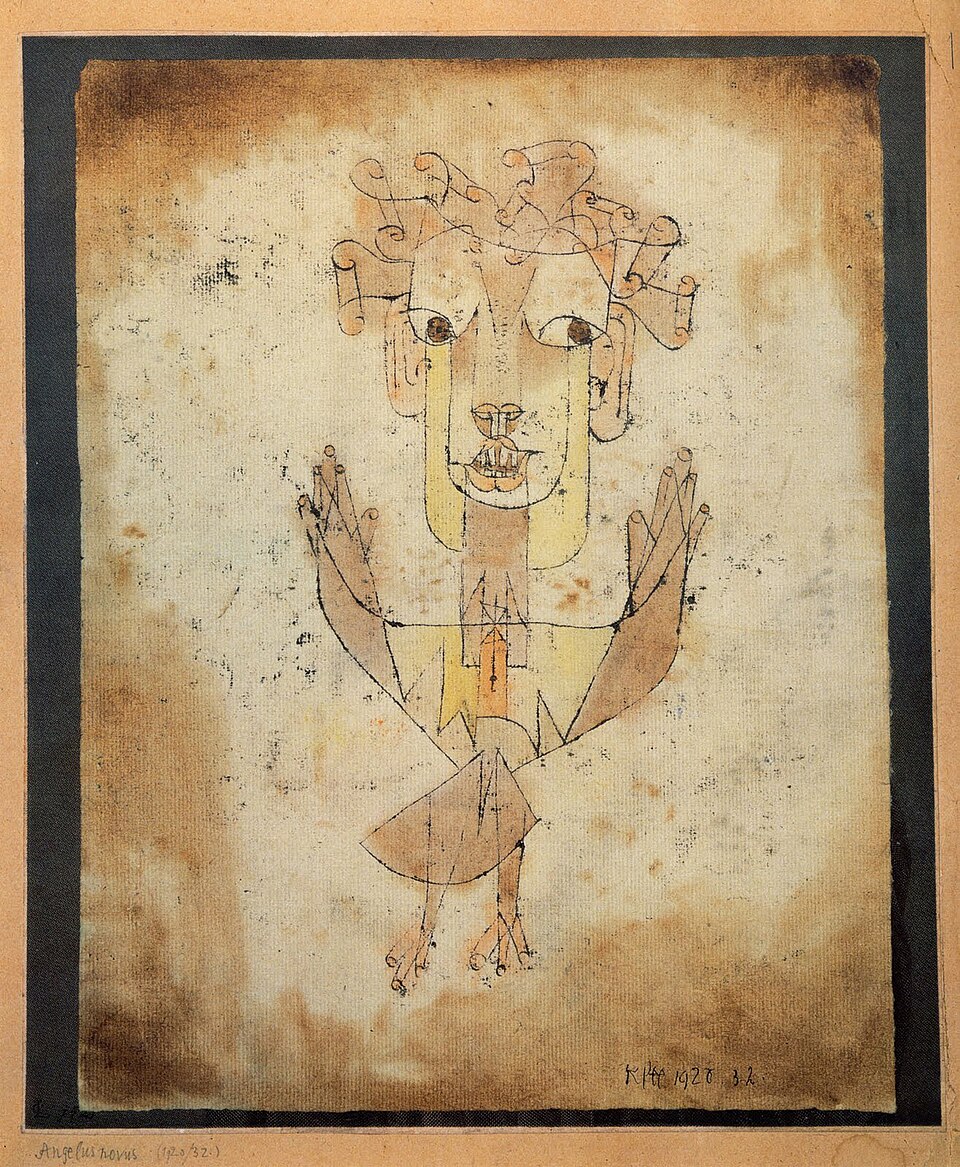
In 1921 the philosopher Walter Benjamin bought a small work on paper, in oil transfer and watercolour, that Klee had made the year before: Angelus Novus. When Benjamin fled Germany in 1933 it went with him to Paris. Before the German invasion forced him to flee again, he left it with the writer Georges Bataille, who hid it, with Benjamin's papers, in the Bibliotheque nationale. Benjamin died in Spain in 1940. That year, in his Theses on the Philosophy of History, he had turned the picture into the angel of history: an angel looking back at the past, where debris piles up, while a storm drives him into the future - the storm, Benjamin wrote, is what we call progress. After the war the picture passed to Theodor Adorno and then, as Benjamin had wished, to his lifelong friend Gershom Scholem in Jerusalem; since 1987 it has belonged to the Israel Museum, which keeps it under strict climate control. In spring 2026 the Jewish Museum in New York opened Paul Klee: Other Possible Worlds with Angelus Novus as its centrepiece. Visitors found a sign instead: because of conditions affecting international transport - the Iran war had disrupted air travel across the region - the shipment of the original had been delayed. Eighty-six years after Benjamin's flight, a war had once again decided where the angel could go.
Key works
- Villa R (1919) - Kunstmuseum Basel
- Angelus Novus (1920) - Israel Museum, Jerusalem
- Twittering Machine (1922) - MoMA, New York
- Ad Parnassum (1932) - Kunstmuseum Bern
In museum collections
- Twittering Machine (1922)
MoMA ↗ · Find a print ↗ - Cat and Bird (1928)
MoMA ↗ · Find a print ↗ - Fish Magic (1925)
Philadelphia Museum of Art ↗ · Find a print ↗ - In the Magic Mirror (1934)
Art Institute of Chicago ↗ · Find a print ↗ - Angel Applicant (1939)
The Met ↗ · Find a print ↗ - Around the Fish (1926)
MoMA ↗ · Find a print ↗ - One Who Understands (1934)
The Met ↗ · Find a print ↗ - Oriental Pleasure Garden (1925)
The Met ↗ · Find a print ↗ - Red Balloon (1922)
Guggenheim ↗ · Find a print ↗ - Still Life (1927)
The Met ↗ · Find a print ↗ - Variations (Progressive Motif) (1927)
The Met ↗ · Find a print ↗ - Baum und Architektur--Rhythmen (Tree and Architecture--Rhythms) (1920)
National Gallery of Art ↗ · Find a print ↗
See the work
Prints
Books
Originals
See also
Browse all 2,101 artists · Open in the directory · Where the work hangs: 114 museums on a map