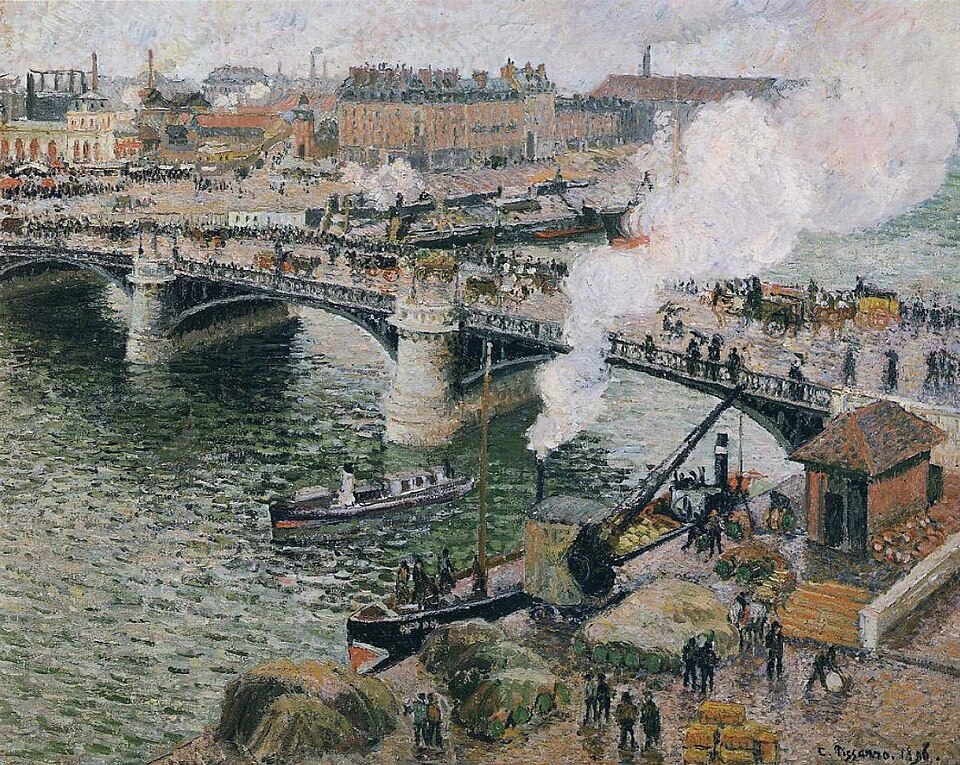
Camille Pissarro
Who
Born on 10 July 1830 in Charlotte Amalie on St Thomas, in the Danish West Indies, he died in Paris on 13 November 1903. A landscape painter of villages, orchards, fields and, late in life, the boulevards of Paris and the ports of Rouen, and a printmaker in etching, aquatint and lithography. From 1884 he lived at Eragny, which he painted for the rest of his life.
Why they matter
He is the one who held Impressionism together: the only artist to show at all eight of the Impressionist exhibitions, from 1874 to 1886, and a teacher to younger painters. Cezanne said of him, "he was a father for me"; he also taught Gauguin. He was open enough to change his own method in his fifties, painting in Seurat's divided colour from about 1885 to 1888 before giving it up.
What to buy
Prints: the National Gallery in London sells made-to-order prints of seven of its Pissarros from its own photography, including The Boulevard Montmartre at Night - the only night scene he ever painted - and the London pictures he made in exile in 1870-71. Start there. Books: the paintings are catalogued in Pissarro: Critical Catalogue of Paintings by Joachim Pissarro and Claire Durand-Ruel Snollaerts (Wildenstein Institute and Skira, 2005, three volumes, 1,529 paintings); the prints in Loys Delteil's catalogue of 1923, which gives every plate its Delteil number. Originals: the prints are where a Pissarro is honestly within reach. He printed his own plates, often in tiny numbers - for one 1888 etching Delteil records eight impressions of a state pulled by Pissarro himself, and 24 pulled after his death. That is the distinction that matters: lifetime impressions, some annotated and numbered in his hand as proofs, against impressions pulled from the same plates after his death. Both are genuine; they are not the same thing, and Delteil records which plates had posthumous printings and which did not. Ask for the Delteil number, the state, and whether the sheet is a lifetime or posthumous impression, and buy only where the seller can answer all three.
Notes
The National Gallery in London, the Met and the Art Institute of Chicago all hold his paintings. In 1897 he painted fourteen views of the Boulevard Montmartre from a hotel room, at different times of day, in snow, rain, fog, mist and sunlight. The National Gallery's night view came from the collection of Lucien Pissarro. He died of sepsis in Paris in 1903.
Story
In September 1870, as the Prussian army advanced on Paris, Pissarro and his family left their house at Louveciennes, west of the city. They went first to the painter Ludovic Piette in Mayenne, then that autumn to relatives in London, and did not come home until late June 1871. The paintings stayed behind.
In London he lived in Lower Norwood, "at that time a charming suburb", and "studied the effect of fog, snow and springtime". The National Gallery counts twelve paintings from that year of exile. One, The Avenue, Sydenham, was almost certainly bought in London in 1871 by the dealer Paul Durand-Ruel, and stayed with his gallery for more than fifty years.
At Louveciennes, Prussian soldiers had moved in, using the ground floor as a stable and the upper floors as barracks. His sister-in-law Felicie Estruc went to see it and wrote to him: the houses burned, "window panes, shutters, doors, staircases and floors are all gone. As for your home it is uninhabitable."
Hundreds of his paintings had been destroyed. Pissarro spoke of losing twenty years' worth of work. The pictures he painted as a refugee in a London suburb survived; much of what he had left at home did not. In 1984 the National Gallery bought The Avenue, Sydenham at Christie's - one of the twelve, back in the city where it was painted.
Key works
- The Avenue, Sydenham (1871) - National Gallery, London
- Chestnut Grove at Louveciennes (1872) - Nelson-Atkins Museum of Art, Kansas City
- The Boulevard Montmartre on a Winter Morning (1897) - The Met, New York
- The Boulevard Montmartre at Night (1897) - National Gallery, London
In museum collections
- Steamboats in the Port of Rouen (1896)
The Met ↗ · Find a print ↗ - The Red Roofs, Côte Saint-Denis at Pontoise, Winter Effect (1877)
Musee d'Orsay ↗ · Find a print ↗ - Morning, An Overcast Day, Rouen (1896)
The Met ↗ · Find a print ↗ - The Banks of the Oise near Pontoise (1873)
Indianapolis Museum of Art ↗ · Find a print ↗ - The Côte des Bœufs, Pontoise (1877)
Art UK ↗ · Find a print ↗ - The House of the Deaf Woman and the Belfry at Eragny (1886)
Indianapolis Museum of Art ↗ · Find a print ↗ - The Harvest, Pontoise (La Récolte, Pontoise) (1881)
The Met ↗ · Find a print ↗ - The Garden of the Tuileries on a Winter Afternoon (1899)
The Met ↗ · Find a print ↗ - A Cowherd at Valhermeil, Auvers-sur-Oise (1874)
The Met ↗ · Find a print ↗ - The Boulevard Montmartre at Night (1897)
Art UK ↗ · Find a print ↗ - The Boulevard Montmartre on a Winter Morning (1897)
The Met ↗ · Find a print ↗ - Entrance to Voisins (1872)
Musee d'Orsay ↗ · Find a print ↗
See the work
Prints
Books
Originals
See also
Browse all 2,101 artists · Open in the directory · Where the work hangs: 206 museums on a map