Henri Matisse
Who
Born on 31 December 1869 at Le Cateau-Cambresis in northern France and died in Nice on 3 November 1954. He trained for the law, and began to paint in 1889 when his mother brought him paints while he recovered from appendicitis. From 1917 he lived at Nice; after surgery for cancer in 1941 left him largely in a wheelchair, he worked in cut paper.
Why they matter
He freed colour from description. At the 1905 Salon d'Automne his pictures and his friends' made the critic Louis Vauxcelles speak of "wild beasts", and Fauvism had its name; Gertrude and Leo Stein bought his Woman with a Hat. Half a century later, drawing with scissors in painted paper, he reinvented himself again: the late cut-outs are as radical as anything he did.
What to buy
Prints: the late cut-outs are flat colour and clean edge, and they reproduce better than almost any painting. Tate, which owns The Snail (1953), sells a large giclee print of it from its own shop, the museum-made choice. Books: the book to own is Jazz itself. The 1983 edition published by George Braziller as a special edition for MoMA is a facsimile of the 1947 book - all twenty plates and Matisse's handwritten text, with an introduction by Riva Castleman - and it is the honest way to have the whole thing. The standard references for collectors are the catalogues by the Duthuit family: the prints (Catalogue raisonne de l'oeuvre grave, 1983) and the illustrated books (Catalogue raisonne des ouvrages illustres, 1988); dealers cite Duthuit numbers. Originals: the paintings and cut-outs are museum pieces, but Matisse was a prolific printmaker and illustrator of books, and these come to auction. The landmark is Jazz, published by Teriade on 30 September 1947: twenty stencil (pochoir) plates on Arches paper, made by Edmond Vairel from the collages, in 250 numbered copies plus 20 hors commerce. Single plates are also sold on their own. Know the difference from the 1983 facsimile before you buy a "Jazz plate", and check any print against its Duthuit number.
Notes
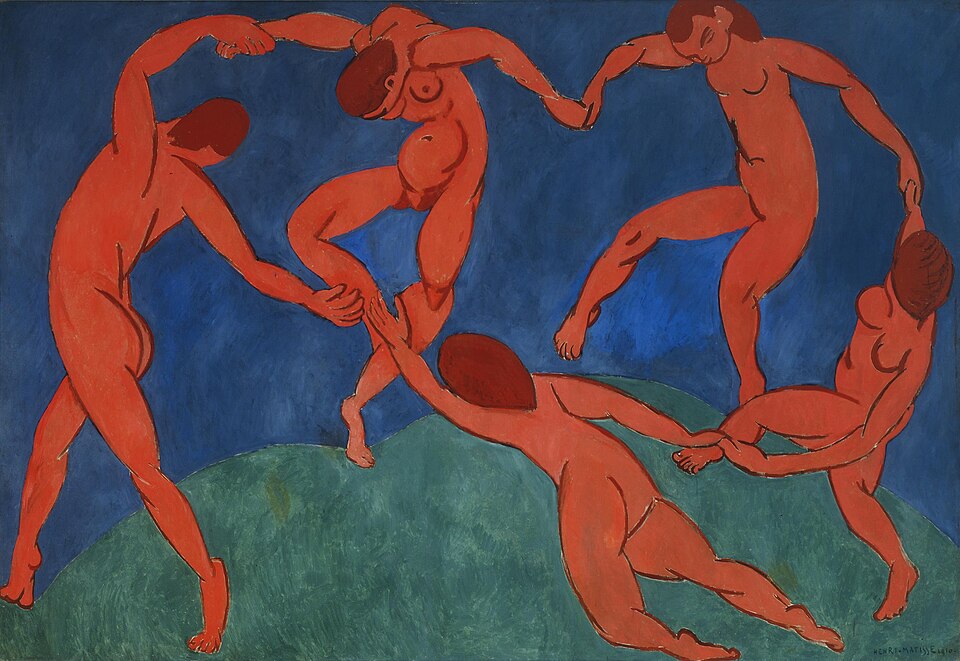
The Russian collector Sergei Shchukin commissioned Dance and Music (1909-1910); both are now in the Hermitage in St Petersburg. The Chapel of the Rosary at Vence (1948-1951) belongs to the same late period as the cut-outs. MoMA holds Jazz and The Boat; Tate has The Snail.
Story
On 18 October 1961 the Museum of Modern Art in New York opened The Last Works of Henri Matisse, a show of the big cut-paper gouaches he had made in his final years. One of them was Le Bateau (The Boat), made in 1953: a boat on water, and below it its reflection. It hung upside down. Nobody noticed - not the critics, not the curators, not the crowds, and not Pierre Matisse, the artist's son and an art dealer, who walked through the gallery too. After 47 days a stockbroker, Genevieve Habert, did. The reflection, she thought, was more complicated than the boat itself, which made no sense. She bought the exhibition catalogue, compared the picture with its plate, and went to a guard, who told her: "You don't know what's up and you don't know what's down and neither do we." So she called The New York Times. Monroe Wheeler, the museum's director of exhibitions, had the work turned the right way up the day before the paper ran the story, on 5 December 1961. A work by the man who taught modern art to see colour first had been, for seven weeks, pure colour and nothing else.
Key works
- Dance (1909-1910) - Hermitage Museum, St Petersburg
- Jazz, illustrated book of twenty pochoirs (1947) - MoMA, New York
- Chapel of the Rosary, Vence (1948-1951) - in situ, Vence
- The Boat (1953) - MoMA, New York
- The Snail (1953) - Tate, London
In museum collections
- The Open Window (1905)
National Gallery of Art ↗ · Find a print ↗ - L’Atelier Rouge (1911)
MoMA ↗ · Find a print ↗ - Bathers with a Turtle (1907)
Saint Louis Art Museum ↗ · Find a print ↗ - Odalisque with Raised Arms (1923)
National Gallery of Art ↗ · Find a print ↗ - Blue Window (1913)
MoMA ↗ · Find a print ↗ - La Négresse (1952)
National Gallery of Art ↗ · Find a print ↗ - Portrait of Greta Moll (1908)
Art UK ↗ · Find a print ↗ - The Young Sailor II (1906)
The Met ↗ · Find a print ↗ - Self-Portrait (1918)
National Gallery of Art ↗ · Musee d'Orsay ↗ · Find a print ↗ - Bathers by a River (1916)
Art Institute of Chicago ↗ · Find a print ↗ - Le rideau jaune (1915)
MoMA ↗ · Find a print ↗ - Piano Lesson (1916)
MoMA ↗ · Find a print ↗
See the work
Prints
Books
Originals
See also
Browse all 2,101 artists · Open in the directory · Where the work hangs: 162 museums on a map