Édouard Manet
Who
Born in Paris on 23 January 1832, he died there on 30 April 1883, eleven days after his left foot was amputated. A painter of modern Paris - cafes, racecourses, boating parties, a barmaid at the Folies-Bergere - and an etcher and lithographer, a founding member of the Societe des Aquafortistes in 1862.
Why they matter
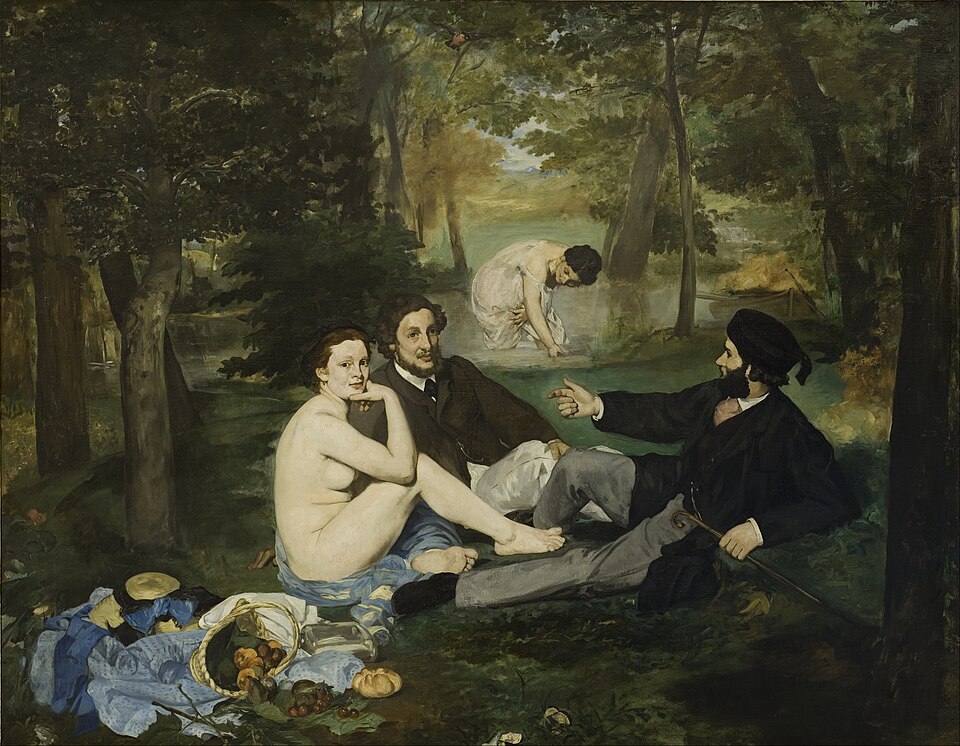
He is the hinge between the old museum painting and modern art. The Salon rejected Luncheon on the Grass in 1863, and it hung instead at the Salon des Refuses, the counter-exhibition Napoleon III allowed that year; two years later the Salon accepted Olympia, and the crowd's fury at it was such that only precautions by the administration kept the canvas from being attacked. Flat colour, black used as a colour, subjects taken from the street rather than from history: he did it first, in the Salon itself, and the younger painters followed.
What to buy
Prints: the National Gallery in London sells made-to-order prints of its own Manets - The Execution of Maximilian, Music in the Tuileries Gardens, Corner of a Cafe-Concert - from its own photography, and that is the best source. Books: the standard one-volume Manet is still the catalogue of the 1983 Paris and New York retrospective, Manet 1832-1883 by Francoise Cachin, Charles S. Moffett and Juliet Wilson Bareau (the Met with Abrams), found second-hand through AbeBooks. The full catalogue raisonne is Rouart and Wildenstein (1975). Originals: the paintings are museum pieces, but the etchings are a real and honest way in. After his death his copper plates were printed in posthumous editions: 30 impressions on blue-green papers by the dealer Louis Dumont in 1894, then 100 by his successor Alfred Strolin in 1905, after which Strolin punched holes in the coppers so nobody could print them again. The Strolin impressions are generally the most wanted, since the earlier posthumous pulls are often poorly inked. Seventeen of those thirty plates were never published in his lifetime. Buy only a sheet whose edition - lifetime, Dumont or Strolin - the seller can name and back up; a sheet sold as just "Manet etching" is a question, not an answer.
Notes
Olympia and The Balcony are at the Musee d'Orsay, A Bar at the Folies-Bergere at the Courtauld Gallery. He painted the execution of Emperor Maximilian in three large canvases in 1867-1869; besides London's, one is in Boston (MFA) and one in the Kunsthalle Mannheim, and neither the paintings nor his lithograph of the subject could be shown in France at the time. The catalogue raisonne counts 430 oil paintings, 89 pastels and more than 400 works on paper.
Story
Manet's Execution of Maximilian in the National Gallery, painted in about 1867-8, is not a single painting that survived. It is a painting put back together by another painter.
A photograph taken in 1883, the year Manet died, already shows the canvas with its left-hand section, the Emperor and General Mejia, cut away. His family then cut up what was left and sold the fragments separately, as if a firing squad were worth more by the soldier.
Edgar Degas, Manet's fellow painter, set about buying the pieces back. Some he bought from the dealer Portier, others from Ambroise Vollard, who had bought them from Manet's family. Degas stuck the fragments he had gathered onto a single canvas and kept it.
After Degas died, his collection was sold, and in 1918 the National Gallery bought the reassembled picture at the sale. On entering the Gallery it was cut into three pieces again. Only in the late 1970s were the fragments combined on one canvas once more, as Degas had put them - an execution scene whose Emperor is missing.
Key works
- Music in the Tuileries Gardens (1862) - National Gallery, London, with the Hugh Lane Gallery, Dublin
- Olympia (1863) - Musee d'Orsay, Paris
- The Execution of Maximilian (c. 1867-1868) - National Gallery, London
- The Balcony (1868-1869) - Musee d'Orsay, Paris
- Boating (1874) - The Met, New York
- A Bar at the Folies-Bergere (1882) - Courtauld Gallery, London
In museum collections
- Luncheon on the Grass (1863)
Musee d'Orsay ↗ · Find a print ↗ - Olympia (1863)
Musee d'Orsay ↗ · Find a print ↗ - A Bar at the Folies-Bergère (1882)
Art UK ↗ · Find a print ↗ - The Balcony (1868)
Musee d'Orsay ↗ · Find a print ↗ - Music in the Tuileries (1862)
Art UK ↗ · Find a print ↗ - The Fif (1866)
Musee d'Orsay ↗ · Find a print ↗ - The Railway (1873)
National Gallery of Art ↗ · Find a print ↗ - Berthe Morisot with a Bouquet of Violets (1872)
Musee d'Orsay ↗ · Find a print ↗ - Spring (1881)
Getty ↗ · Find a print ↗ - The Old Musician (1862)
National Gallery of Art ↗ · Find a print ↗ - Portrait of Emile Zola (1868)
Musee d'Orsay ↗ · Find a print ↗ - The Plum (1878)
National Gallery of Art ↗ · Find a print ↗
See the work
Prints
Books
Originals
See also
Browse all 2,101 artists · Open in the directory · Where the work hangs: 140 museums on a map