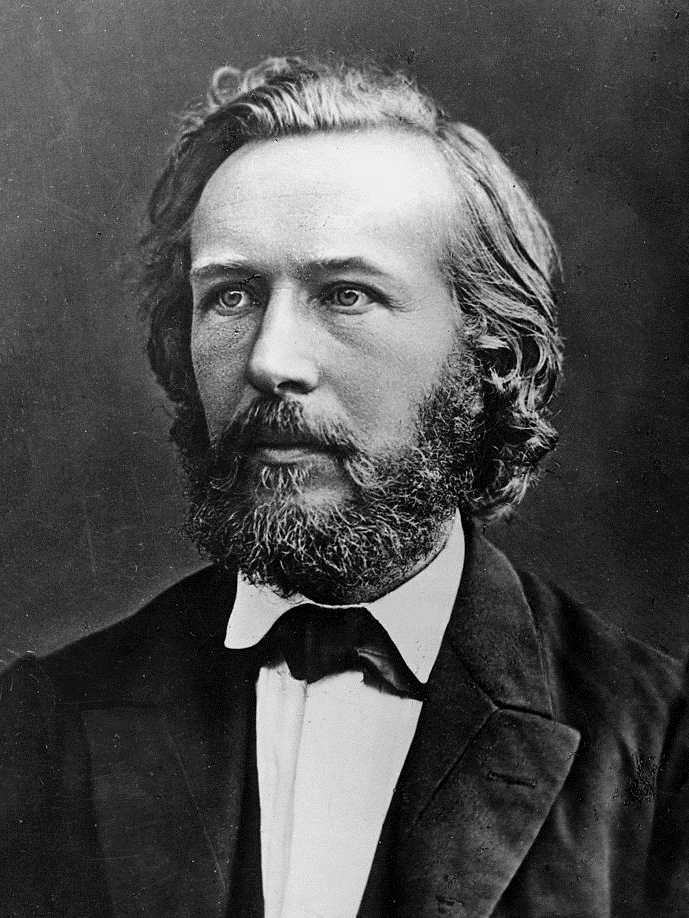
Ernst Haeckel
Who
German zoologist, born in Potsdam on 16 February 1834 and died in Jena on 9 August 1919. He was professor of zoology at the University of Jena from 1862 to 1909, named thousands of species, and coined words biology still uses: ecology, phylum, phylogeny, ontogeny.
Why they matter
He drew the microscopic and deep-sea world with an eye for symmetry that designers understood before scientists did. Kunstformen der Natur (Art Forms in Nature), issued in sets of ten from 1899 and complete in two volumes in 1904, put radiolarians, jellyfish, sponges and orchids onto 100 plates that became a pattern book for Art Nouveau: René Binet, Karl Blossfeldt, Hans Christiansen and Émile Gallé all drew on it, and Berlage's Amsterdam commodities exchange borrowed from its forms. His medium was drawing and watercolour, translated to print by the lithographer Adolf Giltsch.
What to buy
For the wall and the shelf, buy a book, not a poster. Taschen's The Art and Science of Ernst Haeckel, edited by Julia Voss and Rainer Willmann, reproduces 300 prints from the Kunstformen and his monographs on radiolarians, medusae and calcareous sponges; Dover's paperback Art Forms in Nature is the cheapest honest way to have the Kunstformen plates. The original is the book as issued. The first edition came from the Bibliographisches Institut, Leipzig and Vienna, as a folio in ten printed wrappers of ten plates each, gathered into two volumes in 1904; a complete set is a rare-book purchase, and single plates sold by antique-print dealers are the affordable tier. Two cautions. A second edition of 1914 has only 30 plates, so a single sheet is not necessarily from 1899-1904: ask the dealer which edition it came from. And the originals were printed by both lithography and halftone, so a dot screen under a loupe does not by itself mark a modern copy.
Notes
Public domain, and the Kunstformen plates are freely scanned. His house in Jena, the Villa Medusa, sold to the Carl Zeiss foundation in 1918, is now the Ernst-Haeckel-Haus museum. His reputation is mixed: his embryo drawings drew accusations of fraud that historians still dispute, and he promoted social Darwinism and a scientific racism that modern science rejects. He founded the Monist League in 1906.
Story
On 16 February 1864 the German Academy of Sciences awarded Ernst Haeckel its Cothenius Medal, a high honour for his scientific work. It was his thirtieth birthday. On the same day his wife of eighteen months, Anna Sethe, died, of what is now thought to have been a burst appendix. He never fully recovered from the loss.
He remembered her the way a zoologist could. He named a jellyfish after her, Desmonema annasethe, whose trailing tentacles he likened to her long flowing hair. More than three decades later, when he gathered the best of his drawings into Kunstformen der Natur, she was there: the jellyfish sweeps across plate 8, its tentacles winding in a long trail behind the bell.
That book was meant as natural history, a demonstration of the symmetry and order he saw in living things. It had a second life he had not planned. Its deep-sea creatures climbed out of the pages and onto the facades of European cities, onto stage curtains and into paintings, and the zoology book that carried a grieving man's tribute to his wife became a pattern book for Art Nouveau.
Key works
- Die Radiolarien (1862) - monograph on radiolarians
- Kunstformen der Natur (1899-1904) - 100 plates, Bibliographisches Institut, Leipzig and Vienna
- Desmonema annasethe (1899-1904) - plate 8, Kunstformen der Natur