Georges Seurat
Who
Born in Paris on 2 December 1859, he died there on 29 March 1891, aged 31, of an illness variously given as meningitis, pneumonia, infectious angina or diphtheria. A painter of a handful of very large, slowly built canvases of Parisians at leisure, and a draughtsman in conte crayon on rough paper. His son by Madeleine Knobloch, born in February 1890, died two weeks after him.
Why they matter
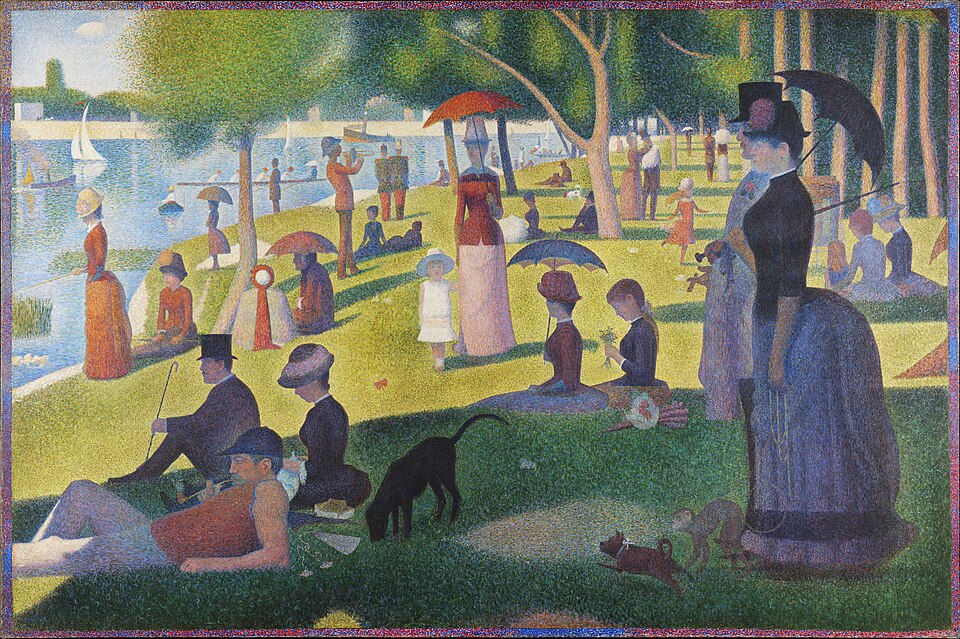
He tried to put Impressionism on a system: colour laid down in small separate touches, to be mixed by the eye rather than on the palette. Bathers at Asnieres was rejected by the Salon in 1884 and shown instead with the new Independents; A Sunday on La Grande Jatte, shown in 1886, made divided colour a movement. He did it in barely a decade, and left only a handful of the great canvases.
What to buy
Prints: buy a museum's own reproduction and buy it large, because a Seurat is its surface - at postcard size the dots disappear and the picture turns into a flat poster. The National Gallery in London prints Bathers at Asnieres from its own photography, and the Met makes Circus Sideshow, his first night scene, to order. Books: the catalogue raisonne is C. M. de Hauke's Seurat et son oeuvre (Grund, Paris, 1961, two volumes, over 700 illustrations), long out of print and a used-book purchase; for reading, any recent exhibition catalogue from Chicago, London or New York. Originals: not realistic. The great paintings are all in public collections, and a drawing offered as his needs the de Hauke catalogue behind it before anything else.
Notes
The Art Institute of Chicago, the National Gallery in London, the Met and the Musee d'Orsay, which holds The Circus, left unfinished at his death, all show major paintings. The Met's Circus Sideshow shows the parade of the Circus Corvi at the Gingerbread Fair near the place de la Nation in spring 1887. A zinc yellow he used in the Grande Jatte began turning brown even in his lifetime. He added the painted border of dots in 1888-89.
Story
Frederic Clay and Helen Birch Bartlett of Chicago bought A Sunday on La Grande Jatte in 1924 and gave it to the Art Institute in 1926. For more than thirty years it stayed there. In 1958 the museum finally lent it, to its own Seurat exhibition's second stop, at the Museum of Modern Art in New York.
On 15 April 1958, while the show was up, a fire broke out on MoMA's second floor. Workmen installing air conditioning had been smoking near paint cans, sawdust and a canvas drop cloth. One workman died, an eighteen-foot Monet Water Lilies was destroyed, and the museum's director, Rene d'Harnoncourt, gathered a volunteer crew of eleven. They wrestled the glass-covered, ten-foot Seurat, more than a quarter of a ton of it, out of its temporary frame, wrapped it against smoke and water, and carried it next door to the Whitney Museum.
It was unharmed. Time magazine reported that the loan was the first and would be the last: the painting had been given with the provision that it could be lent only once. The Art Institute's own exhibition history of the picture lists nothing after 1958. To see the Grande Jatte you go to Chicago.
Key works
- Bathers at Asnieres (1884) - National Gallery, London
- A Sunday on La Grande Jatte - 1884 (1884-86, border added 1888-89) - Art Institute of Chicago
- Circus Sideshow (Parade de cirque) (1887-88) - The Met, New York
- Le Chahut (1889-90) - Kroller-Muller Museum, Otterlo
In museum collections
- A Sunday Afternoon on the Island of La Grande Jatte (1884)
Art Institute of Chicago ↗ · Find a print ↗ - Bathers at Asnières (1884)
Art UK ↗ · Find a print ↗ - The Circus (1891)
Musee d'Orsay ↗ · Find a print ↗ - Young Woman Powdering Herself (1889)
Art UK ↗ · Find a print ↗ - The Circus Parade (1887)
The Met ↗ · Find a print ↗ - The Channel of Gravelines, Petit Fort Philippe (1890)
Indianapolis Museum of Art ↗ · Find a print ↗ - Bridge of Courbevoie (1880)
Art UK ↗ · Find a print ↗ - The Forest at Pontaubert (1881)
The Met ↗ · Find a print ↗ - Landscape with Puvis de Chavannes' Poor Fisherman (1881)
Musee d'Orsay ↗ · Find a print ↗ - Peasant Woman Seated in the Grass (1883)
Guggenheim ↗ · Find a print ↗ - The Channel at Gravelines, Evening (1890)
MoMA ↗ · Find a print ↗ - Landscape at Grandcamp (1885)
Musee d'Orsay ↗ · Find a print ↗
See the work
Prints
Books
See also
Browse all 2,101 artists · Open in the directory · Where the work hangs: 66 museums on a map