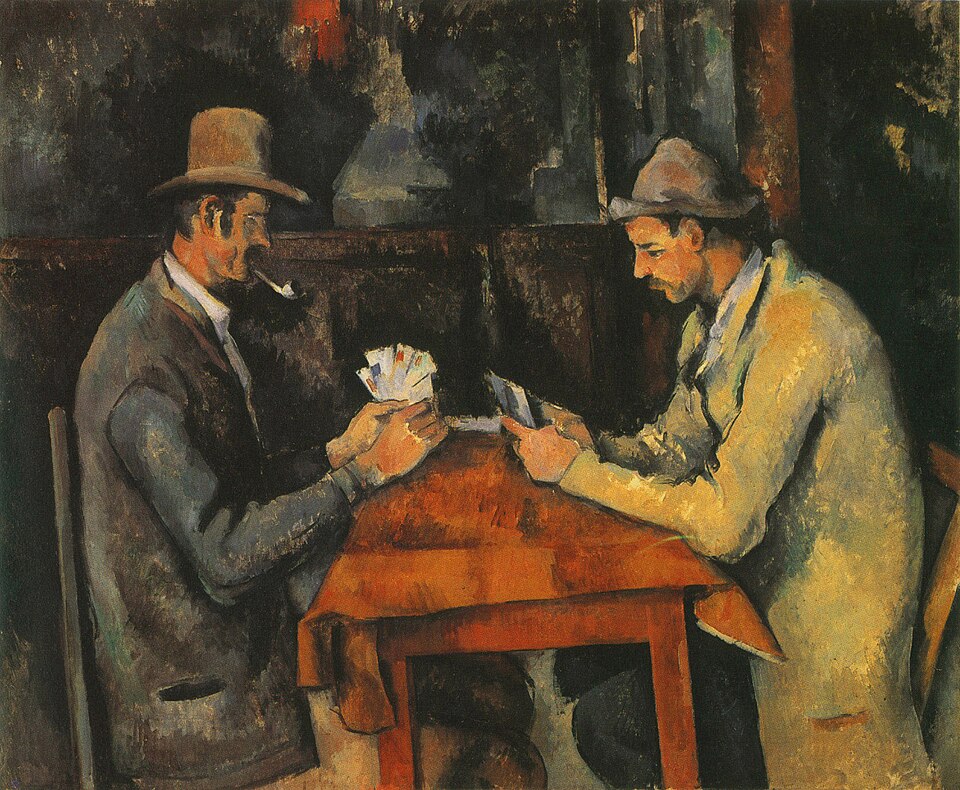
Paul Cézanne
Who
Born on 19 January 1839 in Aix-en-Provence, the son of a banker, he went to school there with Emile Zola and enrolled in the law faculty at Aix in 1859 before turning to painting. He showed at the Impressionist exhibitions of 1874 and 1877 and never again with the group; his first one-man show, at Ambroise Vollard's in Paris, came only in November 1895. He died on 22 October 1906, of pneumonia, days after collapsing in a storm while painting outdoors.
Why they matter
He rebuilt painting out of patches of colour laid side by side, so that an apple, a card player or a mountain is constructed rather than described. He painted Mont Sainte-Victoire in more than 30 oils and 45 watercolours. Matisse and Picasso are both credited with calling him "the father of us all".
What to buy
Prints: museums make the best of him, because the colour is the structure and a muddy print loses the picture. The Philadelphia Museum of Art prints The Large Bathers to order from its own photography; buy it large, since it is a big canvas of small strokes. Books: the paintings are catalogued in John Rewald's The Paintings of Paul Cezanne: A Catalogue Raisonne (Abrams, 1996, two volumes); it is now combined with the catalogues of the watercolours and drawings in an online catalogue raisonne by Walter Feilchenfeldt, Jayne Warman and David Nash, run since 2023 by the Societe Paul Cezanne. Originals: the paintings are not realistic, but the prints are a real, narrow door. He made only eight - five etchings in 1873 and three lithographs in the 1890s. The one to know is the colour lithograph Large Bathers, commissioned by Vollard and printed by Auguste Clot, in two editions of about 100 impressions each: the first from six colour stones, the second from five. First-edition impressions carry a printed line, "Tirage a cent exemplaires No / P. Cezanne". Ask which edition, look for that line, and buy through an auction house or a print dealer who states both; a sheet sold simply as "Cezanne lithograph" should be treated as a reproduction until the seller proves otherwise.
Notes
The Philadelphia Museum of Art, the Met, the Art Institute of Chicago, the Barnes Foundation and the National Gallery in London all hold major paintings. The Large Bathers, the largest and last of his bather pictures, was unfinished at his death; Philadelphia bought it in 1937. The Art Institute of Chicago also holds his 1873 etching Guillaumin with the Hanged Man.
Story
Cezanne and Emile Zola met as schoolboys at the College Bourbon in Aix, and for thirty years they wrote to each other: the novelist in Paris, the painter who could not get into the Salon. Then, from December 1885, the magazine Gil Blas serialised Zola's new novel, L'Oeuvre, and in 1886 Charpentier published it as a book. Its hero, Claude Lantier, is a painter of genius who cannot finish his great picture, and at the end he hangs himself from his scaffolding.
Cezanne recognised himself. He wrote to thank Zola for the copy on 4 April 1886, and for more than a century that was the last letter anyone knew of between them. Biographers called it the rupture: the book that ended the friendship.
In November 2013 a letter came up for sale at Sotheby's in Paris. Cezanne had written it to Zola on 28 November 1887, more than a year after the supposed break, and it was entirely cordial and trusting, in the tone of all the letters before it. In 2016 Henri Mitterand published the whole surviving correspondence, 115 letters, and argued that a long silence is not the same as a quarrel. The most famous broken friendship in French art may simply be a lost pile of letters.
Key works
- The Card Players (1890-92) - The Met, New York
- The Basket of Apples (c. 1893) - Art Institute of Chicago
- Large Bathers (colour lithograph) (1896-98) - printed by Auguste Clot for Ambroise Vollard
- The Large Bathers (1900-1906) - Philadelphia Museum of Art
In museum collections
- Les Grandes Baigneuses (1906)
Philadelphia Museum of Art ↗ · Find a print ↗ - The Basket of Apples (1893)
Art Institute of Chicago ↗ · Find a print ↗ - The Hanged Man's House (1874)
Musee d'Orsay ↗ · Find a print ↗ - Maison devant la Sainte-Victoire près de Gardanne (House in Provence) (1885)
Indianapolis Museum of Art ↗ · Find a print ↗ - Mont Sainte-Victoire with Large Pine (1887)
Art UK ↗ · Find a print ↗ - Still Life with Onions (1898)
Musee d'Orsay ↗ · Find a print ↗ - A Modern Olympia (1873)
Musee d'Orsay ↗ · Find a print ↗ - Apples and Oranges (1899)
Musee d'Orsay ↗ · Find a print ↗ - La Femme à la cafetière (Woman with a Coffeepot) (1895)
Musee d'Orsay ↗ · Find a print ↗ - Pont de Maincy (1879)
Musee d'Orsay ↗ · Find a print ↗ - Bathers (Les Grandes Baigneuses) (1894)
Art UK ↗ · Find a print ↗ - Mont Sainte-Victoire and the Viaduct of the Arc River Valley (1882)
The Met ↗ · Find a print ↗
See the work
Prints
Books
Originals
See also
Browse all 2,101 artists · Open in the directory · Where the work hangs: 167 museums on a map