Piet Mondrian
Who
Born Pieter Cornelis Mondriaan on 7 March 1872 in Amersfoort, in the Netherlands, and died of pneumonia in New York on 1 February 1944. He began with naturalistic Dutch landscapes and trees, moved to Paris in 1912 (and dropped an "a" from his name), left for London in September 1938 and for New York in 1940.
Why they matter
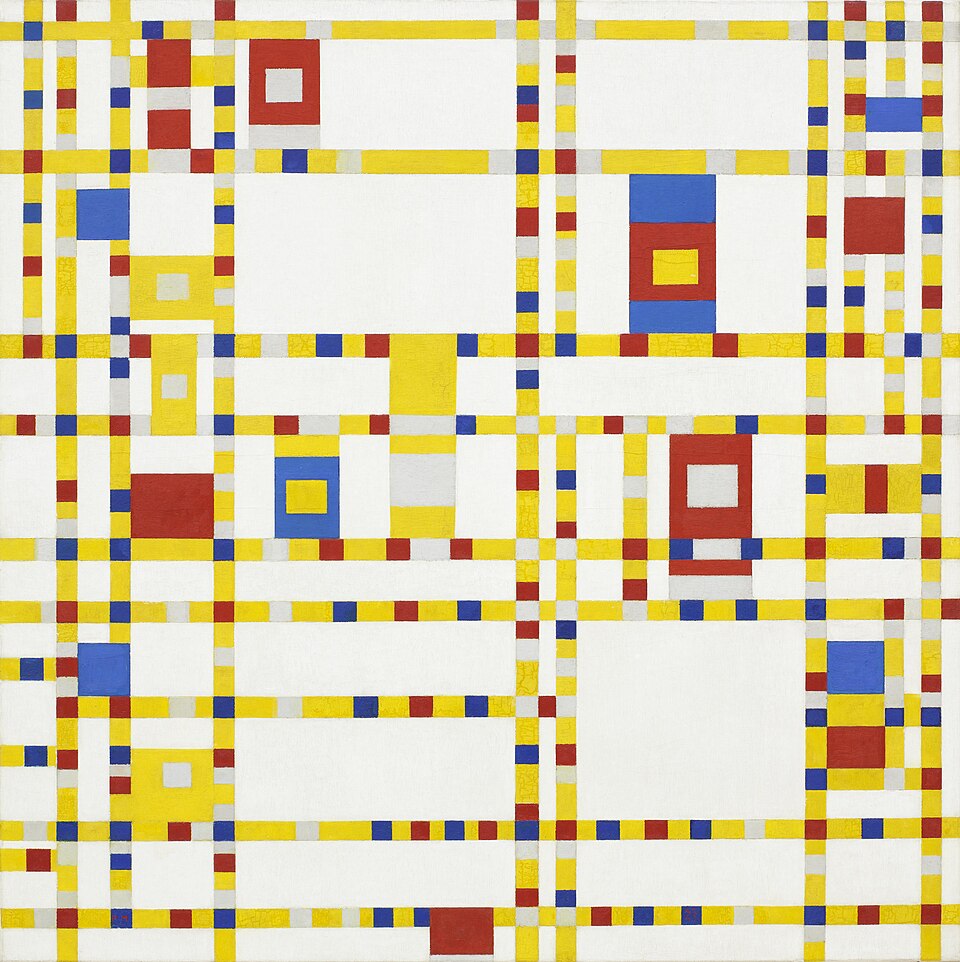
He took painting down to its bones - black horizontals and verticals, white ground, red, yellow and blue - and showed that what was left could still move. The route there is visible in the trees: Evening; Red Tree and Gray Tree turn a single subject from landscape into structure. The grid then escaped the gallery into architecture, fashion and design, and it has never come back. In New York, Broadway Boogie Woogie dropped the black lines and broke the colour into small blinking blocks, as if the grid had started to dance.
What to buy
Prints: flat colour makes Mondrian look easy to reproduce, and that is the trap. The market is full of redrawn "Mondrian-style" grids that match no actual painting, in the wrong proportions. Buy a print that names a specific work, its date and the museum that holds it, and compare it against the museum's own image before ordering. Books: Taschen's Basic Art Mondrian by Susanne Deicher is the cheapest good introduction. The standard reference is the catalogue raisonne by Joop M. Joosten and Robert P. Welsh (Abrams and Prestel, 1998), in two volumes: the naturalistic work to early 1911, then the work of 1911-1944 - worth finding second-hand, and the first volume is the best answer to anyone who thinks he could only paint grids. Originals: not realistic. The paintings are museum and top-auction pieces, and anything offered as a Mondrian should be checked against Joosten and Welsh.
Notes
Kunstmuseum Den Haag (formerly the Gemeentemuseum) holds the largest collection of Mondrians in the world, from the early landscapes to Victory Boogie Woogie. MoMA has Broadway Boogie Woogie. For all the severity of the paintings he was a keen dancer, a regular at dance halls from Laren to Paris to London.
Story
Victory Boogie Woogie was still changing when Mondrian stopped. He began it in New York in 1942, and instead of finishing it in paint he worked with strips of coloured tape and paper, laying tape of one colour over squares painted in another and repainting whole blocks. On 23 January 1944 he made a drastic revision. On the 26th he was taken to hospital, and on 1 February he died of pneumonia, leaving the canvas - a square turned on its point - in his studio as oil, tape, paper, charcoal and pencil. It was never finished, which makes it the nearest thing to watching him work.
It spent the next half-century in American collections, first with Emily and Burton Tremaine. Then in 1998 it went back to the Netherlands, bought for the state with a gift from De Nederlandsche Bank. The bank chose it to mark the end of its long responsibility for the guilder, which it had looked after since 1814 and which was about to give way to the euro. The price raised questions in the Dutch parliament. From 2006 to 2012 conservators and scientists studied its materials down to the tape.
In March 2027 it is due back in New York, where it was made, to hang beside Broadway Boogie Woogie at MoMA: the first time the two last canvases have met in thirty years.
Key works
- Evening; Red Tree (1908-1910) - Kunstmuseum Den Haag
- Gray Tree (1911) - Kunstmuseum Den Haag
- Composition II in Red, Blue, and Yellow (1930) - Kunsthaus Zurich
- Broadway Boogie Woogie (1942-1943) - MoMA, New York
- Victory Boogie Woogie (1942-1944, unfinished) - Kunstmuseum Den Haag
In museum collections
- Broadway Boogie Woogie (1942)
MoMA ↗ · Find a print ↗ - Composition with Red, Yellow and Blue (1937)
Art UK ↗ · Find a print ↗ - Still Life with Gingerpot 2 (1911)
Guggenheim ↗ · Find a print ↗ - View from the Dunes with Beach and Piers, Domburg (1909)
MoMA ↗ · Find a print ↗ - Composition No. 1 with Grey and Red 1938 / Composition with Red 1939 (1938)
Guggenheim ↗ · Find a print ↗ - Oostzijdse Mill along the River Gein by Moonlight (1903)
Rijksmuseum ↗ · Find a print ↗ - Stammer Mill with Streaked Sky (1906)
Nelson-Atkins Museum of Art ↗ · Find a print ↗ - Still Life with Gingerpot I (1911)
Guggenheim ↗ · Find a print ↗ - Composition (1916)
The Met ↗ · Philadelphia Museum of Art ↗ · Guggenheim ↗ · Find a print ↗ - By the Sea (1909)
Yale University Art Gallery ↗ · Find a print ↗ - Composition (No. 1) Gray-Red (1935)
Art Institute of Chicago ↗ · Find a print ↗ - Composition 8 (1914)
Guggenheim ↗ · Find a print ↗
See the work
Prints
Books
See also
Browse all 2,101 artists · Open in the directory · Where the work hangs: 92 museums on a map