James McNeill Whistler
Who
American painter and etcher, born in Lowell, Massachusetts, on 10 July 1834 and died in London on 17 July 1903. Dismissed from West Point after three years, he spent most of his working life in London, painting the Thames at night and making some 500 etchings.
Why they matter
He argued, in paint and in court, that a picture is an arrangement of line, form and colour first and a story second: hence titles like Nocturne and Arrangement, borrowed from music. As a printmaker he treated every impression as a separate work, wiping the ink by hand to strengthen the lines and leave a film of tone on the plate.
What to buy
Originals: his etchings are genuinely buyable, and they are what a Whistler collector owns. Know the editions. The Thames Set was published by Ellis & Green in 1871 in an edition of 100, printed from plates that had been steel-faced to stand the run; those impressions are clean-wiped and lack the tone of his own earlier proofs. In 1879 the Fine Art Society took over the plates and had the printer Frederick Goulding take the steel off and print them again. The First Venice Set was issued in 100 sets and the Second in 30. From about 1880 he often trimmed his own impressions to the platemark, leaving a small tab at the bottom for a pencil butterfly and the letters "imp", meaning he printed it himself. That tab is the mark of an impression he approved, not of rarity. When plates were finished they were cancelled with scored lines or acid, and a few proofs of the cancelled plate were printed, so a sheet with lines across the image is a cancellation proof, not a flaw. Ask any seller for the Glasgow catalogue number and state. Prints: the Tate shop prints the Nocturnes from its own photography, and that is the best reproduction source. Books: the catalogue raisonné of the etchings is the University of Glasgow's Whistler Etchings Project, free online.
Notes
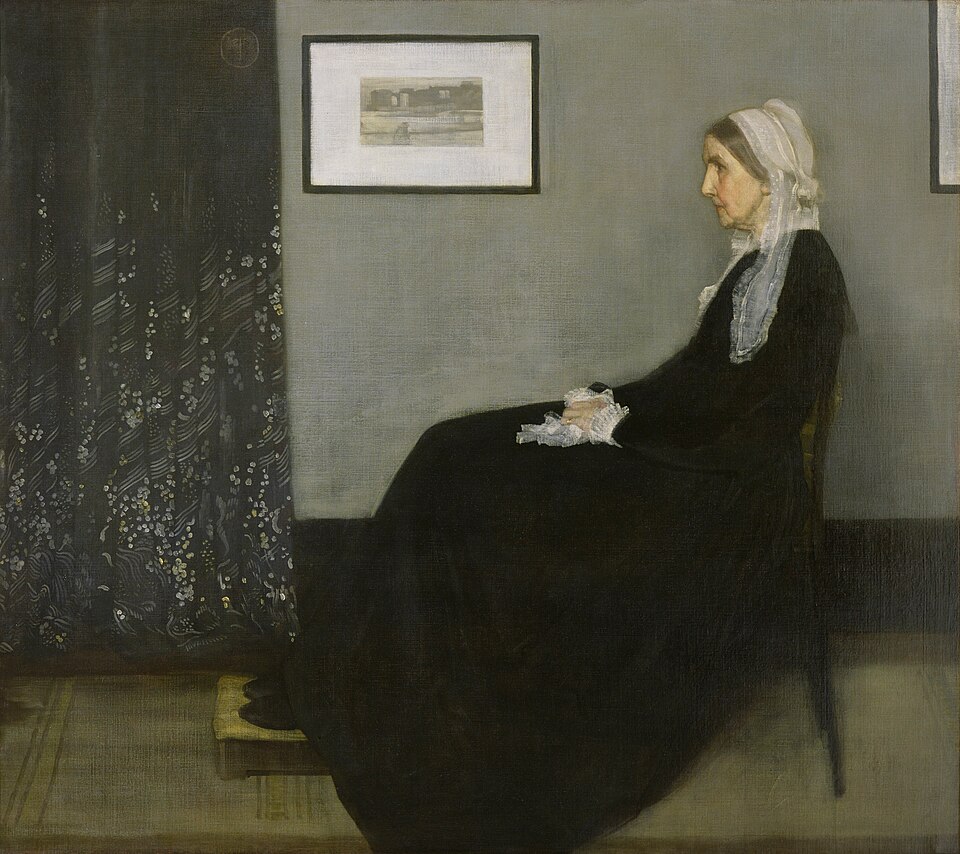
Whistler's Mother was bought by the French state in 1891 and hangs in the Musée d'Orsay. The Falling Rocket is at the Detroit Institute of Arts, Old Battersea Bridge at Tate Britain, and the whole Peacock Room at the Freer Gallery in Washington.
Story
In July 1877 the critic John Ruskin wrote, in Fors Clavigera, that he had seen much "cockney impudence" but never expected to hear a coxcomb ask the price he asked "for flinging a pot of paint in the public's face". The painting was Nocturne in Black and Gold: The Falling Rocket. Whistler sued for libel, and in November 1878 the case came to court over two days. Ruskin was too ill to attend; Edward Burne-Jones testified for him that Whistler's pictures were incomplete. Cross-examined by the Attorney General, Sir John Holker, Whistler admitted the Nocturne had taken about two days. Was that the labour he was charging for? "No; I ask it for the knowledge of a lifetime." The jury found for Whistler and awarded him one farthing, a quarter of a penny, and each side bore its own costs. His, on top of the debts from building his new house in Tite Street, Chelsea, had made him bankrupt by May 1879. Within a month of the verdict he had published his side as a pamphlet, Whistler v. Ruskin: Art and Art Critics, which ran to five editions in two months. The Fine Art Society then sent him to Venice to make twelve etchings. He stayed fourteen months and came back with more than fifty, some of the most celebrated etchings he ever made.
Key works
- Thames Set (sixteen etchings) (published 1871) - Ellis & Green
- Arrangement in Grey and Black No. 1 (Whistler's Mother) (1871) - Musee d'Orsay, Paris
- Nocturne: Blue and Gold - Old Battersea Bridge - Tate Britain, London
- Nocturne in Black and Gold - The Falling Rocket - Detroit Institute of Arts
- The Peacock Room - Freer Gallery of Art, Washington
- Venice etchings (First and Second Venice Sets) - published by the Fine Art Society
In museum collections
- Whistler's Mother (1871)
Musee d'Orsay ↗ · Find a print ↗ - Symphony in White, No. 1: The White Girl (1860)
National Gallery of Art ↗ · Find a print ↗ - Symphony in White, No. 2: The Little White Girl (1864)
Art UK ↗ · Find a print ↗ - Nocturne: Blue and Silver – Chelsea (1871)
Art UK ↗ · Find a print ↗ - Nocturne: Blue and Gold – Old Battersea Bridge (1872)
Art UK ↗ · Find a print ↗ - Arrangement in Grey and Black, No. 2: Portrait of Thomas Carlyle (1873)
Art UK ↗ · Find a print ↗ - Symphony in White, No. 3 (1866)
Art UK ↗ · Find a print ↗ - Mother of Pearl and Silver: The Andalusian (1800)
National Gallery of Art ↗ · Find a print ↗ - Nocturne in Blue and Silver (1871)
Harvard Art Museums ↗ · Art UK ↗ · Find a print ↗ - Arrangement in Flesh Color and Brown: Portrait of Arthur Jerome Eddy (1894)
Art Institute of Chicago ↗ · Find a print ↗ - Arrangement in Yellow and Gray: Effie Deans (1876)
Rijksmuseum ↗ · Find a print ↗ - Battersea Reach (1863)
National Gallery of Art ↗ · Find a print ↗
See the work
Prints
Books
Originals
See also
Browse all 2,101 artists · Open in the directory · Where the work hangs: 96 museums on a map