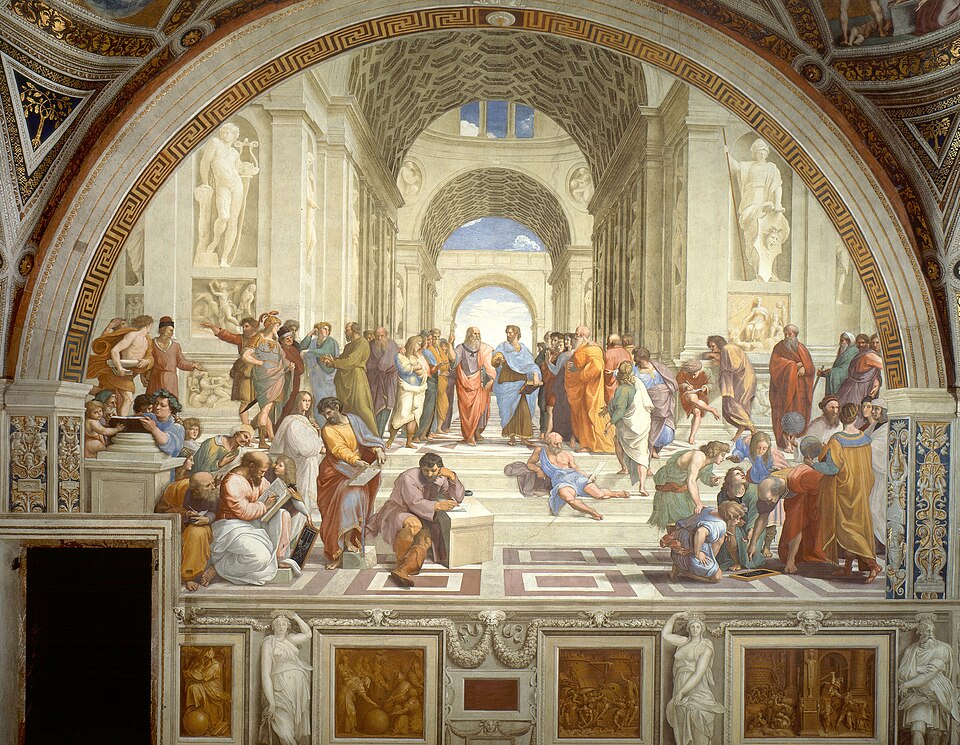
Raphael
Who
Painter and architect, born Raffaello Santi in Urbino in 1483 and dead in Rome on 6 April 1520, aged 37; he is buried in the Pantheon. His Roman years produced The School of Athens in the Vatican, the Sistine Madonna, the tapestry cartoons for the Sistine Chapel and the Transfiguration, left unfinished at his death.
Why they matter
He is the calm one of the three High Renaissance giants: balanced groups, clear space, grace without strain. His portrait of Julius II, in the National Gallery's words, became the model for church portraiture over the following two hundred years. And his work with the engraver Marcantonio Raimondi, who made about 50 prints from his designs, is what made the reproductive print matter.
What to buy
Prints: the National Gallery in London sells made-to-order reproductions of the Raphaels it owns - Pope Julius II among them - on art paper or stretched canvas, in the size and frame you choose. A print from the museum that owns the painting beats any generic Sistine Madonna cherub poster. Books: Taschen's Raphael. The Complete Works by Frank Zollner, Georg Satzinger, Michael Rohlmann and Rudolf Hiller von Gaertringen is the catalogue raisonne, 112 paintings plus the frescoes, tapestries and buildings, in an XXL volume of 720 pages; Taschen also lists a compact 512-page edition by Rohlmann. Both were marked forthcoming when we checked, so check the publisher's page for stock. Originals: Raphael's own paintings and drawings are in museums. What a collector can own is a sixteenth-century engraving by Marcantonio Raimondi after one of his designs. They come up at print auctions - Swann sold his Parnassus, after the Vatican fresco, in 2015 - catalogued by Bartsch number and described by impression and margins. Be exact about what you are buying: the plates stayed in use after the first printing, and the V&A holds a later impression, published by Antonio Salamanca, from a plate so worn that parts had been re-engraved. Ask for the state and an honest description of the impression; a worn or reworked one is a different thing from an early, crisp one.
Notes
The V&A shows seven surviving tapestry cartoons, on loan from the Royal Collection since 1865. The National Gallery's Julius II was only recognised as the original in 1970, having been regarded as a copy. The Sistine Madonna was bought for Dresden by Augustus III in 1754, taken to Moscow by the Red Army after the Second World War, and returned in 1955.
Story
The Raphael Cartoons were never meant to be looked at. Pope Leo X ordered them shortly after his election in 1513: full-size designs for ten tapestries on the lives of Saint Peter and Saint Paul, to hang in the Sistine Chapel. They went to the Brussels workshop of Pieter van Aelst, where the weavers worked from them on low-warp looms, so Raphael had to design every scene knowing it would come out reversed. To make them easier to handle and store, the huge sheets were cut into long vertical strips, probably when they were sent to Brussels in December 1516. Only seven of the cartoons survive. In 1623 Prince Charles, the future Charles I, bought them in Genoa and brought them to England still in strips - not as masterpieces to hang, but as designs for the newly founded tapestry works at Mortlake. After his execution the Commonwealth kept them as national property, and in 1698 William III had Christopher Wren build a gallery for them at Hampton Court. Queen Victoria lent them to the South Kensington Museum, now the V&A, in 1865. Since 1950 they have hung in the Raphael Court, a gallery of 546 square metres; the Sistine Chapel, for which they were made, is 548.
Key works
- The School of Athens (1511) - Stanza della Segnatura, Vatican
- Portrait of Pope Julius II (1511) - National Gallery, London
- Sistine Madonna (c. 1513-1514) - Gemaldegalerie Alte Meister, Dresden
- The Raphael Cartoons (c. 1515-1516) - V&A, London, lent from the Royal Collection
- Transfiguration (1520, unfinished) - Pinacoteca Vaticana
In museum collections
- Madonna of the Goldfinch (1505)
Uffizi ↗ · Find a print ↗ - La velata (1513)
Uffizi ↗ · Find a print ↗ - Madonna del Granduca (1506)
Art UK ↗ · Uffizi ↗ · Find a print ↗ - Alba Madonna (1510)
National Gallery of Art ↗ · Find a print ↗ - Madonna della Seggiola (1513)
Art UK ↗ · Uffizi ↗ · Find a print ↗ - Self-portrait (1505)
Art UK ↗ · Uffizi ↗ · Find a print ↗ - La Belle Jardinière (1500)
Louvre ↗ · Find a print ↗ - The Dream of a Knight (1504)
Art UK ↗ · Find a print ↗ - Madonna del Prato (1505)
Kunsthistorisches Museum ↗ · Find a print ↗ - Madonna of the Pinks (1506)
Art UK ↗ · Find a print ↗ - Portrait of Baldassare Castiglione (1515)
The Met ↗ · Louvre ↗ · Find a print ↗ - Mond Crucifixion (1502)
Art UK ↗ · Find a print ↗
See the work
Prints
Books
Originals
See also
Browse all 2,101 artists · Open in the directory · Where the work hangs: 111 museums on a map