Titian
Who
Tiziano Vecellio, born around 1488-1490 (in old age he claimed 1474, which scholars doubt) and dead in Venice during a plague on 27 August 1576. A Venetian painter of altarpieces, portraits and mythologies, made a Count Palatine and Knight of the Golden Spur by the Emperor Charles V in 1533, and later painter to Philip II of Spain.
Why they matter
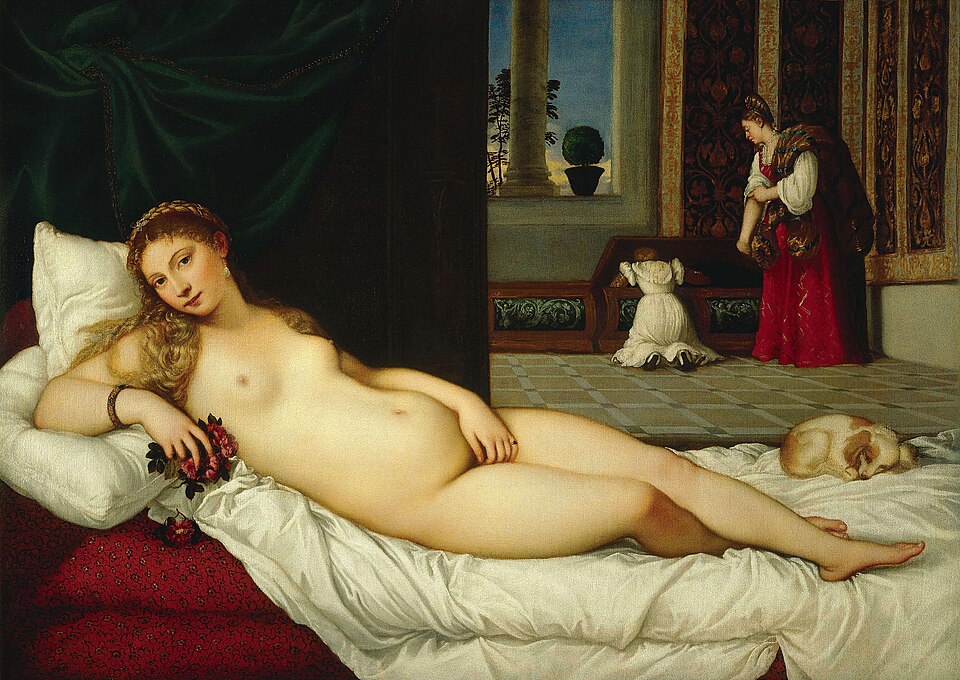
He made colour, not outline, the heart of painting. The Assumption in the Frari created a sensation in 1518 with its scale and colour; the Venus of Urbino is the best known of his reclining Venuses; and the Ovid mythologies he called "poesie", painted for Philip II, were meant as visual equivalents of poetry. His influence runs through Velazquez and Van Dyck, and his late work, loose in brushwork and subtle in tone, is still the most original thing he did.
What to buy
Prints: the National Gallery in London owns Bacchus and Ariadne and prints it to order from its own photography, on art paper or stretched canvas, in three sizes, framed or not. It is the right picture to hang: the sky is ultramarine used at full strength, mixed only with white, and a print made from the owner's own photography is the best chance of seeing that blue at home. Books: Ian G. Kennedy's Titian in Taschen's Basic Art series is a 96-page hardback with about a hundred illustrations, by a former curator of European paintings at the Nelson-Atkins, and is the cheapest honest way in. Originals: not realistic. The paintings are in churches, royal collections and museums; anything offered as "Titian" at an ordinary sale is a copy, a workshop piece or a follower's work.
Notes
Bacchus and Ariadne was painted for Alfonso d'Este, Duke of Ferrara, and bought by the National Gallery in 1826. Diana and Actaeon, one of the poesie for Philip II, is owned jointly by the National Gallery and the National Galleries of Scotland, who bought it together in 2009; Titian told the king he had worked on it and its pair, Diana and Callisto, for more than three years. The Flaying of Marsyas, now counted among his great late works, was barely known until it entered the literature in 1909.
Story
Titian painted his last picture for his own grave, and spent his last years fighting over where it would hang. Around 1575 he was working on a Pieta nearly four metres high, meant to go above his tomb in the Frari in Venice, the church that already held two of his great altarpieces. He thought he had an agreement with the friars. But they would not move a famous crucifix from the chapel he had chosen, and hung his painting in another chapel instead. Titian was furious. He got the papal nuncio in Venice to order the friars to give it back, in a decree of 1 March 1575, took it home, and enlarged it to fit over the high altar of the church at Pieve di Cadore, where he now meant to be buried. Then plague reached Venice. In 1576 Titian and his son Orazio died within days of each other; inside the painting, a small votive picture shows two figures agreed to be the pair of them, probably praying to be spared. His body could not be carried to Cadore, so he was quietly buried in the Frari after all. The painting stayed in Venice, unfinished, until Palma Giovane completed it and added an inscription below Christ recording his part. It has hung in the Accademia since 1814.
Key works
- Assumption of the Virgin (1516-1518) - Santa Maria Gloriosa dei Frari, Venice
- Bacchus and Ariadne (1520-1523) - National Gallery, London
- Venus of Urbino (c. 1538) - Uffizi, Florence
- Diana and Actaeon (1556-1559) - National Gallery, London, and National Galleries of Scotland, Edinburgh
- Pieta (c. 1575-1576) - Gallerie dell'Accademia, Venice
In museum collections
- Venus of Urbino (1538)
Uffizi ↗ · Find a print ↗ - Equestrian Portrait of Charles V (1548)
Museo del Prado ↗ · Find a print ↗ - Flora (1517)
Uffizi ↗ · Find a print ↗ - The Feast of the Gods (1514)
National Gallery of Art ↗ · Find a print ↗ - Allegory of Prudence (1550)
Art UK ↗ · Find a print ↗ - Diana and Actaeon (1557)
Art UK ↗ · Find a print ↗ - Bacchus and Ariadne (1520)
Art UK ↗ · Find a print ↗ - Woman with a Mirror (1515)
Louvre ↗ · Find a print ↗ - La Bella (1537)
Uffizi ↗ · Find a print ↗ - The Bacchanal of the Andrians (1523)
Museo del Prado ↗ · Find a print ↗ - La Schiavona (1510)
Art UK ↗ · Find a print ↗ - Pastoral Concert (1510)
Louvre ↗ · Find a print ↗
See the work
Prints
Books
See also
Browse all 2,101 artists · Open in the directory · Where the work hangs: 154 museums on a map