Suzanne Valadon
Who
Born Marie-Clementine Valadon on 23 September 1865 at Bessines-sur-Gartempe in the Limousin, she began modelling in Montmartre in 1880, at fifteen, for Renoir, Toulouse-Lautrec and Puvis de Chavannes among others. She learned by watching them, drew, etched under Degas's eye, then painted, and died in Paris on 7 April 1938. The painter Maurice Utrillo, born in 1883, was her son.
Why they matter
She crossed from one side of the easel to the other, and brought what she knew with her. Her nudes are heavy, unposed women bathing and drying themselves, and her 1923 Blue Room turns the reclining odalisque into a clothed woman in striped trousers with a cigarette in her mouth. She painted the male nude too, at full scale, ground a woman painter of her day could barely stand on. In 1894 she was the first woman admitted to exhibit at the Salon of the Societe Nationale des Beaux-Arts. The Barnes Foundation's 2021 show was the first devoted to her at a major American institution, and the Centre Pompidou gave her a full retrospective in 2025.
What to buy
Originals: her etchings are the realistic way in. Degas bought her drawings and taught her soft-ground etching, and she made about thirty plates, mostly women at their toilette. In 1932 eighteen plates engraved between 1895 and 1910 were printed at the Daragnes press for an album published in an edition of 75, with a preface by Claude Roger-Marx; she signed the sheets in pencil. Those 1932 impressions are what the market mostly offers - a dealer should say so and give the Petrides number. Impressions printed in her working years are rare, and at least one plate was lost before 1932, so a sheet sold as a "lifetime" impression needs a dealer who can say how they know. Prints: a reproduction of The Blue Room or of the Met's Joy of Life is the cheapest honest way in; buy one that names the museum. Books: the catalogue raisonne is Paul Petrides, L'oeuvre complet de Suzanne Valadon (1971), covering paintings, drawings and etchings, now found secondhand. In English, Suzanne Valadon: Model, Painter, Rebel, edited by Nancy Ireson (Barnes Foundation with Paul Holberton, 2021), is the recent book to read.
Notes
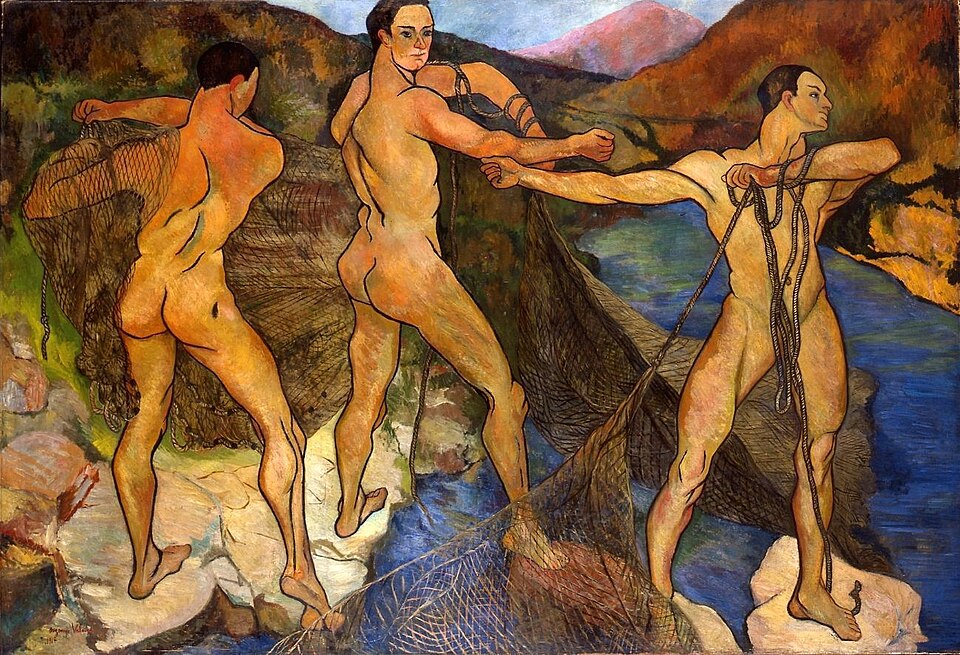
The Centre Pompidou holds the key paintings: Adam and Eve and Casting the Net, both bought by the State in 1937, the year before she died, and The Blue Room, given by Lord Duveen in 1926. The Met has Joy of Life (1911), Lilacs and Peonies (1929) and a red-chalk Standing Nude of 1902. She is the woman dancing in Renoir's Dance in the City (1883) at the Musee d'Orsay; whether she is also the dancer in his Dance at Bougival in Boston is disputed. Her second husband, the painter Andre Utter, was twenty-one years younger than she was and the model for her male nudes.
Story
In 1909 Valadon, in her forties, met a 24-year-old painter, Andre Utter. That year she painted Adam and Eve: a man and a woman, naked, on a canvas more than a metre and a half high. Eve is Valadon. Adam is Utter. The Centre Pompidou calls it what it is, a self-portrait with her lover disguised as the Bible.
A woman painting a naked man was not done. When the picture was finally shown in public, at the Salon d'Automne of 1920, Adam wore a belt of vine leaves. An early photograph of the canvas shows he did not have one to begin with; the museum thinks the leaves were painted in at the request of the Salon's organisers. They are still there.
Utter went on posing. In 1914 she painted him three times over on a single canvas three metres wide, a young man hauling a fishing net, and showed it at the Salon des Independants, where the avant-garde critics disliked it; it was her last big picture of the male nude. The couple married the same year. In 1937 the French State bought both paintings. The woman who had begun as other painters' model is now in the national collection twice, with the man she chose as hers.
Key works
- Adam and Eve (1909) - Centre Pompidou, Paris
- Joy of Life (1911) - The Met, New York
- Casting the Net (1914) - Centre Pompidou, Paris
- The Blue Room (1923) - Centre Pompidou, Paris
- Lilacs and Peonies (1929) - The Met, New York
In museum collections
- Joy of Life (1911)
The Met ↗ · Find a print ↗ - Portraits of the Family (1912)
Musee d'Orsay ↗ · Find a print ↗ - Femmes au bain (1893)
National Gallery of Art ↗ · Find a print ↗ - La Toilette (1895)
National Gallery of Art ↗ · Find a print ↗ - Lilacs and Peonies (1929)
The Met ↗ · Find a print ↗ - Reclining Nude (1928)
The Met ↗ · Find a print ↗ - Portrait of Mme Zamaron (1922)
MoMA ↗ · Find a print ↗ - Untitled (Still Life) (1921)
Nelson-Atkins Museum of Art ↗ · Find a print ↗
See the work
Prints
Books
Originals
See also
Browse all 2,101 artists · Open in the directory · Where the work hangs: 63 museums on a map