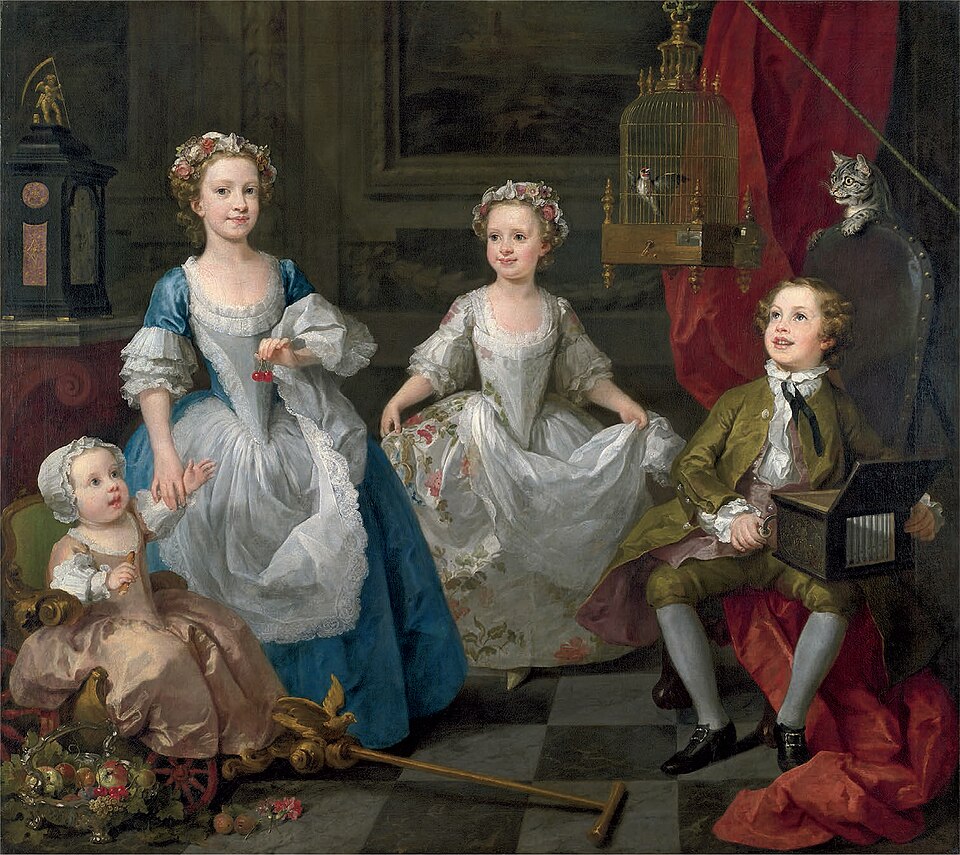
William Hogarth
Who
Painter and engraver, born in London on 10 November 1697 and died there on 26 October 1764. He made his name with "modern moral subjects": series of paintings telling a story of London life scene by scene, painted in order to be engraved and sold as sets of prints.
Why they matter
He invented the narrative picture series as a commercial product and sold it to the public directly, by subscription, rather than through a patron. The prints made him famous and the piracy they attracted made him a lawmaker: the Engravers' Copyright Act of 1735 was the first copyright law to cover visual works and the first to recognise an individual artist's rights.
What to buy
Originals: this is one of the few old masters whose genuine prints an ordinary collector can own. He published over 200 plates in large editions, kept the copper plates until his death, and they went on being printed from for nearly sixty years. His widow Jane issued impressions until 1789; John Boydell then bought the plates and published complete folios in 1790, 1794 and 1795; Baldwin, Cradock and Joy bought them in 1818 and issued The Works of William Hogarth in 1822 with the plates "restored" by the engraver James Heath. The same worn plates were reissued under Heath's title into the 1830s and by Henry Bohn into the 1840s, so a "Heath" sheet may be from 1822 or twenty years later, and the earlier the better. Single Heath and Boydell sheets are the cheapest honest way in. Hogarth's own printings are on laid paper, though Jane and Boydell used laid paper too; thick wove paper usually means a nineteenth-century printing. Beware the copies: Thomas Cook's engravings of 1796-1803 are his own versions on new plates, not Hogarth's, and a "Hogarth" from outside these editions is a copy or a re-cut plate. Ask for the edition, not just "18th-century". Prints: the Met publishes its impressions online, and the National Gallery's Marriage A-la-Mode reproduces well. Books: Ronald Paulson's Hogarth's Graphic Works (third edition, The Print Room, 1989) is the standard catalogue of the prints; Dover's Engravings by Hogarth is the cheap reference to hang beside them.
Notes
The eight Rake's Progress paintings have been at Sir John Soane's Museum in London since 1802. The National Gallery holds the six Marriage A-la-Mode paintings, The Shrimp Girl and The Graham Children. The Harlot's Progress paintings were destroyed in a fire at William Beckford's Fonthill House in 1755, so that series survives only in the engravings.
Story
Hogarth's first series, A Harlot's Progress, was sold in 1732 to subscribers as sets of six engravings, 1,240 of them. The pirates moved faster than he could. Copies of the harlot were on sale almost at once, and when he painted his second series, A Rake's Progress, he found that plagiarists were sending "mean and necessitous persons" to his house at the Golden Head in Leicester Fields, posing as subscribers, to look at the paintings and memorise them. A pirated version, The Progress of a Rake, Exemplified in the Adventures of Ramble Gripe, Esq., was advertised in June 1735 before his own prints existed. Hogarth's answer was to lobby Parliament. An act "for the encouragement of the arts of designing, engraving, and etching historical and other prints, by vesting the properties thereof in the inventors and engravers" became law on 25 June 1735, the first copyright law to deal with pictures and the first to recognise an individual artist's rights. Hogarth held back the Rake's Progress engravings until that very day and published them the moment the law could protect them. It is still called Hogarth's Act. The paintings of the harlot he had been protecting did not last: they burned at Fonthill in 1755, and the prints are all that survive of them.
Key works
- A Harlot's Progress (six engravings) (1732) - the paintings burned at Fonthill in 1755
- A Rake's Progress (eight paintings) (1733-1734) - Sir John Soane's Museum, London
- Marriage A-la-Mode (six paintings) (1743-1745) - National Gallery, London
- The Shrimp Girl (1740-1745) - National Gallery, London
- The Graham Children (1742) - National Gallery, London
- Gin Lane and Beer Street (engravings) (1751)
In museum collections
- The Four Stages of Cruelty
V&A ↗ · Find a print ↗ - The Graham Children (1742)
Art UK ↗ · Find a print ↗ - The Shrimp Girl (1743)
Art UK ↗ · Find a print ↗ - Beer Street and Gin Lane (1751)
V&A ↗ · Find a print ↗ - The Painter and his Pug (Self-portrait) (1745)
Art UK ↗ · Find a print ↗ - Hogarth's Servants (1752)
Art UK ↗ · Find a print ↗ - Strolling Actresses Dressing in a Barn (1738)
National Gallery of Art ↗ · Find a print ↗ - The Distrest Poet (1736)
Art UK ↗ · V&A ↗ · Find a print ↗ - David Garrick as Richard III (1745)
Art UK ↗ · Find a print ↗ - Marriage A-la-Mode: 2. The Tête à Tête (1743)
Art UK ↗ · Find a print ↗ - Marriage A-la-Mode: 6. The Lady's Death (1743)
Art UK ↗ · Find a print ↗ - The Orgy (1735)
Art UK ↗ · Find a print ↗
See the work
Prints
Books
Originals
See also
Browse all 2,101 artists · Open in the directory · Where the work hangs: 90 museums on a map