Artemisia Gentileschi
Who
Roman painter, daughter of Orazio Gentileschi and the most accomplished follower of Caravaggio. First woman admitted to the Accademia delle Arti del Disegno in Florence, in 1616. Worked in Rome, Florence, Venice, Naples and, briefly, London.
Why they matter
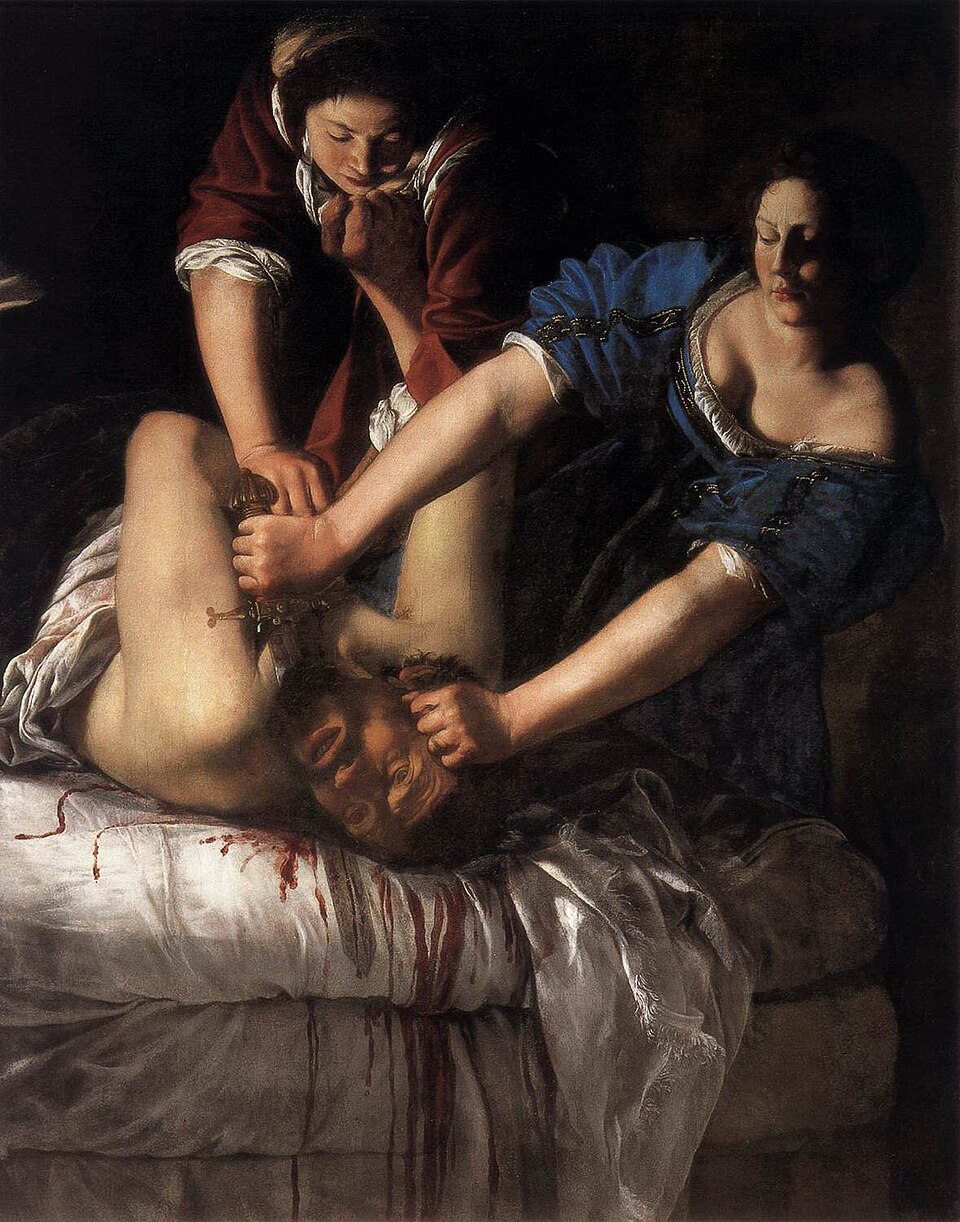
The Judith paintings are the most physically convincing scenes of violence in Baroque art, and she painted women as agents rather than ornaments across her whole career. Her rediscovery over the last fifty years is the clearest case of a major artist written out of the story and written back in.
What to buy
Prints: reproductions of the Uffizi Judith are easy to find and mostly poor; the Uffizi's own image is free and large. Books: the National Gallery London 2020 exhibition catalogue is the current standard introduction. Originals: none. New attributions do surface at auction, at prices in the millions.
Notes
Her rape by the painter Agostino Tassi in 1611 and the subsequent trial, transcripts of which survive, has dominated popular accounts of her life; the recent scholarship tries to put the paintings first.
Key works
- Judith Slaying Holofernes (c. 1612-1613) - Museo di Capodimonte, Naples
- Judith Beheading Holofernes (c. 1620) - Uffizi, Florence
- Self-Portrait as the Allegory of Painting (1638-1639) - Royal Collection
- Susanna and the Elders (1610) - Schloss Weissenstein, Pommersfelden
In museum collections
- Danaë (1612)
Saint Louis Art Museum ↗ · Find a print ↗ - Judith Beheading Holofernes (1620)
Uffizi ↗ · Find a print ↗ - Esther before Ahasuerus (1629)
The Met ↗ · Find a print ↗ - Conversion of the Magdalene (1620)
Uffizi ↗ · Find a print ↗ - Self-Portrait as Saint Catherine of Alexandria (1614)
Art UK ↗ · National Museum Norway ↗ · Find a print ↗ - Lucretia (1630)
Getty ↗ · Find a print ↗ - Mary Magdalene in Ecstasy (1625)
National Gallery of Art ↗ · Find a print ↗ - Nativity of St. John the Baptist (1635)
Museo del Prado ↗ · Find a print ↗ - Saint Catherine of Alexandria (1632)
Nationalmuseum Sweden ↗ · Find a print ↗ - Judith and her maidservant with the head of Holofernes (1608)
National Museum Norway ↗ · Find a print ↗ - Susanna and the Elders (1630)
Art UK ↗ · Find a print ↗ - The Sleeping Christ Child (1630)
MFA Boston ↗ · Find a print ↗
See the work
Prints
Books
See also
Browse all 2,101 artists · Open in the directory · Where the work hangs: 37 museums on a map