Caravaggio
Who
Michelangelo Merisi, born in Milan on 29 September 1571 and dead at Porto Ercole in Tuscany on 18 July 1610. Made his name in Rome, killed a young man there in 1606 and fled under a death sentence, working in Naples and Malta, where he was made a knight in 1607 and expelled the next year.
Why they matter
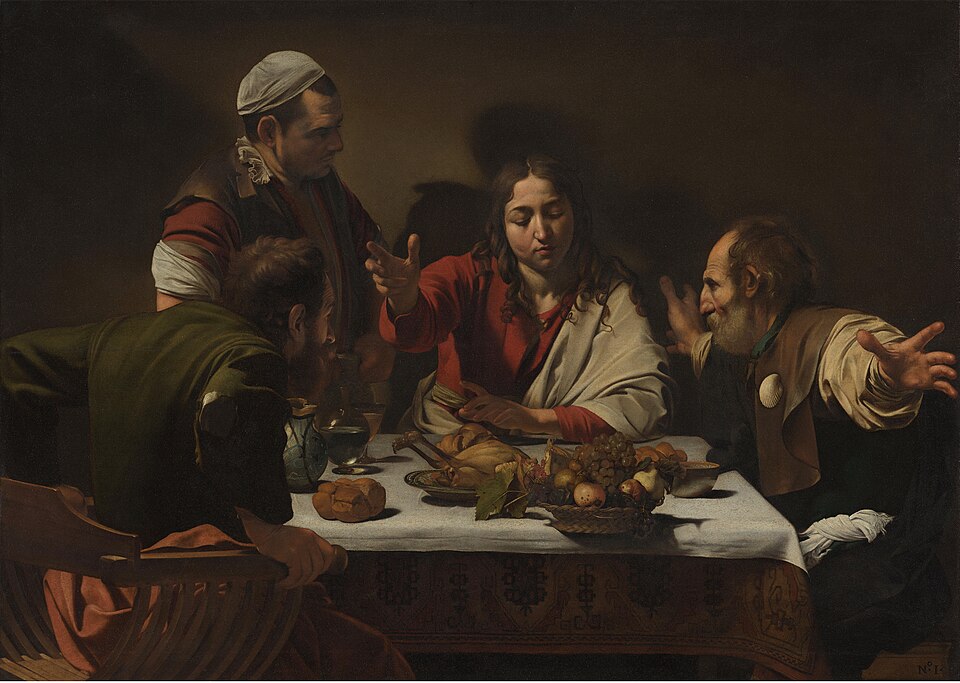
He painted scripture as if it were happening in the street outside: ordinary faces and a single hard light cutting figures out of the dark. The Supper at Emmaus gives Christ a beardless young face and sets a fruit basket teetering on the edge of the table, right at the viewer. His followers carried the manner on, and Artemisia Gentileschi was the most accomplished of them.
What to buy
Prints: the National Gallery in London sells The Supper at Emmaus made to order, on art paper or stretched canvas, in the size and frame you choose. A reproduction from the museum that owns the painting is the one to trust over an anonymous poster. Books: Sebastian Schutze's Caravaggio. The Complete Works for Taschen is a catalogue raisonne of every painting, with five chapters on his career; the 45th Edition is a compact 512-page hardback and the cheapest honest way to own the whole work. Originals: not realistic. The paintings are in churches and museums; a "Caravaggio" offered at an ordinary sale or online is a copy or a follower's work, whatever the listing says.
Notes
The Beheading of Saint John in Valletta is the only painting he signed. The Taking of Christ hangs in the National Gallery of Ireland on indefinite loan from the Jesuit Community in Dublin. Contemporary sources said he died of fever on the way from Naples to Rome; the cause is still argued over.
Story
One of Caravaggio's great paintings spent about sixty years on the wall of a Jesuit house in Dublin, taken for a copy. The Taking of Christ was painted around 1602 for the Roman nobleman Ciriaco Mattei. By the late eighteenth century it had dropped out of sight: when Giuseppe Vasi catalogued it in 1786 he gave it to the Dutch painter Gerard van Honthorst, and in 1802 the Mattei family sold it under that name to the Scottish collector William Hamilton Nisbet. It later passed to an Irish doctor, Marie Lea-Wilson, who gave it to the Jesuit Fathers in Dublin in the 1930s in gratitude for their support after her husband was assassinated. There it hung as a copy of a lost original. In the early 1990s the conservator Sergio Benedetti, examining the community's pictures, recognised it, and restoration confirmed it. The Jesuits lent it to the National Gallery of Ireland, where it remains. The man holding up a lantern to the arrest is believed to be Caravaggio himself.
Key works
- The Cardsharps (c. 1594) - Kimbell Art Museum, Fort Worth
- Basket of Fruit (c. 1595-1596) - Milan
- The Calling of Saint Matthew (1599-1600) - Rome
- The Supper at Emmaus (1601) - National Gallery, London
- The Taking of Christ (c. 1602) - National Gallery of Ireland, Dublin, on loan from the Jesuit Community
- The Beheading of Saint John (1608) - Valletta
In museum collections
- Supper at Emmaus (1601)
Art UK ↗ · Find a print ↗ - Death of the Virgin (1603)
Louvre ↗ · Find a print ↗ - Bacchus (1598)
Uffizi ↗ · Find a print ↗ - The Fortune Teller (1594)
Louvre ↗ · Find a print ↗ - Boy Bitten by a Lizard (1594)
Art UK ↗ · Find a print ↗ - The Musicians (1595)
The Met ↗ · Find a print ↗ - Madonna of the Rosary (1607)
Kunsthistorisches Museum ↗ · Find a print ↗ - David and Goliath (1600)
Museo del Prado ↗ · Find a print ↗ - David with the Head of Goliath (1607)
Kunsthistorisches Museum ↗ · Find a print ↗ - Salome with the Head of John the Baptist (1607)
Art UK ↗ · Find a print ↗ - The Crowning with Thorns (1602)
Kunsthistorisches Museum ↗ · Find a print ↗ - Sacrifice of Isaac (1603)
Uffizi ↗ · Find a print ↗
See the work
Prints
Books
See also
Browse all 2,101 artists · Open in the directory · Where the work hangs: 54 museums on a map