Berthe Morisot
Who
Born on 14 January 1841 in Bourges, she died in Paris on 2 March 1895 of pneumonia caught while nursing her daughter, Julie Manet. Her mother was a great-niece of Fragonard. She first showed at the Salon in 1864 and in 1874 married Eugene Manet, Edouard Manet's brother.
Why they matter
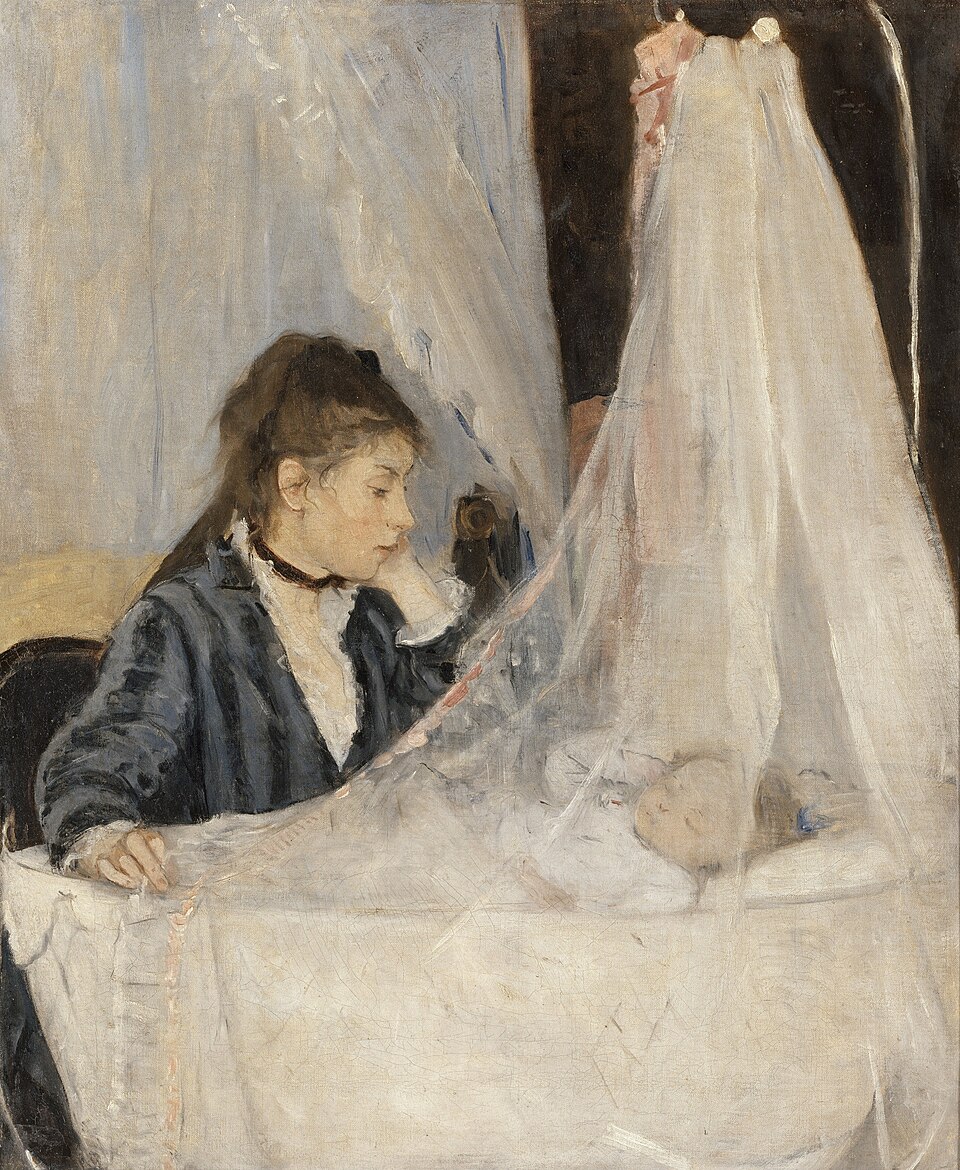
She was the only woman in the Impressionist group when it formed, and she showed at the first exhibition in 1874 and at every one of the eight but 1879, the year Julie was born. The Cradle, her sister Edma watching her sleeping baby, hung in that first show; it failed to sell, stayed in the family, and was bought by the Louvre in 1930. Her subject was the private life of women - sisters, daughters, mothers, a morning at the mirror - painted with quick, open brushwork.
What to buy
Prints: go to the museums that own the paintings. The National Gallery in London sells a print of Summer's Day, and the National Gallery of Art in Washington prints The Harbor at Lorient to order from its own photography; both keep her pale, broken colour better than a generic poster. Books: Berthe Morisot, Woman Impressionist (Rizzoli, 2018), edited by Sylvie Patry for the exhibition of the same name, is the current standard introduction. Originals: her paintings are museum pieces, but she made eight drypoints in the late 1880s, and these are the honest way in. Ask when an impression was printed. The plates were printed after her death for Theodore Duret's books on the Impressionists and later by Vollard, and at least one was cancelled by piercing and still printed again, so holes in the image mean a late impression. A serious dealer names the state and the printing and cites Janine Bailly-Herzberg's catalogue of her prints.
Notes
The Cradle is in the Musee d'Orsay, The Harbor at Lorient in Washington, The Psyche Mirror in the Thyssen-Bornemisza in Madrid. Her daughter Julie Manet became a painter and collector herself.
Story
Summer's Day, two women in a rowing boat on the lake in the Bois de Boulogne, belonged to the Lane Bequest, a group of pictures that London and Dublin both claimed as theirs. In April 1956 two Irish students decided to make the point in person. Paul Hogan, an art student, used his student status to get into the Tate with Billy Fogarty, and they timed their move for the guards' morning tea break.
On the first attempt the painting stuck to the wall and a guard came back, so they waited. On the second, Hogan lifted it down and walked out along the main corridor with an Impressionist masterpiece under his arm. A press photographer caught him leaving. The two took a taxi to Piccadilly Circus and hid the picture under the bed of a woman Hogan had met the night before; she handed it in at the Irish Embassy in London. The students were never charged.
Since 1959 the painting has been shared between the National Gallery in London and the Hugh Lane Gallery in Dublin, and in February 2026 it went back to Dublin on a five-year loan - seventy years after two students tried to carry it there themselves.
Key works
- The Harbor at Lorient (1869) - National Gallery of Art, Washington
- The Cradle (1872) - Musee d'Orsay, Paris
- The Psyche Mirror (1876) - Museo Thyssen-Bornemisza, Madrid
- Summer's Day (c. 1879) - National Gallery, London (on loan to the Hugh Lane, Dublin, 2026-2031)
In museum collections
- The Cradle (1872)
Musee d'Orsay ↗ · Find a print ↗ - Summer's Day (1879)
Art UK ↗ · Find a print ↗ - The Mother and Sister of the Artist (1869)
National Gallery of Art ↗ · Find a print ↗ - The Port at Lorient (1869)
National Gallery of Art ↗ · Find a print ↗ - In the Dining Room (1886)
National Gallery of Art ↗ · Find a print ↗ - Young Girl in a Ball Gown (1879)
Musee d'Orsay ↗ · Find a print ↗ - Woman at Her Toilette (1877)
Art Institute of Chicago ↗ · Find a print ↗ - Louise Riesener (1888)
Musee d'Orsay ↗ · Find a print ↗ - Banks of the Seine (1883)
National Museum Norway ↗ · Find a print ↗ - In the Bois de Boulogne (1880)
Nationalmuseum Sweden ↗ · Find a print ↗ - The Artist's Sister at a Window (1869)
National Gallery of Art ↗ · Find a print ↗ - The Children of Gabriel Thomas (1894)
Musee d'Orsay ↗ · Find a print ↗
See the work
Prints
Books
Originals
See also
Browse all 2,101 artists · Open in the directory · Where the work hangs: 80 museums on a map