Paula Modersohn-Becker
Who
Born on 8 February 1876 in Dresden, she died on 20 November 1907 in Worpswede, aged 31, of a pulmonary embolism eighteen days after the birth of her daughter. She joined the artists' colony at Worpswede near Bremen in 1898, married the landscape painter Otto Modersohn in 1901, and made repeated stays in Paris from 1900, where she absorbed Cezanne and the Post-Impressionists.
Why they matter
In a working life of barely ten years she made more than 700 paintings and over 1,000 drawings, and sold few of them. She was the first known woman painter to paint nude self-portraits, and the first believed to paint herself pregnant: flat, simplified, heavy figures that point straight to German Expressionism, made before it had a name. In 1927 she became the first woman to have a museum devoted to her art alone, in Bremen; ten years later the Nazis purged about 70 of her paintings from German museums as degenerate.
What to buy
Prints: buy one that names the painting and the museum that holds it - the Paula Modersohn-Becker Museum in Bremen or the Museum Folkwang in Essen - and prefer one taken from a museum's photography. Her earthy colour and matt oil-tempera surfaces go muddy in cheap printing, so look at the colour before you buy. Books: Diane Radycki's Paula Modersohn-Becker: The First Modern Woman Artist (Yale University Press, 2013) is the standard book in English. Originals: the paintings are museum pieces and not a realistic buy. Her etchings exist, but in posthumous printings - the National Gallery of Art catalogues its Old Woman as printed after 1919 by Felsing - so ask when any impression was pulled, and do not treat one as a lifetime print without documentation.
Notes
The Paula Modersohn-Becker Museum, opened by the businessman Ludwig Roselius in 1927, is part of the Museen Bottcherstrasse in Bremen and holds the wedding-anniversary self-portrait; her 1906 portrait of Rilke is in Bremen's Museen Böttcherstraße. Rilke wrote his Requiem for a Friend for her in 1908, on the first anniversary of her death, though in 1922 he was still dismissing the portraits made of him, hers included.
Story
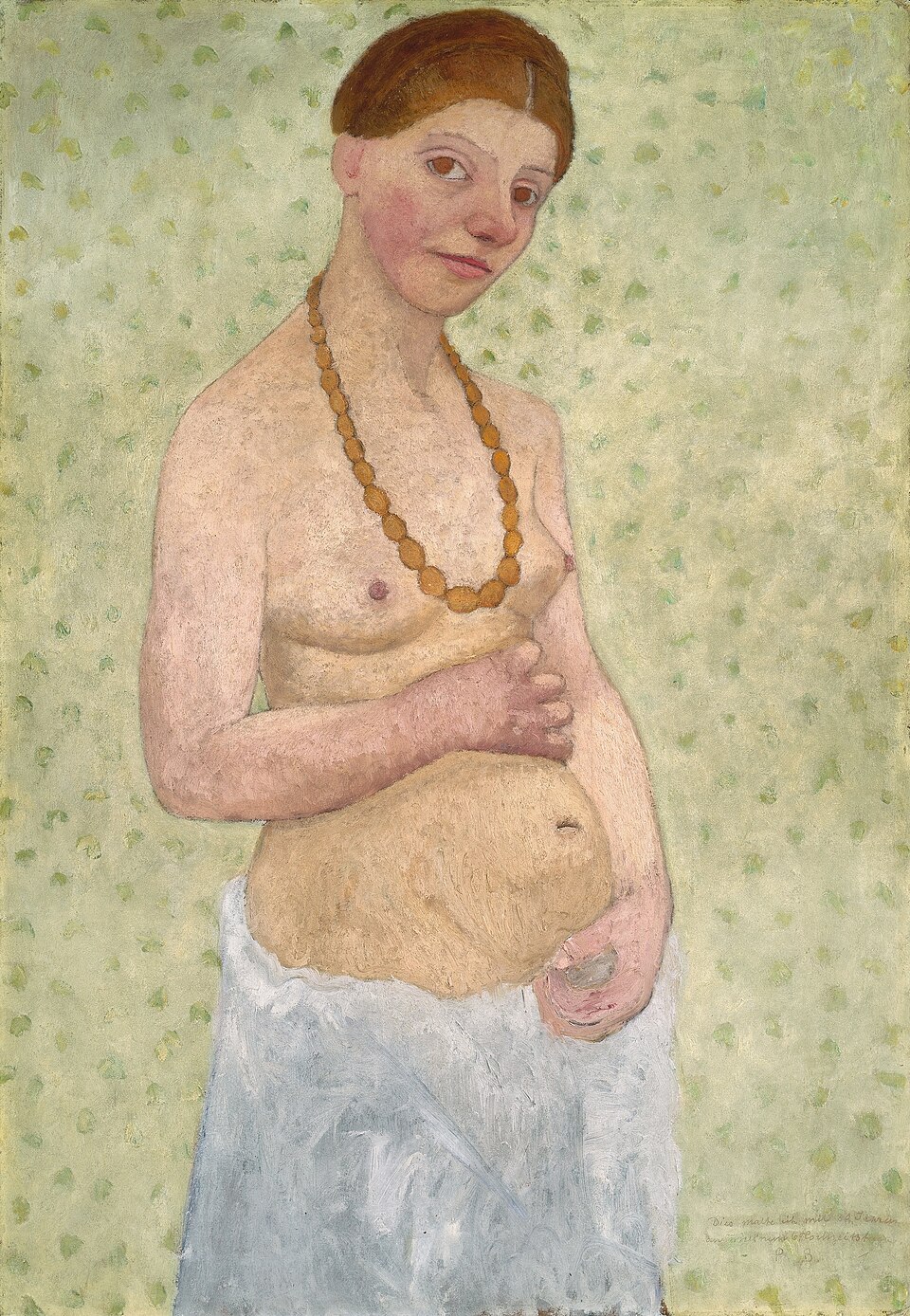
On 25 May 1906, in Paris, she painted herself bare to the hips, an amber necklace at her throat, a white cloth at her hips, and a belly that looks pregnant. She wrote across the corner: "Dies malte ich mit 30 Jahren an meinem 6. Hochzeitstag. P. B." - I painted this at 30 on my sixth wedding anniversary.
Almost none of it was true. She had married Otto Modersohn on 25 May 1901, so it was the fifth anniversary, not the sixth. She was not pregnant. And the initials left out her husband's name: in February she had moved to Paris, having decided to leave him and Worpswede for good and give herself entirely to art. The picture is the first known nude self-portrait by a woman painter, and she made it as a declaration of independence.
It did not last. In 1907 she went back to Otto in Worpswede, and this time she was pregnant. Her daughter Mathilde was born on 2 November; on 20 November she died of an embolism, aged 31. Her last words were "What a pity." The painting of a pregnancy that had not happened was hardly known in her lifetime; it stayed with her family and then with Ludwig Roselius, and the museum in Bremen acquired it in 1988.
Key works
- Self-Portrait at 6th Wedding Anniversary (1906) - Paula Modersohn-Becker Museum, Bremen
- Portrait of Rainer Maria Rilke (1906) - Museen Böttcherstraße, Bremen
- Self-Portrait with Camellia Branch (1906-1907) - Museum Folkwang, Essen
In museum collections
- Birch Tree in a Landscape (1899)
Harvard Art Museums ↗ · Find a print ↗ - Chalet (1899)
National Gallery of Art ↗ · Find a print ↗ - Fruit Tree in Bloom (1900)
National Gallery of Art ↗ · Find a print ↗ - Half-Nude Woman Holding Her Hair Apart (1898)
National Gallery of Art ↗ · Find a print ↗ - Landscape with Trees (1902)
National Gallery of Art ↗ · Find a print ↗ - Landscape with Windblown Trees
Art UK ↗ · Find a print ↗ - Old Factory (1900)
National Gallery of Art ↗ · Find a print ↗ - Old Woman
National Gallery of Art ↗ · Find a print ↗ - Portrait of a Woman (1898)
National Gallery of Art ↗ · Find a print ↗ - Seated Old Woman (1900)
National Gallery of Art ↗ · Find a print ↗ - Self-Portrait with Two Flowers in Her Raised Left Hand (1907)
MoMA ↗ · Find a print ↗ - Seven Trees (1902)
The Met ↗ · Find a print ↗
See the work
Prints
Books
See also
Browse all 2,101 artists · Open in the directory · Where the work hangs: 42 museums on a map