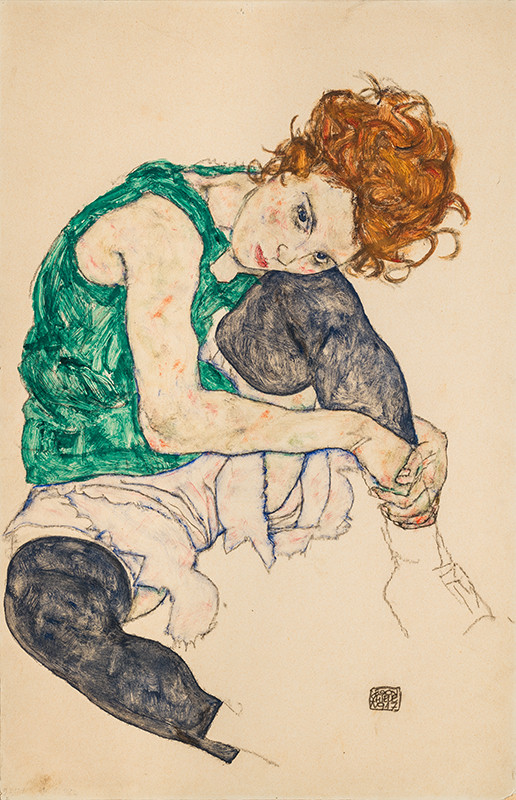
Egon Schiele
Who
Born on 12 June 1890 in Tulln an der Donau, in Austria-Hungary, and died in Vienna on 31 October 1918, aged 28, of the Spanish flu - three days after his wife Edith died of it. Gustav Klimt took him up from 1907, buying and swapping drawings and introducing him to patrons. In 1912, at Neulengbach, he spent 21 days in custody over his drawings; a judge burned one of them. Six years later his fifty works in the 1918 Vienna Secession exhibition made it a triumph.
Why they matter
He drew the body as nobody in Vienna had dared to: angular, bony, twisted, exposed, his own included. He learned from Klimt and then went the other way: less ornament, emptier grounds, and the line left to carry everything. His work on paper - more than two thousand unique drawings and watercolours in a career of barely a decade - is the core of it, and the self-portraits are among the most unsparing ever made.
What to buy
Prints: the Belvedere, which holds 14 of his paintings, sells made-to-order giclee prints of its own Schieles - Death and the Maiden, The Family, The Embrace and others - which is the best source for the oils; being custom-made, they cannot be returned. For the drawings, choose a reproduction at the size of the sheet, not a blown-up poster. Books: Taschen's Basic Art Schiele by Reinhard Steiner is the cheapest good introduction, and Tobias G. Natter's Egon Schiele. The Paintings (Taschen, 512 pages) the big one. The standard catalogue is Jane Kallir's Egon Schiele: The Complete Works (1990, expanded 1998), now continued online by the Kallir Research Institute. Originals: the paintings are museum pieces, and a drawing or watercolour is a serious purchase that should come with its Kallir number. His prints are the realistic tier, and there are only seventeen. At his death only one, the self-portrait Male Nude I, had been published in a signed edition. In 1922 the Verlag Neuer Graphik/Rikola issued the portfolio Das graphische Werk von Egon Schiele, an edition of 80 with all six etchings and his last two lithographs. Then the plates went on printing: the Self-Portrait and Portrait of Franz Hauer in editions of 65 in 1966, Portrait of Arthur Roessler in 80 in 1970, Squatting Woman in 100 in 1990. Always ask which printing an etching is, and check it against Kallir; a sheet with no catalogue number, or a signature printed in the image, is a reproduction until proven otherwise.
Notes
The Leopold Museum in Vienna holds more than 200 of his works, including the paired portraits of 1912 of himself and of Wally Neuzil. The Belvedere was the first museum in Austria to buy one of his paintings in his lifetime, the portrait of his wife Edith in 1918. The Albertina holds works on paper, and there is an Egon Schiele Museum in his birthplace, Tulln.
Story
In 1912 Schiele painted Wally Neuzil, the model and lover he had met the year before, as a pendant to his Self-Portrait with Chinese Lantern Plant. By 1939 the portrait belonged to Lea Bondi Jaray, a Jewish art dealer in Vienna. That year the dealer Friedrich Welz saw it in her apartment and, under the Nazi "Aryanization" of Jewish property, demanded she hand it over. She fled to London. After the war American forces recovered it from Welz but mistook it for part of Heinrich Rieger's collection, and it went to the Austrian state gallery, from which the collector Rudolf Leopold bought it in 1954. Bondi Jaray died in London in 1969 without getting it back.
In late 1997 the Leopold Museum lent Wally to MoMA. A New York Times article laid out its history, and in January 1998 the Manhattan District Attorney subpoenaed it. It stayed in the United States through twelve years of litigation until, on 20 July 2010, the US government, Bondi Jaray's estate and the museum settled. The Leopold paid the estate and promised something rarer: a permanent sign next to the painting, in Vienna and wherever it is ever lent, setting out its true provenance. After a few weeks at New York's Museum of Jewish Heritage it returned to Vienna on 18 August 2010, its history now part of the label.
Key works
- Portrait of Wally Neuzil (1912) - Leopold Museum, Vienna
- Self-Portrait with Chinese Lantern Plant (1912) - Leopold Museum, Vienna
- Death and the Maiden (1915) - Belvedere, Vienna
- The Family (1918) - Belvedere, Vienna
In museum collections
- Death and the Maiden (1915)
Belvedere ↗ · Find a print ↗ - The Family (1918)
Belvedere ↗ · Find a print ↗ - The embrace (1917)
Belvedere ↗ · Find a print ↗ - Eduard Kosmack (1910)
Belvedere ↗ · Find a print ↗ - Portrait of Gerti Schiele (1909)
MoMA ↗ · Find a print ↗ - Portrait of Herbert Reiner (1910)
Belvedere ↗ · Find a print ↗ - Portrait of Paris von Gütersloh (1918)
Minneapolis Institute of Art ↗ · Find a print ↗ - Self-Portrait (1911)
The Met ↗ · National Gallery of Art ↗ · Find a print ↗ - City on the Blue River II (1911)
Belvedere ↗ · Find a print ↗ - Crouching Nude in Shoes and Black Stockings, Back View (1912)
The Met ↗ · Find a print ↗ - Dancer (Die Tänzerin) (1913)
National Gallery of Art ↗ · Find a print ↗ - Dr. Ernst Wagner (1918)
National Gallery of Art ↗ · Find a print ↗
See the work
Prints
Books
Originals
See also
Browse all 2,101 artists · Open in the directory · Where the work hangs: 30 museums on a map