Emily Carr
Who
Born on 13 December 1871 in Victoria, British Columbia, she trained in San Francisco, in London and, in 1910-11, in Paris and Brittany, where Harry Phelan Gibb showed her the Fauves' colour. She painted the totem poles and village sites of the Northwest Coast, then the British Columbia forest, and in her last years wrote books. She died in Victoria on 2 March 1945.
Why they matter
She is the Canadian modernist the country itself did not find until she was in her fifties. Her 1912 journeys to Haida Gwaii and the Upper Skeena produced a record of Indigenous villages and poles; her paintings of the 1930s - Big Raven, Scorned as Timber, Beloved of the Sky - turned the West Coast rainforest into moving, swelling form. After 1927 the Group of Seven took her in as an equal, and she exhibited with them in 1930 and 1931. She was also a writer good enough to win the Governor General's Award, and she represented Canada at the Venice Biennale of 1952, after her death.
What to buy
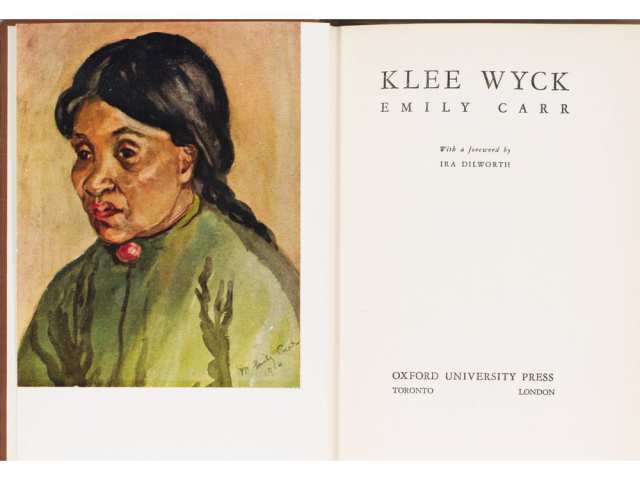
Prints: a reproduction of one of the forest paintings of the 1930s, where the colour carries at poster size; buy one that names the gallery holding the picture, usually the Vancouver Art Gallery. Books: her own come first and cost least. Klee Wyck (1941), the stories of her journeys along the coast, won the Governor General's Award for non-fiction, and The Book of Small (1942), The House of All Sorts (1944) and the journals, Hundreds and Thousands (1966), are all worth reading. On the paintings, Doris Shadbolt's The Art of Emily Carr (1979) is the classic study, and Emily Carr: New Perspectives on a Canadian Icon (2006), the catalogue of the National Gallery of Canada and Vancouver Art Gallery retrospective, is the largest. The Art Canada Institute's Emily Carr: Life & Work by Lisa Baldissera (2017) is free to read online. Originals: not realistic. The major oils are in museums, and even small oil sketches are serious lots at the Canadian auction houses; one that surfaces without a history belongs with an auction house that will authenticate it, not on a marketplace listing.
Notes
The Vancouver Art Gallery has the largest collection of her work, through the Emily Carr Trust, and is strongest in the forest paintings of the 1930s. The National Gallery of Canada, the Art Gallery of Ontario, the McMichael Canadian Art Collection and the Royal BC Museum hold more. The AGO renamed Carr's own title Indian Church to Church in Yuquot Village in 2018 after consulting the Nuu-chah-nulth, a change still argued over. In 2024 a small 1912 oil, Masset, QCI, bought at a barn sale in the Hamptons for next to nothing, was authenticated by the Heffel auction house and sold in Toronto that November; it is thought to have been a gift from Carr to a friend who had moved from Victoria to the Hamptons.
Story
Carr came back from France in 1911 and was the first to bring Fauvism to Vancouver. By 1913 she was running a boarding house on Simcoe Street in Victoria, and for the next thirteen years she hardly painted. She kept the house, raised chickens, rabbits and sheepdogs, and made pottery and hooked rugs with First Nations designs.
In 1927 Eric Brown, director of the National Gallery of Canada, invited her to show in West Coast Art: Native and Modern in Ottawa. She travelled east and met the Group of Seven. Lawren Harris told her, "You are one of us." She was fifty-five, and she went home and started again: the great forest pictures all come after it. Harris bought Indian Church, painted in 1929, hung it in his house and called it her best work.
A heart attack in 1937 slowed the painting, so she wrote. Klee Wyck, the name - "Laughing One" - given to her by the Nuu-chah-nulth, came out in 1941 and won the Governor General's Award for non-fiction. The landlady who had put her brushes away for thirteen years ended with a national prize for her prose.
Key works
- Autumn in France (1911) - National Gallery of Canada, Ottawa
- Church in Yuquot Village (formerly Indian Church) (1929) - Art Gallery of Ontario, Toronto
- Big Raven (1931) - Vancouver Art Gallery
- Scorned as Timber, Beloved of the Sky (1935) - Vancouver Art Gallery
- Above the Gravel Pit (1937) - Vancouver Art Gallery
See the work
Prints
Books
See also
Browse all 2,101 artists · Open in the directory · Where the work hangs: 9 museums on a map