Richard Gerstl
Who
Viennese painter, born on 14 September 1883, who entered the Academy of Fine Arts in Vienna at fifteen and painted for only a few years before killing himself in his studio on 4 November 1908, aged 25. He left portraits, self-portraits and landscapes, most of them unseen by the public for more than twenty years.
Why they matter
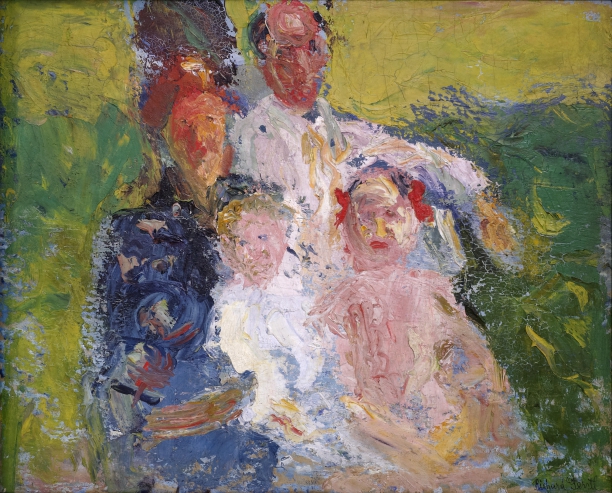
He was the Viennese Expressionist before there was one. While Klimt's circle made gold and ornament, Gerstl turned against the Jugendstil and declined to exhibit with Klimt, and his last portraits of the Schoenberg family dissolve faces into thick, smeared paint. When his work was finally shown in 1931 he was presented as a forerunner of Kokoschka and Schiele.
What to buy
Originals are not realistic: only about sixty works survive, and the important ones are in Vienna's museums - the Leopold Museum, the Belvedere and mumok. Prints: there is no good museum-shop range for him, so a reproduction is a marketplace buy; choose one made from the Belvedere's or Leopold Museum's own photography of a named painting, and expect the thick late paint to flatten in any print. The book to buy is the catalogue of the 2017 Neue Galerie New York retrospective, the first museum show of his work in the United States, published by Hirmer with essays by Raymond Coffer, Jane Kallir, Diethard Leopold, Jill Lloyd and others; look for it second-hand.
Notes
The Leopold Museum holds the large Semi-Nude Self-Portrait (159 x 109 cm); the Belvedere holds six paintings, including the Laughing Self-Portrait, the Fey sisters and two portraits of Mathilde Schoenberg; mumok holds The Schoenberg Family, painted at the end of July 1908. He is public domain, so the Belvedere's online images and Wikimedia Commons are free to use.
Story
Around 1907 Gerstl fell in with the composers Arnold Schoenberg and Alexander von Zemlinsky, and the young painter and the composer came to admire each other's talents. Gerstl painted the whole family, including Schoenberg's wife Mathilde, who was six years older than him. In the summer of 1908 she left her husband and children for Gerstl; in October she went back.
On the night of 4 November 1908 Schoenberg's pupils gave an orchestral concert, to which Gerstl had pointedly not been invited. That night he went into his studio, burned every letter and piece of paper he could find, and hanged himself in front of the studio mirror, stabbing himself as well. He was 25 and had never had an exhibition.
His brother Alois kept the canvases that were left in the studio. They stayed out of sight for more than two decades, until the dealer Otto Kallir showed them at his Neue Galerie in Vienna in 1931 as "Richard Gerstl - A Painter's Destiny". The show went on to Munich, Berlin and Aachen. A painter nobody had heard of turned out to have reached, alone and before 1908, the raw Expressionism that made Kokoschka and Schiele famous.
Key works
- Semi-Nude Self-Portrait (1902-04) - Leopold Museum, Vienna
- The Sisters Karoline and Pauline Fey (1905) - Belvedere, Vienna
- Self-Portrait, Laughing (Belvedere, Vienna)
- The Schoenberg Family (1908) - mumok, Vienna
In museum collections
- Self-Portrait, Laughing (1908)
Belvedere ↗ · Find a print ↗ - Woman with Child (Mathilde Schönberg with Daughter Gertrud) (1906)
Belvedere ↗ · Find a print ↗ - Mathilde Schönberg (1907)
Belvedere ↗ · Find a print ↗ - Prof. Ernst Diez (1906)
Belvedere ↗ · Find a print ↗ - Railway to the Kahlenberg (1907)
Belvedere ↗ · Find a print ↗ - Sisters Karoline and Pauline Fey (1905)
Belvedere ↗ · Find a print ↗
See the work
Prints
Books
See also
Browse all 2,101 artists · Open in the directory · Where the work hangs: 5 museums on a map